At a Glance
TVS Motor Company is currently operating at a velocity that most legacy automotive players struggle to achieve. While the broader industry often grapples with the “Innovator’s Dilemma”—balancing old-world internal combustion engine (ICE) cash cows with the cash-burning future of Electric Vehicles (EVs)—TVS has seemingly managed to put both on the same high-speed track. In FY26, the company clocked its highest-ever revenue of ₹47,270 crore, a staggering 30% jump from the previous year. This isn’t just growth; it is a full-scale assault on market share across segments.
However, beneath the shiny chrome of record sales lies a more complex financial narrative. The company’s Operating PBT (Profit Before Tax) grew by 40% to ₹4,975 crore, yet the debt levels remain a point of serious scrutiny. With borrowings sitting at ₹32,791 crore, the leverage profile is thick. Much of this capital is being funneled into an aggressive investment strategy through its Singapore arm, targeting premium global brands like Norton and high-tech EV startups.
The “red flag” for any seasoned auditor here is the investment-to-net-worth ratio. The company has been aggressively deploying capital into subsidiaries, some of which are still in the gestation or loss-making phase. For the four years ended FY25, investments reached 93% of standalone net worth. Furthermore, the issuance of ₹1,900 crore in Non-Convertible Redeemable Preference Shares (NCRPS) suggests a tactical delay in deleveraging to fund current growth.
Investors are witnessing a high-stakes transition. TVS is no longer just a “moped and scooter” company; it is evolving into a global mobility conglomerate. The question is whether the cash flows from the legacy ICE business can continue to subsidize the heavy-lifting required for EV dominance and luxury motorcycle reinvention before the debt burden becomes too heavy to carry.
Introduction
TVS Motor Company (TVSM) stands as a unique beast in the Indian automotive landscape. It is the only manufacturer with a presence across all three two-wheeler categories—motorcycles, scooters, and mopeds—while maintaining a formidable grip on the three-wheeler market.
The company has successfully transitioned from being a regional player to a global exporter, with 28% of its revenue now flowing from international markets. From the streets of Lagos to the showrooms of Central America, TVS has built a distribution network that acts as a natural hedge against domestic slowdowns.
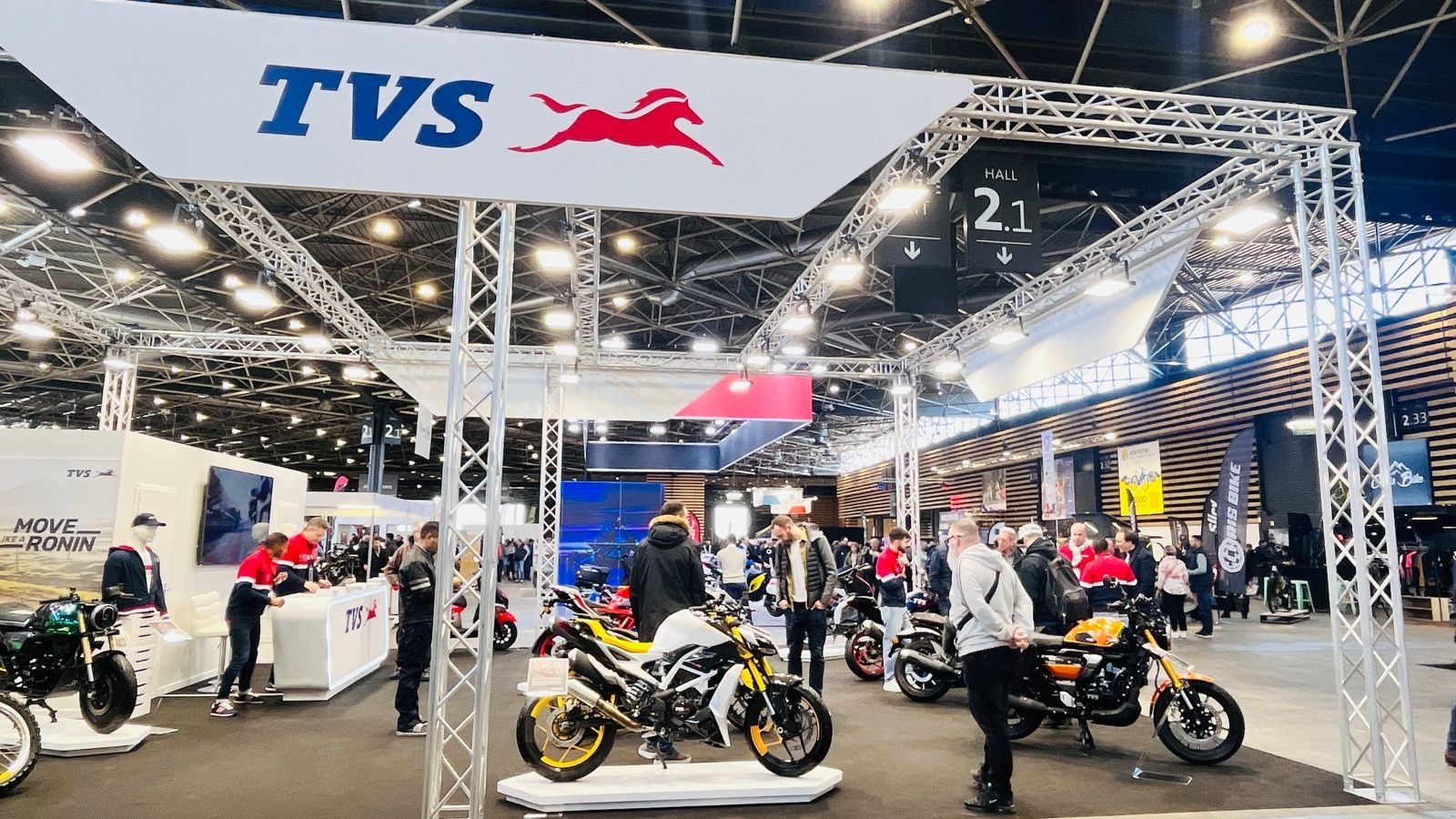
In the domestic arena, TVS has been a “disruptor-in-chief.” While competitors were slow to react to the EV wave, TVS scaled its iQube platform to over 9 lakh customers, claiming the #2 spot in the high-speed electric two-wheeler segment.
This article deconstructs the FY26 performance, the massive capital allocation shifts, and the underlying financial health of a company that is betting the house on being the future of mobility.
Business Model – WTF Do They Even Do?
If you think TVS is just about making bikes that deliver milk, you haven’t been paying attention. They are essentially a lifestyle and technology company disguised as a vehicle manufacturer.
Their business model operates on three distinct levels:
- The Cash Cow (ICE Portfolio): From the entry-level XL100 moped to the Apache series, this segment generates the massive cash flows required to keep the lights on and the R&D labs running.
- The Future Bet (Electric Vehicles): They aren’t just “assembling” EVs; they are building an entire ecosystem. This includes the iQube for the masses and the TVS X for the premium enthusiasts.
- The Ego Trip (Luxury & Global): Through the acquisition of Norton Motorcycles, TVS is attempting to break into the ultra-premium global market. They are also expanding their “E-bike” (electric bicycles) footprint in Europe via Swiss E-mobility Group.
They also run a massive Financial Services arm (TVS Credit), which acts as a lubricant for their vehicle sales. By financing their own customers, they capture the interest margin that would otherwise go to a bank. It’s a closed-loop system designed to capture every rupee from the consumer’s pocket.
Financials Overview
The latest results for the quarter ended March 2026 (Q4 FY26) show a company firing on all cylinders, though the comparison with the previous year is skewed by accounting treatments of PLI (Production Linked Incentive) benefits.
| Metric (₹ Cr) | Q4 FY26 (Latest) | Q4 FY25 (YoY) | Q3 FY26 (QoQ) |
| Revenue | 15,053 | 11,542 | 14,756 |
| EBITDA | 2,172 | 1,904 | 2,267 |
| PAT | 820 | 698 | 891 |
| EPS (₹) | 16.24 | 13.64 | 17.71 |
Financial Wisdom: Always look for the “Normalized” number. Management highlighted that last year’s Q4 included a full-year PLI benefit, making the base look artificially high. On a normalized basis, the EBITDA margin improved by 60 bps YoY.
The management has “walked the talk” on premiumization. In previous concalls, they promised a shift toward higher-margin scooters and premium bikes. The numbers validate this: Scooter sales grew 32% in Q4, outstripping motorcycles.
Valuation Discussion – Fair Value Range
To determine the fair value of TVS Motor, we must account for its dual nature: a stable manufacturing business and a high-growth EV/Global investment house.
1. P/E Method
The industry average P/E is approximately 27.8. However, TVS trades at a significant premium due to its EV leadership and growth trajectory.
- Annualized EPS (FY26): ₹63.53
- Target P/E Multiple: 40x – 45x (Premium for EV market share)
- Value: ₹2,541 to ₹2,858
2. EV to EBITDA Method
- TTM EBITDA: ₹8,352 Cr
- Target Multiple: 20x – 22x
- Enterprise Value: ₹1,67,040 Cr to ₹1,83,744 Cr
- Adjusting for Net Debt: Approx. ₹2,700 to ₹3,000 per share.
3. DCF Method (Discounted Cash Flow)
Assuming a 5-year CAGR of 15% and a terminal growth rate of 4%, with a WACC (Weighted Average Cost of Capital) of 11%.
- Intrinsic Value: ₹2,950 to ₹3,200
Fair Value Range: ₹2,650 – ₹3,100
Disclaimer: This fair value range is for educational purposes only and is not investment advice.
What’s Cooking – News, Triggers, Drama
There is never a dull moment at TVS. The current “drama” revolves around Norton. Management just pumped another ₹290 crore into the brand this quarter. They are promising a 2026 launch for the “Manx” and “Atlas” families. It’s a bold, expensive bet on “high-emotion luxury.”
On the EV front, they launched the TVS Orbiter V1 at a provocative price of ₹49,999 under a Battery-as-a-Service (BaaS) model. This is a direct punch in the gut to the unorganized electric moped market and low-end competitors.
Also, keep an eye on the Hyundai JDA (Joint Development Agreement) signed in April 2026. They are co-developing electric three-wheelers. When a global giant like Hyundai chooses you to build their electric rickshaws, you know you’ve got the tech right.
Are the heavy investments in Norton a stroke of genius or a vanity project that will drain the balance sheet?
Balance Sheet
The balance sheet is where the “detective” finds the clues. TVS is running a very “lean” ship—perhaps too lean in some areas.
| Item (₹ Cr) | Mar 2026 | Mar 2025 | Mar 2024 |
| Total Assets | 56,501 | 47,651 | 42,024 |
| Net Worth | 9,565 | 8,504 | 6,784 |
| Borrowings | 32,791 | 28,609 | 26,006 |
| Other Liabilities | 14,145 | 10,539 | 9,235 |
| Total Liabilities | 56,501 | 47,651 | 42,024 |
- Borrowings are higher than a mountain kite: At ₹32,791 Cr, the debt-to-equity ratio is a staggering 3.43. Most of this sits in TVS Credit, but the consolidated picture looks heavy.
- The Bonus “Debt”: They issued ₹1,900 Cr worth of preference shares as a “bonus” to shareholders. It’s essentially a promise to pay cash later, keeping the liquidity tight for now.
- Asset Rich, Cash Poor? Fixed assets surged to ₹10,200 Cr as they expanded capacity to 61 lakh units. They are building for a future that hasn’t fully arrived yet.
Cash Flow – Sab Number Game Hai
Cash flow is the truth serum of finance. For TVS, the serum shows a company in a massive investment phase.
| Component (₹ Cr) | Mar 2026 | Mar 2025 | Mar 2024 |
| Operating Cash Flow (CFO) | 1,867 | 3,503 | -1,253 |
| Investing Cash Flow (CFI) | -2,964 | -2,899 | -1,481 |
| Financing Cash Flow (CFF) | 909 | 1,155 | 3,239 |
They generated ₹1,867 Cr from operations, but spent nearly ₹3,000 Cr on new plants and investments. Where did the extra money come from? Borrowings. The Free Cash Flow (FCF) is negative at -₹1,280 Cr. In simple English: they are spending more than they are earning to buy their way into the future.
Ratios – Sexy or Stressy?
| Ratio | Value | Commentary |
| ROE | 33.8% | Sexy. They are sweating the equity perfectly. |
| ROCE | 17.4% | Stressy. The massive debt is diluting the returns on capital. |
| Debt to Equity | 3.43 | Eye-watering. A high-wire act that requires constant growth. |
| PAT Margin | 5.4% | Lean. There’s very little room for error if raw material prices spike. |
| Inventory Days | 26 | Efficient. They aren’t letting bikes gather dust in the warehouse. |
Financial Wisdom: A high ROE with a high Debt-to-Equity ratio usually means the company is using massive leverage to boost returns. It works great in a bull market, but it’s a double-edged sword.
P&L Breakdown – Show Me the Money
| Year | Revenue (₹ Cr) | EBITDA (₹ Cr) | PAT (₹ Cr) |
| Mar 2026 | 56,070 | 8,352 | 3,186 |
| Mar 2025 | 44,089 | 6,575 | 2,380 |
| Mar 2024 | 38,779 | 5,435 | 1,779 |
TVS is like that one friend who gets a 30% salary hike every year but still asks for a loan because they bought a vintage British motorcycle (Norton) and a fancy electric scooter. The top-line growth is phenomenal, but the net profit margin remains stubbornly in the mid-single digits.
Peer Comparison
| Company | Revenue (₹ Cr) | PAT (Qtr) (₹ Cr) | P/E |
| TVS Motor | 56,070 | 820 | 53.4 |
| Bajaj Auto | 44,685 | 2,012 | 26.9 |
| Hero Motocorp | 37,455 | 1,474 | 17.3 |
| Eicher Motors | 16,536 | 1,070 | 35.5 |
The Roast:
- Bajaj Auto is the “Rich Uncle” who makes double the profit on less revenue.
- Hero Motocorp is the “Retired Athlete” still living off old trophies (Splendor) but trading at a bargain-bin valuation.
- TVS is the “Tech Bro”—highly valued, very flashy, but heavily leveraged.
Miscellaneous – Shareholding and Promoters
The Promoters (TVS Group) hold a steady 50.27%. They aren’t selling, which is a vote of confidence.
- FIIs (Foreign Investors): Have been loading up, increasing stake to 22.56%.
- DIIs (Mutual Funds): Seem to be trimming slightly, now at 18.84%.
- Public: Holds a small 8.3%.
Promoter Roast: The Srinivasan family has been running this for generations. They are the “Old Money” of Chennai who suddenly decided to become “New Age” EV enthusiasts. They’re essentially trying to turn a legacy tractor-era mindset into a Tesla-competitor mindset.
Corporate Governance – Angels or Devils?
TVS generally ranks high on corporate governance. They won the Deming Prize, which isn’t easy—it requires obsessive attention to quality and process.
However, the “Devil” is in the complexity. The web of subsidiaries (Singapore, Europe, Indonesia, Dubai) and the constant inter-company investments make the consolidated accounts a nightmare for a simple investor to track. The recent appointment of Ravindran Shanmugam as an Independent Director is a move toward more professional oversight.
No major pledges and a clean audit history provide comfort, but the sheer volume of “Related Party Transactions” with TVS Credit and other group companies requires a watchful eye.
Industry Roast and Macro Context
The Indian two-wheeler industry is currently undergoing a “mid-life crisis.”
- The GST Squeeze: The industry is begging for a GST cut from 28% to 18%. Management says the “GST 2.0” sentiment is positive, but the government is taking its sweet time.
- The Rural Mirage: We keep hearing “Rural is recovering,” yet entry-level bike sales (100cc) are barely moving. All the growth is in the “Premium” and “Urban” segments.
- The EV War: Ola is burning cash, Ather is trying to list, and Bajaj/TVS are using their ICE profits to fight back. It’s a battle of attrition.
The macro context is simple: If you don’t have an EV play, you’re a dinosaur. If you don’t have a premium play, you’re a commodity. TVS is trying to be neither.
EduInvesting Verdict
TVS Motor Company is a high-conviction bet on the future of mobility. They have the best product pipeline in the industry and have successfully cracked the EV code without losing their ICE dominance.
SWOT Analysis:
- Strengths: Diverse portfolio, EV market share (#2), strong export footprint.
- Weaknesses: Extremely high leverage, thin net profit margins.
- Opportunities: Norton global launch in 2026, expansion of BaaS (Battery as a Service) model.
- Threats: Aggressive pricing from EV startups, high interest rates affecting TVS Credit.
The company has successfully “walked the talk” on volumes and technology. However, the financial risk is real. The negative free cash flow and the heavy reliance on debt to fund overseas subsidiaries mean that any global macro shock could hit them harder than their peers.
Is the “Norton” dream a multi-bagger global strategy, or just an expensive hobby? Share your thoughts below.