Sukhjit Starch & Chemicals Ltd, Mar 2026: A Commodity Grinder Learning to Say No to Bad Deals
Section 1: At a Glance
Sukhjit Starch reported FY26 revenue of ₹1,432 Cr—down 4% year-on-year despite a rebound in Q4. Net profit collapsed to ₹27 Cr (down 46% YoY), while EBITDA margins fell to 5.8%, the lowest in over a decade. The stock trades at 19.8x FY26 earnings on just 8.65% ROE. On the surface, this looks like a slowly drowning commodity business. But the latest quarterly results and management commentary suggest something quieter is happening: the company has stopped chasing volume at any price and has started defending profitability instead. That’s either wisdom or a slow fade—and the next two quarters will tell us which.
The worry signals are loud. CRISIL revised its rating outlook to Negative in August 2025, citing margin moderation and expected earnings pressure. Interest coverage fell to 3.6x (from 4.14x), and the company is grinding its way through a maize-price volatility cycle that it cannot fully control. Yet there’s a counternarrative buried in the Nov 2025 concall: management expects “sequential improvement in operating performance” and believes export competitiveness “restarted again” as India’s maize costs have reached parity with global markets. If that holds, the margin floor may not be as low as the latest numbers suggest.
The question for investors: Is this the bottom of a cycle, or the top of a slow collapse?
Section 2: Introduction
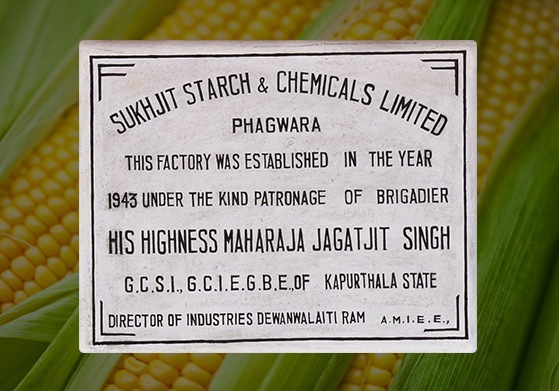
Sukhjit Starch & Chemicals was incorporated in 1943 by the Sardana family and remains firmly under their control (66% promoter holding). The company operates four maize-grinding units across India—Phagwara (600 TPD), Nizamabad (250 TPD), Malda (450 TPD), and Gurplah (300 TPD)—for a combined capacity of 1,600 TPD and an estimated 12% domestic market share based on installed capacity.
Over the past three years, the business has been caught in a slow-motion squeeze. Revenue CAGR (5-year) sits at 15%, but the 3-year CAGR is flat (–0.33%), and TTM sales have contracted 4%. Profitability has deteriorated faster: 5-year profit CAGR is 7.8%, but the 3-year number is deeply negative (–24.4%). The latest dividend payout (FY26) was zero—the first skip in over a decade, a signal that cash reserves are tightening and management is playing defence.
Section 3: WTF Do They Even Do?
Sukhjit makes maize starch and its derivatives—the industrial backbone of packaging, paper, textiles, pharmaceuticals, and food processing. The product mix is roughly: native starch (~42%), derivatives like glucose and sorbitol (~31%), and by-products such as maize oil and cattle feed (~27%).
The business is not complex. Buy maize, grind it, sell the outputs to blue-chip customers (Dabur, Nestle, Mars, Mondelez, Marico) and anonymous packaging companies. Margins depend entirely on the spread between maize cost and selling price. In years of cheap maize, SSCL thrives. In years of dear maize, it survives. In years when maize is volatile—which is now, perpetually—management learns to say no to bad orders.
The customer list is reassuring (top-five contribute only 15% of revenue, so no single customer has leverage), but the end-markets are not. Paper, textiles, FMCG, pharma—all of these are discretionary-spend sectors exposed to macro noise. When FMCG volumes stall, ingredient demand softens. When government policy turns uncertain (as it did around GST rationalisation in Sept 2025), the trade pauses and orders evaporate.
Sukhjit also operates Sukhjit Mega Food Park (SPV), a leased-plot model that generates rental income. This is a rounding error to the core business but a useful asset-play backstop if the commodity grind ever gets too painful.
Section 4: Financials Overview
Figures are consolidated, in ₹ crore.
Metric
Q4 FY26
YoY
QoQ
Revenue
402
+11.7%
+27.6%
EBITDA
26
-37.5%
+30.0%
PAT
15
+336%
+366%
EPS
4.67
—
—
Q4 was a relief on the surface: revenue rebounded 27.6% sequentially, and PAT exploded 336% year-on-year (though from a devastated Q4 FY25 base of ₹3 Cr). But the full-year story is grimmer. FY26 revenue of ₹1,432 Cr represented a 4.3% decline, and PAT of ₹27 Cr was 46% lower than FY25’s ₹50 Cr. The EBITDA margin fell to 5.8%—a 330-basis-point collapse from FY25’s 9.2%.
What happened? Management attributed the squeeze to a toxic combination of maize-price volatility and demand softness. During H1 FY26 (concall Nov 2025), maize stayed elevated between ₹22–23 per unit, while end-market demand—especially from FMCG—weakened. Management explicitly stated: “Our sales numbers are down, but we wanted to remain profitable” and “We did not get into a price war.” In other words, they chose margin over volume. By Q4, farm-gate maize had softened to ₹19–20 (a meaningful dip), and GST uncertainty had cleared, permitting a sequential recovery.
The annualised EPS for FY26 is ₹8.65 (no multiplication needed; full year is in the books).
Section 5: Valuation—Fair Value Range Only
P/E Method: Current P/E = 19.8x on FY26 EPS of ₹8.65. Industry median P/E (from peer table) is 16.2x. Sukhjit’s peers trade between 12.6x (KRBL) and 62.4x (Sanstar). A fair-value P/E band for a steady-state commodity starch player with modest growth would be 14x–18x, assuming margin recovery. Applying this:
14x × ₹8.65 = ₹121 per share
18x × ₹8.65 = ₹156 per share
EV/EBITDA Method: FY26 EBITDA = ₹101 Cr (PBT ₹36 + Interest ₹31 + Depreciation ₹34). Industry median EV/EBITDA (from peers) is 8.54x. Sukhjit trades at 8.54x (screener data matches peer median). A fair-value band, assuming margin recovery to 8–9% EBITDA margin:
EV less net debt (₹54 Cr net cash): ₹912 – 54 = ₹858 Cr equity value
Per share: ₹858 Cr ÷ 3.12 Cr shares = ₹275 per share
That number looks too high, so let’s reality-check: if margins improve to 6.5% (midpoint of CRISIL’s 8–8.5% guidance for FY27), EBITDA ≈ ₹93 Cr, and 8.5x multiple = ₹790 Cr EV, less net cash = ₹736 Cr equity, = ₹236 per share. Still elevated.
Discounted Cash Flow (Simplified): Assume FY27 revenue grows 8% (management’s guidance), margins recover to 7.5% EBITDA, capex of ₹10 Cr, working capital neutral. FCF ≈ ₹50–55 Cr. Perpetual growth 2%, WACC 10%: terminal value / 3.12 shares ≈ ₹130–₹160 per share.
Fair Value Range: ₹120–₹160 per share. Current CMP of ₹172 implies the market is betting on faster or deeper margin recovery than management is guiding, or sustained export tailwinds that remain unquantified.