Goldiam International FY26: Diamond Retail, Diamond Growth, Diamond-Shaped Questions
Section 1: At a Glance
₹1,021 Cr revenue, ₹171 Cr profit, 28% and 46% growth respectively. A lab-grown diamond exporter that’s moved into B2C retail. P/E of 30.8x on a 15.4% ROE. So: the market is pricing in a story much bigger than last year’s numbers.
FY26 was Goldiam’s loudest year yet. Revenue crossed ₹1,000 crore for the first time. EBITDA expanded 36% to ₹249 Cr (24.3% margin). Net profit nearly doubled to ₹171 Cr. Order book stood at ₹180 Cr. Cash in the bank: ₹489 Cr (cash + investments). And the board just approved a 1:3 bonus — one new share for every three you own.
The tailwind is real: US tariff disruptions, lab-grown diamond adoption globally, and a domestic B2C footprint (ORIGEM brand) that’s gone from 0 stores to 24 in 18 months. But the P/E is also telling you the market believes in all of it. The question is whether execution — especially ORIGEM’s path to scale — matches the ambition.
Promoters hold 58.5%, down from 66% three years ago. No pledges, no audit red flags. A profitable exporter finally trying to own the consumer.
Section 2: Introduction
Goldiam started in 1986 cutting diamonds from a Special Economic Zone in Mumbai. For decades, it was a B2B export play — manufacturing diamond jewellery for US and European retailers on a wholesale model. The margin was thin, the volume was steady, the leverage to global demand was solid.
But commodity pricing, tariff chaos, and the rise of lab-grown diamonds forced a pivot. Over the last five years, Goldiam shifted from natural diamonds (once 90% of business) to lab-grown diamonds (now 88% of export sales). It built backward integration: a CVD diamond-growing facility (Eco-Friendly Diamonds, 88% owned). And crucially, it set up a US casting subsidiary to dodge tariffs by claiming “US Product of Origin” — a masterstroke born in September 2025 when US tariffs spiked 50%.
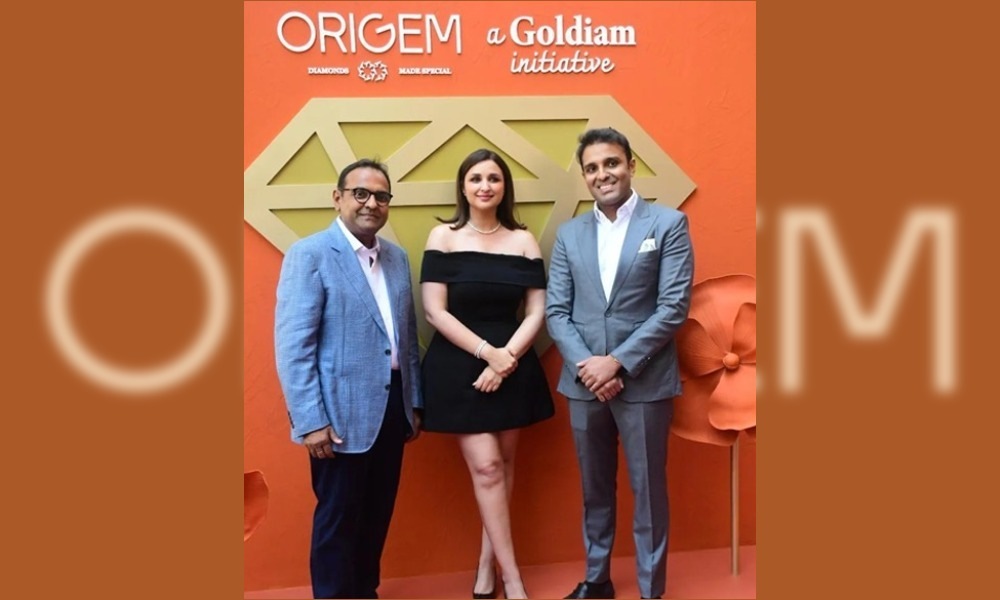
Then, in 2023, Goldiam launched ORIGEM — an omnichannel LGD retail brand targeting India’s accessible luxury segment. Engagement rings, wedding bands, customizable pieces. A direct-to-consumer play in a market where lab-grown diamond awareness is still single-digit but growing double-digit.
Section 3: WTF Do They Even Do?
Two engines. One exporting, one retailing.
B2B Exports (88% of FY26 revenue, ₹900 Cr): Goldiam manufactures lab-grown diamond jewelry — engagement rings, wedding bands, bracelets, necklaces — for top-tier US retailers like Zales, Helzberg, and online flash-sale platforms. Revenue is denominated in USD. Inventory sits with customers (65% consignment model). The US accounts for 95% of exports. Realisations for lab-grown are 35% higher than mined diamonds because Goldiam sells higher-caratage pieces. Tariffs are now “not material” because of the hybrid casting trick: cast raw gold in the US, polish and set diamonds in India, ship finished goods — thus claiming US origin and dodging duty on 70% of the value-add.
B2C Retail (12% of FY26 revenue, ₹122 Cr projected from ORIGEM): ORIGEM operates 24 company-owned stores across 12 Indian cities. Average monthly sales per mature store target: ₹35 lakh. Capex per store: ₹3.7–3.8 Cr (inventory + fit-out). Each store should break even in 6 months and turn profitable by year 3. As of Q4, the network was loss-making (₹15 Cr annual loss across all stores) but mature stores are moving into breakeven. Plans: 45–50 stores by FY27 end, 15 more by H1FY27.
Both are high-margin, asset-light (no diamond mining, raw materials sourced), and positioned in secular tailwinds: US demand resilience and India’s LGD penetration shift.
Section 4: Financials Overview
Figures are consolidated, in ₹ crore.
Metric
FY26
FY25
YoY
Revenue
1,021
799
+28%
EBITDA
249
183
+36%
PAT
171
117
+46%
EPS
13.68
9.38
+46%
Q4 alone: ₹243 Cr revenue, ₹58 Cr EBITDA (23.9% margin), ₹37 Cr PAT. The last quarter was the strongest — suggesting momentum into FY27.
On the May 27 earnings call, management positioned FY26 as a “record year despite tariffs, Middle East war, and gold price volatility.” They guided FY27 to “double-digit growth” (no precision given) with margin expansion coming from the full-year benefit of the US hybrid casting model (200–300 bps incremental EBITDA margin boost).
They also flagged a shift upmarket: new entries into tennis bracelets and tennis necklaces — higher skill-set, higher caratage, higher ASP — alongside the core bridal business. Fashion jewelry is being positioned as a co-equal growth vector alongside engagement rings.
Section 5: Valuation: Fair Value Range
Methodology:
P/E Method: FY26 EPS of ₹13.68 × peer P/E band of 20–28x (derived from Titan, Kalyan, Thangamayil) = ₹274–383 range.