Search for Stocks /

Hardwyn India Ltd FY26: ₹160 Cr Revenue, 92x Earnings, and 4.7% ROCE

Spotted a factual error — a wrong number, date, or fact? Tell us and we will check the source.

General information and entertainment, not investment advice. The author is not a SEBI-registered adviser or research analyst. No recommendation, no promised returns. Markets carry risk including loss of capital. Figures may not be current. Consult a registered adviser before acting.


1. At a Glance

At ₹24.2 per share (prices referenced are not live), Hardwyn India trades at 92.8x reported earnings—a multiple that sits above both its own 5-year average (94.4x) and the peer median (29.2x).

The architectural hardware company grew revenue 13.4% to ₹160 Cr in FY26, and profit 18.2% to ₹12.7 Cr, but the business’s return on capital (ROCE 4.7%, ROE 3.18%) remains weak.

A 2:5 bonus was approved on June 5, 2026, ahead of an EGM on July 3. The company targets ₹1,000 Cr+ revenue by FY32 at 30–35% CAGR. It holds ₹348 Cr in investments (Slim X subsidiary stake) against a ₹1,180 Cr market cap.

The tension: volume growth and new product launches mask a business returning little on its capital, while the market prices in a recovery story that hasn’t yet arrived.


2. Introduction

Hardwyn India manufactures and distributes architectural hardware, kitchen fittings, glass solutions, and furniture hardware to residential and commercial builders, contractors, and dealers across India.

Incorporated in 2017, the company is India’s first NSE- and BSE-listed architectural hardware manufacturer. It operates through a dealer network of 4,000+ across 30+ states and cities, targeting developers, real estate contractors, and project-based buyers.

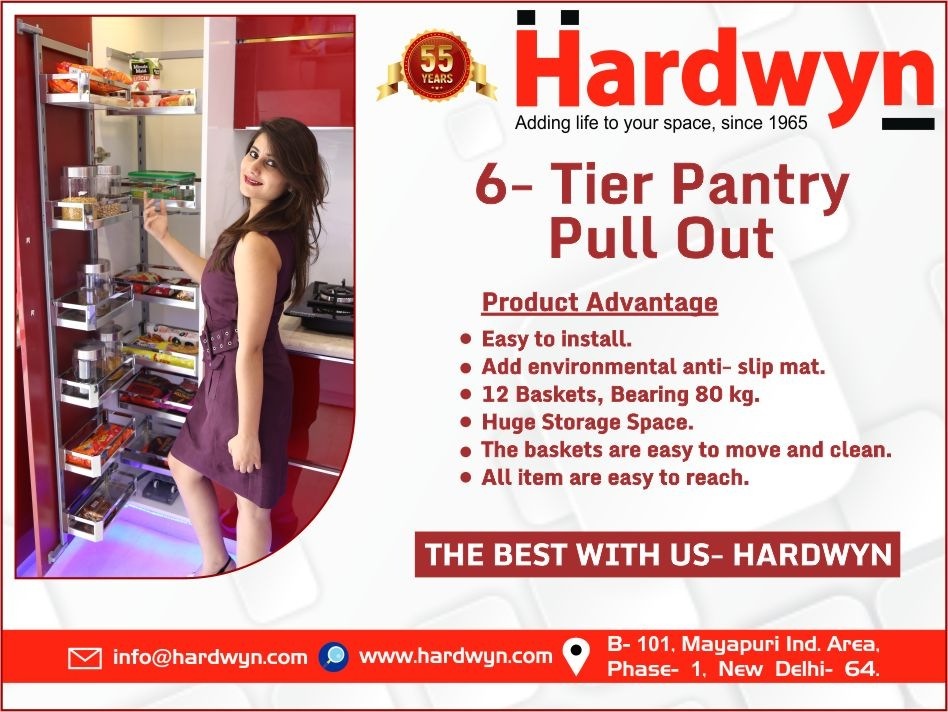
The business is split across door hardware (closers, locks, handles), glass hardware (fittings, floor springs, sliding systems), kitchen hardware (basket wire, pull-outs, solutions), wardrobe hardware, and furniture fittings.

In November 2023, the company incorporated Slim X Interior Solutions Pvt Ltd, a specialist subsidiary focused on premium glass and sliding hardware. By October 2025, Hardwyn acquired a 33.50% stake in Fiba Hardwyn Locks via a preferential share allotment at ₹184 per share (₹467 Cr consideration).

In June 2026, the board approved a 2:5 bonus and authorized capital increase to ₹70 Cr ahead of director regularizations.


3. Business Model: WTF Do They Even Do?

Door closers, floor springs, and patch fittings sound boutique until you realize every modern building—mall, office, hospital, residential tower—needs them.

The company sells 1,000+ unique products. Door Hardware covers closers, mortise locks, latches, and handles; Glass Hardware covers patch fittings, floor springs, locks, and sliding systems; Kitchen Hardware is basket wire, pull-outs, and corner solutions; Wardrobe Hardware and Furniture fittings round out the portfolio.

Revenue was ₹97% stock-in-trade (wholesale/retail bought goods) and 3% manufactured goods in FY23, so the model is more distributor with light manufacturing than pure maker. Raw material and inventory dominate costs.

Products reach buyers via 4,000+ dealers, e-commerce partnerships (Moglix, Amazon, IndiaMART, Justdial, Hardwyn.com), and direct institutional sales to large builders and infrastructure projects. The company claims 30+ marquee clients including Commonwealth Games Delhi sites and Delhi Metro.

Slim X is the premium glass and sliding systems brand, positioned for high-ticket architectural projects requiring precision-engineered systems. The Kirti Nagar Experience Centre (launched 2023) and dealer meets (500+ dealers in Kerala, FY26) are attempts to build brand identity beyond wholesale commodity hardware.

The pitch: category expansion, geographic penetration into Tier-II/III cities, and export push into South Asia, Middle East, and Africa. Volume and margin play, not innovation.


4. Financials Overview

Figures are consolidated, in ₹ crore.

MetricQ4 FY26Q4 FY25YoYFY26FY25YoY
Revenue46.4136.30+27.8%160.05141.10+13.4%
EBITDA5.592.82+98.2%20.4018.00+13.3%
PAT3.421.74+96.6%12.7110.75+18.2%
EPS (Reported)₹0.07₹0.04₹0.26₹0.22

Q4 was sharp. Revenue grew 27.8%, net profit more than doubled, and OPM jumped to 12% from 7.8% in Q4 FY25. The company attributes this to Kitchen Basket Wire Series sales momentum, improved dealer penetration, and new product launches (mortise handles in contemporary designs).

Full-year FY26 revenue hit ₹160 Cr, up 13.4% YoY. Net profit grew faster at 18.2%, lifting PAT margin to 7.94% from 7.62% in FY25. Operating margin compressed slightly to 12.7% (FY25: 12.8%), despite EBITDA growing 13.3%.

The company sold 2.05 Cr hardware units (counting method not disclosed), 2.27 Mn units of aluminium/traded items, and 2.05 Mn hardware/fittings during the year—suggesting high volume, low-ticket repeat orders.

Free cash flow was ₹5 Cr (operating cash ₹6.84 Cr, investing ₹2.27 Cr outflow). Working capital management improved: debtor days fell to 89 from 82, but inventory days rose to 126 from 173.

Wisdom line: margin expansion and volume growth can coexist when the distributor upgrades product mix and dealer quality. Hardwyn’s numbers say both things happened; the stock’s multiple suggests neither story is enough.


5. Market Expectations & Historical Multiples

This section describes how the market is currently pricing the company and how that compares with its own history and peer group. It is descriptive, not predictive.
MetricCurrentHistorical AveragePeer Median
P/E92.8x94.4x (5Y)29.2x
EV/EBITDA56.9x
P/B2.90x2.82x
ROE3.18%3.33% (5Y)10.26%
ROCE4.70%10.82%

The market currently pays 92.8x earnings here, nearly at its own 5-year median (94.4x), yet sharply above the peer set (29.2x). Hardwyn’s two closest comparables—Sheela Foam (48.6x P/E) and Responsive Industries (29.5x)—trade at less than a third of this multiple.

ROE of 3.18% trails not only peers (10.26% median) but the cost of equity, suggesting shareholder capital is not earning its keep. ROCE of 4.7% is below cost of capital, implying the company destroys value on an incremental rupee.

EV/EBITDA of 56.9x is punchy for a ₹160 Cr revenue distributor with mid-teen margins. The ₹348 Cr investment in Slim X (subsidiary) sits on the balance sheet, which inflates book value and may suppress ROE by keeping net worth artificially high.

The market appears to be pricing in margin expansion (structural shift toward Kitchen and Glass, high-ticket solutions, and exports), geographic scale (Tier-II/III penetration), and the Slim X recovery. It is not pricing in current profitability or capital efficiency. A rational expectation: no return to normalcy on ROCE or ROE unless the company shrinks net worth or doubles earnings.


6. What’s Cooking

The board approved a 2:5 bonus (2 free shares per 5 held) in June 2026, ahead of shareholder approval at an EGM on July 3.

Hardwyn signed an MoU with Bhutan for architectural and construction supplies, marking first formal export exposure beyond India.

The company acquired 33.50% of Fiba Hardwyn Locks (door locks, mortise cylinders, latches) via preferential share allotment at ₹184 per share totaling ₹467 Cr (October 2025). The deal added ₹348 Cr to the balance sheet as an investment asset.

In October 2025, the board authorized an increase in authorized capital from ₹55 Cr to ₹70 Cr, likely supporting future acquisitions or capital needs.

Kitchen Basket Wire sales accelerated in FY26, contributing to EBITDA growth. The company introduced five new mortise handle designs (contemporary series) and hosted a 500-dealer conference in Kerala to strengthen regional penetration.

The Slim X brand, focused on premium sliding hardware and glass solutions, launched the Modest Series and expanded presence in corporate offices, retail showrooms, and hospitality venues.

The company was awarded a highest-quality certificate for floor springs (February 2025) and exhibited at Aluminium Expo 2026, indicating vendor credibility and industry visibility.


7. Balance Sheet: Sab Number Game Hai

ItemFY24FY25FY26
Total Assets442.88449.27452.45
Equity Capital + Reserves382.32393.09405.81
Borrowings9.069.676.31
Other Liabilities51.5046.5140.33
Total Liabilities442.88449.27452.45

Assets = Liabilities: ✓

The company is nearly debt-free. Borrowings fell to ₹6.31 Cr (1.3% of equity) from ₹9.67 Cr a year prior, pushing debt-to-equity to 0.02x (almost zero).

Of ₹452 Cr total assets, ₹348 Cr are Investments (Slim X stake), ₹99.65 Cr are Other Assets (receivables, inventory, cash), and ₹4.45 Cr are Net Block (PP&E). The bulk of working capital is locked in debtors (₹39.2 Cr) and inventory (₹46.4 Cr).

Three observations: (1) The company is sitting on ₹2.05 Cr in cash—modest firepower for a distributor claiming ₹1,000 Cr ambitions. (2) ₹348 Cr invested in Slim X is 77% of total equity; the holding does not appear to be generating cash or earnings consolidation yet. (3) Other Liabilities fell to ₹40 Cr from ₹47 Cr, mostly payables and accruals—no hidden liabilities, but tight working capital management.

Net cash position (Cash + Investments – Debt): ₹344 Cr. Remove the Slim X bet, and the company holds ₹348 Cr less in liquid savings, which is negative.

Wisdom line: A zero-debt balance sheet looks clean until you realize it’s financing growth ambitions on cash flow, not borrowing, which suggests cautious management or limited growth appetite.


8. Cash Flow: Sab Number Game Hai

YearOperatingInvestingFinancing
FY242.16-5.313.33
FY251.41-0.58-0.56
FY266.84-2.27-4.43

Operating cash flow improved sharply to ₹6.84 Cr in FY26 from ₹1.41 Cr, driven by profit growth and working capital release (inventory days fell, though debtors rose).

Investing cash outflow was ₹2.27 Cr (capex, likely in manufacturing and Experience Centre expansion). Net cash burn was ₹4.43 Cr in financing (interest and modest dividend?—the company pays 0% dividend yet, so this is probably debt repayment and subsidiary financing).

The pattern: the company generates modest operating cash, reinvests in capex, and returns excess to debt reduction. Free cash flow of ₹4.57 Cr (operating minus investing) is positive but tight for a company claiming ₹1,000 Cr revenue ambitions.

Wisdom line: Cash generation is real, but the engine is slow. At this pace, organic growth to ₹500+ Cr would take a decade; acquisitions like Slim X and Fiba suggest the company is borrowing (via equity issuance, not debt) to accelerate growth.


9. Ratios: Sexy or Stressy?

RatioValue
ROE3.18%
ROCE4.70%
P/E92.8x
PAT Margin7.94%
D/E0.02x

ROE of 3.18% means every rupee of shareholder capital earned 3.2 paise in net profit—roughly inflation. The 5-year average is 3.33%, showing no improvement trajectory.

ROCE of 4.70% is half the cost of capital (assume 8–10%); the company destroys value on incremental capital deployed. This ratio is the core problem: growth investments are not earning returns.

P/E of 92.8x is a bet on margin expansion or ROCE improvement. At cost of equity of 8–10%, the market is implying growth of 20%+ over a decade, which is aggressive for a distributor.

PAT Margin at 7.94% is respectable for the category but barely above historical levels, suggesting opex leverage is running thin.

D/E of 0.02x is defensive, but the company’s lack of borrowing capacity (and willingness) suggests it won’t aggressively fund growth or weather downturns through debt.


10. P&L Breakdown: Show Me the Money

YearRevenueEBITDAPAT
FY24135.1417.129.75
FY25141.1018.0010.75
FY26160.0520.4012.71

Revenue grew 13.4% in FY26 to ₹160 Cr, stepping up from 4.3% (FY25) and 2.9% (FY24). The acceleration is real—Kitchen Basket Wire penetration and new product launches (mortise handles, glass systems) are driving volume.

EBITDA climbed 13.3% to ₹20.4 Cr, roughly in line with revenue growth, suggesting margin stability (EBITDA margin 12.8% in FY25 to 12.7% in FY26).

Net Profit grew 18.2% to ₹12.71 Cr, outpacing revenue, thanks to lower depreciation amortization year-on-year and slightly lower interest (from 0.85% of revenue to 0.68%).

The trajectory is a modest distribution business in mid-volume growth mode, with margin stickiness and profit conversion near historical levels. No margin expansion yet—the ₹1,000 Cr vision will require operating leverage (opex control) or product mix shift that isn’t visible in consolidated numbers.


11. Peer Comparison

CompanyRevenuePATP/EROESales Mix
Sheela Foam3,821153.6848.6x4.89%Mattresses (retail)
Responsive Industries1,394148.9529.5x10.26%Furniture (modular)
Wakefit Innovations1,489192.9419.5x23.63%Furniture (direct-to-consumer)
Safe Enterprises21864.5918.9x35.90%Doors + Furniture (retail)
Euro Pratik Sales33582.9431.2x30.49%Doors (retail)
Hardwyn India16012.7192.8x3.18%Architectural hardware (B2B/wholesale)

Hardwyn is the smallest by revenue (₹160 Cr), with the lowest ROE (3.18%) and the highest P/E (92.8x). Sheela Foam, the largest, trades at 48.6x on a 4.89% ROE—suggesting size and brand command lower multiples. Wakefit (19.5x) and Safe Enterprises (18.9x) have scale, ROE above 20%, and direct consumer reach.

Hardwyn’s wholesale, dealer-driven model is capital-light (debt-free) but low-return (3% ROE). Peers in furniture and mattresses have better consumer stickiness, margin profile (12–30% net margins vs 8%), and ROE (10–35%). Architectural hardware is a functional, low-differentiation category; Hardwyn’s brands (Slim X aside) are not household names.

The company is sized between micro-cap and small-cap; its multiples isolation (92.8x vs 29.2x peer median) is anomalous and unsustainable unless growth and ROCE move sharply.


12. Miscellaneous: Shareholding & Promoters

HolderStake
Promoters43.77%
Public55.12%
FIIs0.64%
Government0.46%

Promoters Rubaljeet Singh Sayal (23.70%) and Swaran Jeet Singh Sayal (20.06%) hold 43.77% combined. They have been steady holders; no pledging is reported.

Public holdings include institutional investors (Ginni Chadha 19.15%) and a distributed retail base. FII participation is minimal (0.64%), and government holdings emerged in December 2024 (0.46%), likely via ETF inclusion.

Promoter roast: The Sayal brothers have held firm through the October 2025 Fiba acquisition at ₹184 per share—a considerable bet on Hardwyn’s future given the 92.8x P/E context. Their willingness to issue equity at ₹184 suggests confidence, or desperation to consolidate the door-lock category, or both.


13. Corporate Governance: Angels or Devils?

No pledging is reported. Auditors are BDO India (statutory), and the board includes independent directors Yogesh Garg (appointed June 5, 2026) and external professionals.

Related-party transactions are disclosed (Fiba deal, Slim X investments) and approved by audit committee. Depreciation schedules and tax provisions are standard.

In March 2026, Company Secretary Ankita Jain resigned; Diksha was appointed in June 2026. No major governance scandals or regulatory action is reported.

The bonus approval (June 5) and capital authorization (June 5) were routine board actions ahead of EGM shareholder ratification—par for course in Indian listed equities.

No red flags on auditor changes, audit qualifications, tax demands, or board vacancies. Governance is by-the-book, though the company’s relative youth (incorporated 2017, listed 2023) means limited history for deep scrutiny.


14. Industry Roast & Macro Context

Architectural hardware is a hidden linchpin: every building needs it, but no one talks about it. India’s architectural hardware market is estimated at USD 1.89 Bn (2018) and is projected to grow to USD 4.8 Bn by 2030 (7.8% CAGR), backed by urbanization, real estate growth, and commercial infrastructure expansion.

The door hardware segment (Hardwyn’s core) is estimated at USD 120–160 Mn (2024) and grows 3–4% CAGR, a mature segment. Glass hardware (premium, high-margin) is USD 4.9 Bn (2024) and grows 6.2% CAGR—faster and higher-margin, where Slim X aims to play.

Competition is fragmented: large players like Godrej, Hafele, and Dorma dominate institutional/premium segments; Hardwyn is competing in mid-market dealer and retail segments where Chinese imports, unbranded copies, and local fabricators battle on price and availability.

Pricing wars are endemic in door hardware. Distributors stack on volume and rely on service (4,000 dealer network, 200+ service centers) to differentiate. The category doesn’t reward innovation—a door closer is a door closer.

Regulatory tailwinds exist: building safety codes (ISI, UL, UKAS certifications) create moats against Chinese knock-offs, and Hardwyn’s early ISI certifications (it was India’s first to get ISI marks on door closers) provide credibility.

The sector’s dull margin profile and low-return characteristics mean large players don’t over-invest and small players survive on niche and geography. Hardwyn’s ambition to grow 30–35% CAGR to ₹1,000 Cr by FY32 implies either consolidation (buy rivals like Fiba), geographic blitzkrieg into Tier-II/III, or premium product (Slim X) success—none guaranteed.


15. EduInvesting Verdict

DimensionAssessment
StrengthsDebt-free balance sheet; first-mover ISI certification; nationwide dealer network (4,000+); profit growth outpacing revenue (FY26: +18.2% vs +13.4%); acquisition of Fiba (33.5%) and Slim X subsidiary position company for category consolidation and premiumization.
WeaknessesROCE 4.7% and ROE 3.18% well below cost of capital, destroying shareholder value on incremental deployment; P/E 92.8x is 3.2x peer median with no visible margin or ROCE inflection; 96% of revenue from stock-in-trade (wholesale), not manufacturing—low-moat distributor model; working capital days rising (127 days), straining cash conversion.
OpportunitiesTier-II/III cities underpenetrated; glass/sliding hardware (6.2% CAGR, higher margins) growing faster than door hardware; export MoU with Bhutan (early-stage); consolidation of fragmented architectural hardware space via Fiba and M&A.
ThreatsChinese import competition in low-end hardware; pricing pressure in mature door closer segment; Slim X’s ₹348 Cr investment has yet to consolidate or distribute earnings; leverage limited (no debt), reducing growth optionality; ₹1,000 Cr revenue target by FY32 would require 30–35% CAGR—historically 23% 5-year CAGR and 13% recent.

A balance sheet with nothing to hide, a multiple with everything to prove. Hardwyn is debt-free, growing, and well-positioned in a structural tailwind (real estate, infrastructure, glass hardware expansion). But at 92.8x earnings, a 4.7% ROCE, and 3.18% ROE, the market is priced not for the company it is, but for the company it might become—a leap of faith in consolidation, premiumization, and exports that remains nascent. The bonus and equity issuance (₹467 Cr Fiba deal) signal management’s conviction, or a need to grow via financial engineering to meet ambitious targets.


One Response

  1. Hello. During the conference call the MD (Rubaljeet Sayal) claimed that the brand HARDWYN was launched in 1965 by his father. However annual reports and filings suggest that the current company (Hardwyn India Ltd) was acquired by the promoters in 2019 (it was previously known as Garv Industries Ltd) and recently they acquired a minority stake in FIBA Locks. So what exactly was the business of the promoters before 2019? Which corporate entity was that business under? Was that entity acquired or merged by Hardwyn India Ltd?

Leave a Reply
