Concord Biotech Q4 FY26: The Disruption Hangover and the Capacity Bet
General information and entertainment, not investment advice. The author is not a SEBI-registered adviser or research analyst. No recommendation, no promised returns. Markets carry risk including loss of capital. Figures may not be current. Consult a registered adviser before acting.
1. At a Glance
The fiscal year closed on a whimper. Revenue fell 12% to ₹1,055 Cr; net profit contracted 30% to ₹263 Cr. Q4 alone saw sales plummet 24% while PAT sank 37%.
The company attributes this to three overlapping headwinds: a U.S. customer procurement slowdown (driven by tariff uncertainty), a European supply blockade due to missing regulatory paperwork for 3 months, and a geopolitical flare in the Middle East that froze a ₹50 Cr tender and broader supply routines.
The more troubling structural signal is working capital intensity. Debtor days stayed elevated at 159, while inventory days ballooned to 483—a 15-year high. Management frames this as temporary (staggered procurement patterns, fermentation cycle artifacts), but the balance sheet is now sitting on ₹326 Cr of inventory against a ₹1,055 Cr annual revenue run.
The forward posture leans on new capacity scaling, injectable facility ramp, and a fresh U.S. commercial footprint (Stellon). Management telegraphed “very good visibility” for H1 FY27 and expects growth “slightly better off” than the historical 18% baseline. Margins carry a +1 to +1.5% renewable energy tailwind.
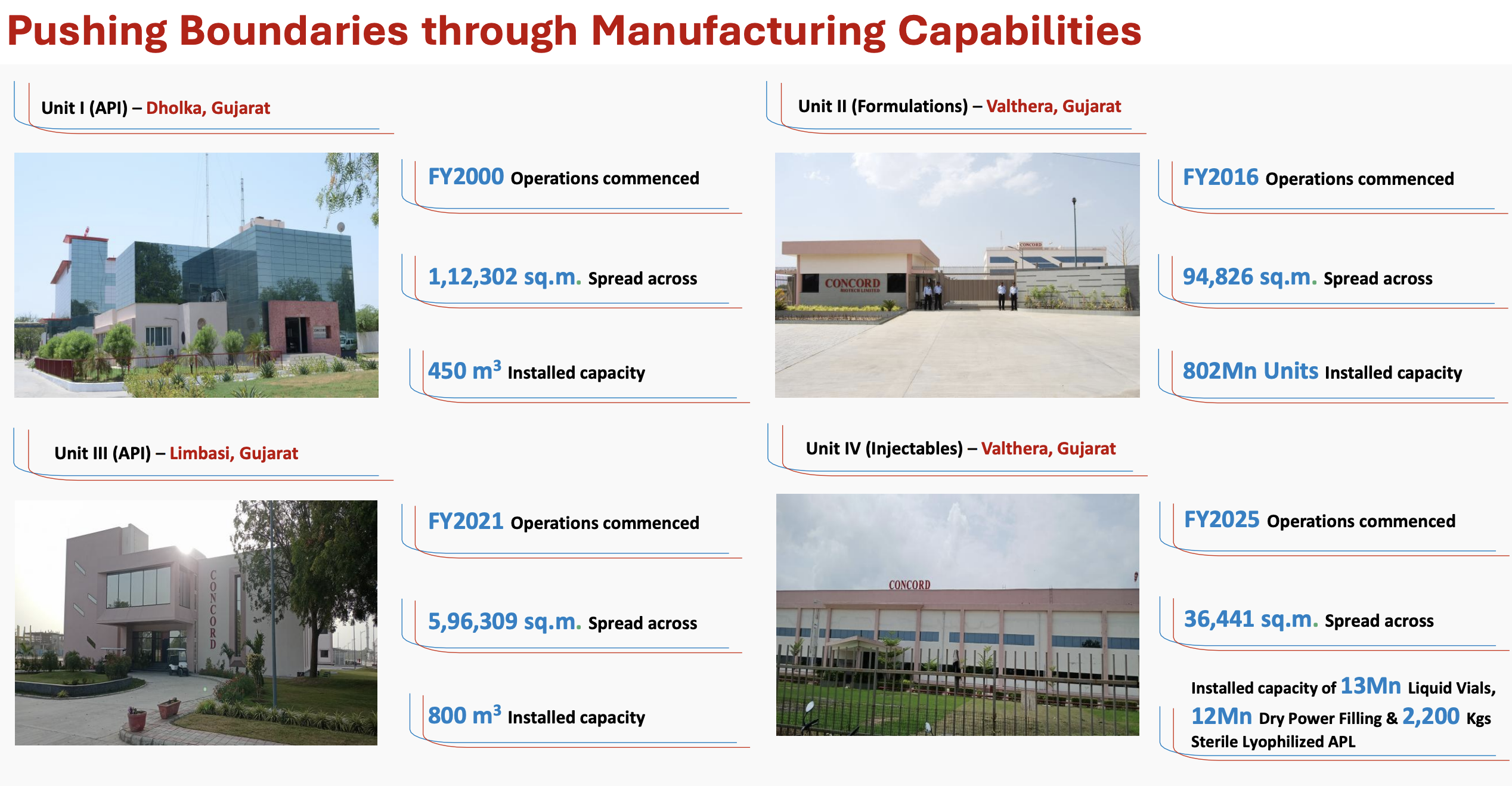
Tension to watch: capacity utilization across three API facilities sits at 77%, 30%, and 53%. The company’s peak potential is ₹3,000 Cr revenue; current run is ₹1,055 Cr. That’s the bridge between a niche fermentation player and a scaled pharmaceutical ingredient supplier.
2. Introduction
Concord Biotech was incorporated in 1984 and has spent four decades building fermentation expertise in a corner of pharma few others inhabit.
The business splits three ways: APIs (fermentation-based, immunosuppressants and oncology—79% of FY26 revenue), formulations (critical care, nephrology, rheumatology—21%), and CDMO (contract R&D and manufacturing, still emerging). The company serves 250+ customers across 70+ countries, with 55% of FY26 revenue still domestic and 45% export.
For most of the last five years the company reliably delivered mid-teens growth. Revenue CAGR over FY21–FY25 was 18%; FY26 snapped that streak.
In June 2024, it acquired Stellon Biotech (a U.S.-based commercialization vehicle) for USD 1.5 Mn to build direct market access in America. In March 2025, it commissioned an injectable facility at Valthera—its fourth major manufacturing footprint—and secured WHO-GMP certification the same month. It has also invested in Celliimune Biotech, a cell and gene therapy play, and incorporated Concord Lifegen to deepen domestic formulations.
Management reads FY26 not as a demand shock but as a series of timing and geopolitical obstacles that will ease. Therein lies the debate.
3. Business Model: WTF Do They Even Do?
Concord is a fermentation-API company with a backward-integrated supply chain and a formulations tail.
The API Play
Fermentation APIs are molecules grown in vats—cultures of microorganisms are fed nutrients, left to multiply and metabolize, then purified. Most pharmaceutical ingredients are chemical synthesis; fermentation is messier, slower, and far harder to scale. But in niches—immunosuppressants, certain oncology drugs, antifungals—fermentation can be the only practical or economical route.
Concord holds 30+ fermentation-based APIs. Its largest franchise is immunosuppressants: Tacrolimus, Mycophenolate Mofetil, Cyclosporine, Sirolimus, and Pimecrolimus. These are post-transplant mainstays and chronic immune-disorder staples. The company claims 30% global volume share in Cyclosporine and 40% in Tacrolimus. That’s market dominance in a niche, though margins are nothing to celebrate at the customer level.
The company also has oncology (Everolimus, Temsirolimus, Mitomycin, Dactinomycin) and antifungals (Nystatin, Amphotericin B, Anidulafungin, Caspofungin). It filed 135+ Drug Master Files (DMFs) globally, enabling it to sell to innovators and generics makers worldwide. It has five USFDA ANDA approvals for finished formulation products.
Why fermentation is hard.
The fermentation process takes 30–50 days per batch. The company must stock high levels of culture media, raw materials, and work-in-progress inventory—most of which sits as WIP because the final 1–5% of production doesn’t happen until a customer order arrives. Shelf-life only starts ticking once manufacture is complete. This structural feature—the company calls it “elongated working capital intensity”—is why debtor days (159) and inventory days (483) are both chronically elevated.
Backward integration to key starting materials (KSMs) gives the company cost control and supply resilience but locks capital into inventory buffers.
The Formulations Play
The company launched formulations in 2016, shifting from pure API supply into branded and semi-branded finished goods. It now markets 100+ approved products across critical care, nephrology, oncology, rheumatology, and antifungals.
Formulations is crowded. India has thousands of small-cap generics makers; competition is vicious, price-eroding, and margin-compressing. Concord’s edge here is backward integration: it makes its own APIs, so the margin floor is higher than for a company buying APIs from third parties.
FY26 formulation revenue was ₹226 Cr, down 13% YoY. The company blames geopolitical disruptions and the EU paperwork snag. The injectable facility (commissioned March 2025) is a bet that injectables command better margins and less commoditization than oral solids—and that the company’s fermentation know-how will help it scale sterile manufacturing faster than generics competitors.
The CDMO Angle
The company is pitching itself as a contract development and manufacturing partner (CDMO) for innovators. It offers strain improvement, process scale-up, and full manufacturing. In FY26, CDMO contribution was “single digits, maybe 1% to 4%” of revenue—mostly APIs where IP belongs to third-party innovators.
Management noted it has two active innovator customers and is in advanced-stage discussions for more. If this scales, it could diversify revenue away from its commodity immunosuppressant core.
The Central Tension
Concord is neither pure API nor pure formulation. It’s betting that vertical integration, fermentation expertise, and strategic moves into injectables, CDMO, and U.S. commercial presence will let it dodge the margin compression that’s hollowed out generic pharma. But every rupee invested in the injectable facility, Stellon, Celliimune, and Concord Lifegen is capital that’s not earning yet.
4. Financials Overview
Figures are consolidated, in ₹ crore.
Annual Results: FY24, FY25, FY26
Metric
FY24
FY25
FY26
YoY %
Revenue
1,017
1,200
1,055
-12.1%
EBITDA
432
506
367
-27.4%
PAT
305
373
263
-29.5%
EPS
29.13
35.65
25.17
-29.4%
Q4 Snapshot (Q4 FY26 vs Q4 FY25)
Metric
Q4 FY26
Q4 FY25
YoY %
Sales
326
430
-24.2%
EBITDA
119
190
-37.6%
PAT
90
140
-36.8%
EPS (annualized)
34.4
53.5
-35.8%
Margins Under Pressure
EBITDA margin: 34.8% in FY26 vs. 42.2% in FY25 (730 bps decline). PAT margin: 24.6% vs. 31.0% (640 bps decline).
Management provided an “adjusted” figure excluding the new injectable