General information and entertainment, not investment advice. The author is not a SEBI-registered adviser or research analyst. No recommendation, no promised returns. Markets carry risk including loss of capital. Figures may not be current. Consult a registered adviser before acting.
FY26 delivered what the company promised: 50% profit growth and a 210-basis-point EBITDA margin jump, driven by a product-mix shift toward higher-margin segments and tighter operational control.
Net profit jumped to ₹146.8 Cr from ₹97.9 Cr a year ago, while revenue crept up just 1.8% to ₹1,470.6 Cr. The company made money from less volume — a rarity and a signal that something changed operationally.
EBITDA margin jumped to 13.8% from 11.6%, funded by traction in defence and semiconductor applications and a reported pickup in CNG recovery post-fuel volatility. The standalone India business alone reported a 53% EBITDA margin expansion year-on-year.
But balance this against ₹162.3 Cr of unfinalized capex sitting in CWIP — a Mundra greenfield now live with only one production line, and an Egypt facility nearing commissioning with both execution and forex risk baked in. The market still prices the stock at 8x FY26 earnings, a 73% discount to the peer median of 30.4x, which leaves room for interpretation.
The order book is ₹1,000 Cr domestic and ~$75M (~₹625 Cr) in the US — meaningful runway. Dubai remains under shipment stress from regional geopolitics, not demand.
2. Introduction
Everest Kanto Cylinder, established in 1978, manufactures high-pressure seamless steel gas cylinders — the containers that hold CNG, oxygen, nitrogen, and other industrial gases.
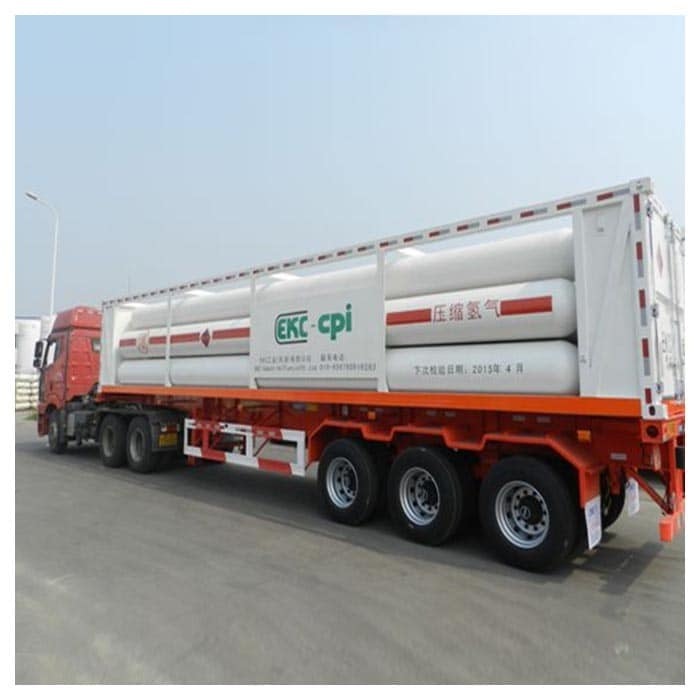
The company operates six facilities globally: two established sites in Tarapur (Maharashtra) and Kandla (Gujarat), a greenfield in Mundra (now live since FY26), two plants in Dubai serving Middle East and Africa, a US subsidiary (CP Industries Holdings) handling composites and large vessels, and an Egypt facility near commissioning.
Over the past two decades, the sector has been driven by three structural tailwinds: India’s CNG adoption (now 22% of passenger vehicle sales), city-gas distribution network expansion, and industrial gas demand from automotive OEMs and chemical processing. The company’s client roster includes Tata Motors, VE Commercial Vehicles, Bajaj Auto, and major city gas distributors like Mahanagar Gas and Adani Total Gas.
CNG and industrial gas remain the core revenue drivers, though the company has pivoted toward higher-margin segments — defence, semiconductors, and hydrogen — which collectively contributed to the FY26 margin expansion.
A ₹1,267 Cr GST differential liability from a show-cause notice remains unresolved, though management indicated optimism on a government clarification by H2 2026.
3. Business Model: WTF Do They Even Do?
The company manufactures seamless steel cylinders in high-pressure grades. The raw material — seamless steel tubes — accounts for 50–55% of revenue and is 80%+ imported, with a 4–5 month lead time. This structural import dependence makes the business vulnerable to forex volatility and creates working capital intensity.
The manufacturing process is capital-light once a facility is built; the entry barrier is regulatory (PESO certification, CCOE approvals) rather than capital. The company holds authorizations across 25+ countries.
Product mix spans four buckets: (a) CNG cylinders for automotive and city-gas distribution networks, the bread-and-butter; (b) industrial gas cylinders (oxygen, nitrogen, argon) for healthcare, aerospace, and chemical processing; (c) jumbo cylinders and composites, high-margin niche products (the company is India’s only manufacturer of high-alloy high-strength jumbo cylinders); and (d) hydrogen and specialist containers, including a custom ultra-large hydrogen cylinder for ISRO.
Revenue splits roughly 65.7% India, 10.3% UAE (Dubai), and 24.2% USA & Hungary, with the remainder scattered across Europe and Southeast Asia.
The stickiness of the business comes from product certification. An automotive OEM or city-gas player switching cylinder suppliers involves re-testing, regulatory sign-off, and operational friction. Once in, the customer tends to stay.
4. Financials Overview
Figures are consolidated, in ₹ crore.
Metric
FY26 Latest
FY25
YoY Change
Revenue
1,470.6
1,499.2
-1.9%
EBITDA
203.1
178.6
+13.7%
PAT
146.8
97.9
+49.9%
EPS (FY26 basis)
13.1
8.73
+50.2%
Q4 FY26 alone (ending Mar 26): Revenue ₹358.2 Cr, EBITDA ₹39.6 Cr (11.1% margin), PAT ₹45.9 Cr.
The full-year revenue contraction masks a profitability divergence. EBITDA grew 13.7% despite flat sales, signalling a hard shift in the revenue mix and/or operational leverage kicking in.
From the concall, management attributed the uplift to “favourable product mix, improved realisations, and operational efficiencies.” Standalone India operations (the cleaner proxy for the core business) reported revenue ₹946.2 Cr and EBITDA margin 16.0%, up 540 basis points year-on-year — a stark improvement tied to traction in semiconductors and defence, which are higher-margin segments.
The Egypt subsidiary remains a loss-making start-up; the US subsidiary (CP Industries) swung into profitability and supported consolidated EBITDA in Q1 FY26. Dubai operations struggled due to shipment delays tied to regional geopolitics, not underlying demand.
Working capital intensity moderated but remained elevated at 288 days (vs. 256 days in FY25). The company carries high inventory (₹526.5 Cr) to manage a 4–5 month raw-material import