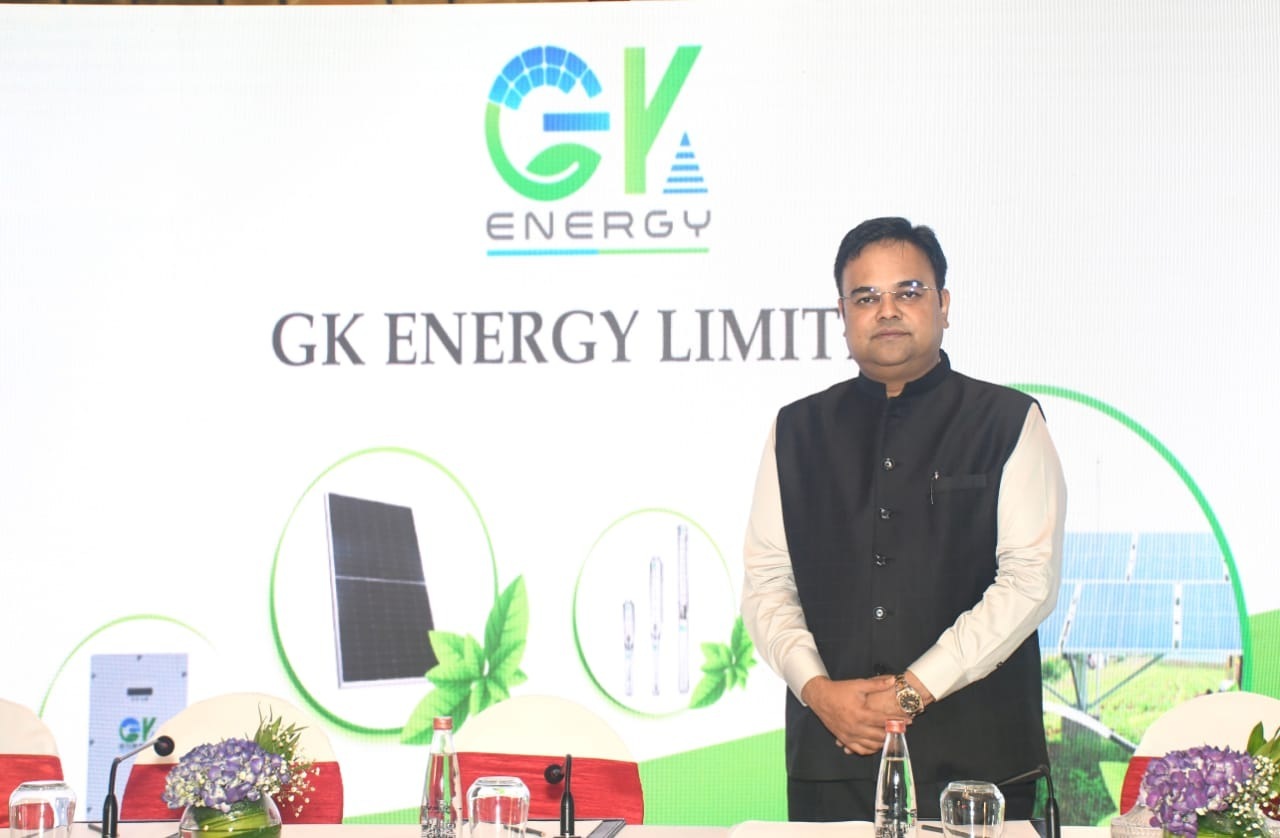
The numbers are out, and they aren’t just talking—they are screaming. GK Energy Ltd has just capped off a transformational FY26, proving that you don’t need to own the smoke-stack factories to dominate the solar landscape. In a year where the company successfully transitioned from a private player to a listed entity on the NSE and BSE, the financial trajectory looks less like a steady climb and more like a vertical takeoff.
With Revenue hitting ₹1,532.54 crore (a 40% YoY jump) and PAT surging by 51.1% to ₹201.27 crore, the company is aggressively capitalizing on the decentralized renewable energy wave sweeping across rural India. But beneath these headline numbers lies a deeper story of a “Net Cash Surplus” fortress and an “Asset-Light” execution machine that is making traditional manufacturers look heavy and slow.
1. At a Glance
If you ever wanted to see a financial “glow-up,” look no further than GK Energy’s balance sheet post-IPO. We are looking at a company that has managed to scale its cumulative installations to over 1,40,000 systems while maintaining a lean, mean operating structure.
The most provocative number? ₹2,406 million (₹240.6 cr) in surplus cash. Just a year ago, this company was navigating a net debt position. Today, it sits on a mountain of liquidity while delivering a 40.9% ROCE. This isn’t just growth; it’s high-octane, capital-efficient growth that should make every “heavy-industry” investor do a double-take.
However, it’s not all sunshine and silicon. The company is currently a “one-state wonder,” deriving ~90% of its revenue from Maharashtra. This geographical concentration is a massive red flag for anyone who understands how state-level policy shifts can cripple an EPC player overnight. Furthermore, the receivable days stood at a staggering 140 days for the full year, peaking even higher in the mid-year due to “software integration” and “monsoon delays.”
Is GK Energy a high-speed execution machine, or is it a policy-dependent player one administrative delay away from a working capital crisis?
The company is now aggressively pushing into the PM Surya Ghar Yojana (Rooftop Solar) to diversify its revenue, but for now, the heart of the beast remains the PM-KUSUM scheme. With a targeted roadmap of 1 million systems by 2030, the ambition is bold, but the execution risks in the rural hinterlands are even bolder.
2. Introduction
GK Energy is effectively the “Uber” of solar water pumps. They don’t want to own the manufacturing line; they want to own the ecosystem, the technology, and the last-mile execution. Established in 2008, they have spent 18 years learning how to navigate the complex, muddy terrain of Indian rural infrastructure.
The business is simple yet difficult to replicate: they provide Engineering, Procurement, and Construction (EPC) services for solar-powered agricultural pumps. They are the bridge between government subsidies and the farmer’s field.
While others are busy worrying about factory labor strikes and machinery depreciation, GK Energy focuses on supply chain integration and decentralized warehousing. They have covered 7,500+ villages and saved over 1.6 million tons of CO2.
In the high-stakes game of renewable energy, GK Energy has chosen to be the nimble scout rather than the heavy tank. This allows them to pivot quickly—as seen in their recent entry into Solar Rooftop systems—without the baggage of idle manufacturing capacity.
3. Business Model – WTF Do They Even Do?
Let’s be real: explaining EPC models can be as boring as watching solar panels collect dust. But here is the “lazy investor” version: GK Energy is a high-tech project manager.
They participate in massive government tenders (like PM-KUSUM and Magel Tyala). Once they win, they don’t go into a factory to build panels. Instead, they leverage an OEM/ODM ecosystem. They control the “soul” of the product—specifying the quality of solar cells and controllers—and then outsource the assembly to partners.
The “Detective” Insight:
Why do this? Because manufacturing is a trap for the capital-inefficient. By staying “Asset-Light,” they keep their Fixed Costs low. If the solar market dips, they don’t have a massive factory to feed. If the market explodes (like it is now), they just hire more installation partners and ramp up their 12+ warehouses.
They also engage in Solar Cell Trading (13% of H1FY26 revenue), which they claim is a “workaround” to control their supply chain. In plain English: they buy the cells themselves to make sure their module manufacturers don’t run out of stock and delay their projects. It’s a clever way to maintain an “Asset-Light” label while keeping a “Heavy-Hand” on the supply chain.
4. Financials Overview
The financial results for the quarter ended March 31, 2026, show a company that is hitting its stride, though some quarterly volatility remains.
Latest Quarterly & Annual Performance (Standalone)
| Metric (₹ in Crores) | Mar 2026 (Latest) | Mar 2025 (YoY) | Dec 2025 (QoQ) | YoY Change (%) |
| Revenue | 418.57 | 352.52 | 460.20 | +18.7% |
| EBITDA | 85.96 | 67.43 | 95.19 | +27.5% |
| PAT | 59.05 | 44.85 | 58.83 | +31.7% |
| EPS (₹) | 2.91 | 2.64 | 2.90 | +10.2% |
Author’s Wisdom:
Management previously talked about H2 being the “strong half” for volumes, and they delivered. While revenue dipped slightly QoQ (Dec to Mar), the PAT margins actually improved to 14.11% in the final quarter. Management “walked the talk” on margin resilience, moving EBITDA margins from ~19% last year to over 20% now. They proved that scale leads to better procurement pricing.
5. Valuation Discussion
To understand if the market is over-optimistic or under-valuing this solar sprint, we look at three valuation lenses.
I. P/E Method
- Annualized EPS (FY26): ₹9.92
- Current P/E: 13.0
- Industry P/E: 18.7
- Fair Value Range: Based on a conservative P/E of 14x to 16x, the value sits between ₹139 and ₹159.
II. EV to EBITDA Method
- FY26 EBITDA: ₹313.18 Cr
- Enterprise Value (EV): ₹2,374 Cr
- EV/EBITDA: ~7.58x
- Peer Median: ~15x – 20x for EPC players.
- Calculation: Using a 9x – 10x multiple gives an implied value range of ₹150 to ₹165.
III. DCF (Discounted Cash Flow)
Assuming a 15% Free Cash Flow growth for the next 5 years (conservative given the 66% 10-year revenue CAGR) and a 12% discount rate:
- Estimated Fair Value: ₹145 – ₹155.
Consolidated Fair Value Range: ₹140 — ₹165
This fair value range is for educational purposes only and is not investment advice.
6. What’s Cooking – News, Triggers, Drama
There is plenty of spice in the kitchen.
- The GST Raid: On March 5, 2026, the company concluded a GST inspection. The result? ₹7.36 crore in ITC disallowances. The company is appealing, but it’s a reminder that rapid growth often attracts the taxman’s magnifying glass.
- The Massive Order Inflow: In May 2026, they bagged a ₹353.89 crore order from MSEDCL for 15,000 pumps. Their order book is a revolving door of hundreds of crores.
- The 875 MW Cell Bet: They signed a deal for 875 MW of Solar Cells through March 2027. This is a massive commitment. If solar cell prices crash globally, they are locked in. If prices skyrocket, they are geniuses.
- Management Exodus: Shubham Suresh Jain was appointed as CS in March 2026 after the previous CS and an Assistant GM resigned. Why the musical chairs in the back office during a record year?
7. Balance Sheet
The balance sheet is where the “IPO Effect” is most visible. The company has moved from being strapped for cash to being a liquidity powerhouse.
| Row (₹ in Millions) | Mar 2026 (Consolidated) | Mar 2025 | Mar 2024 |
| Total Assets | 12,993.89 | 5,836.33 | 2,145.00 |
| Net Worth | 8,846.35 | 2,091.07 | 560.00 |
| Borrowings | 2,026.62 | 2,177.89 | 622.00 |
| Other Liabilities | 2,120.92 | 1,567.37 | 963.00 |
| Total Liabilities | 12,993.89 | 5,836.33 | 2,145.00 |
- The Cash King: From ₹10 million in cash to ₹3,354 million. They are literally swimming in IPO gold.
- Asset-Light? Fixed assets jumped from ₹130M to ₹1,050M. It seems the “Asset-Light” model is getting a bit “Heavy” as they build their own module line.
- The Debt Mirage: Borrowings are still at ₹2,026 million, but with ₹3,354 million in cash, they are Net Debt Free.
8. Cash Flow – Sab Number Game Hai
Cash flow has historically been the Achilles’ heel of EPC companies. If you don’t collect from the government, you die.
| Year (₹ in Crores) | Mar 2026 | Mar 2025 | Mar 2024 |
| Operating Cash Flow (CFO) | 53 | -99 | -5 |
| Investing Cash Flow | -137 | -53 | -10 |
| Financing Cash Flow | 418 | 152 | 15 |
Analysis:
The Operating Cash Flow finally turned positive (₹53 Cr), but it is still tiny compared to the ₹201 Cr PAT. Where is the money? It’s sitting in Receivables (₹586 Cr). Financing cash flow is the hero here, thanks to the ₹474 Cr share issue. They are using IPO money to fund the gap between installing a pump and the government actually cutting the check.
9. Ratios – Sexy or Stressy?
The ratios tell the story of a high-return business with a working capital hangover.
| Ratio | Mar 2026 | Mar 2025 | Mar 2024 |
| ROE (%) | 36.8 | 36.8 | 51.7 |
| ROCE (%) | 40.9 | 74.0 | 60.0 |
| Debt to Equity | 0.23 | 1.05 | 1.12 |
| PAT Margin (%) | 13.1 | 12.2 | 8.8 |
| Receivable Days | 140 | 120 | 135 |
Witty Judgement:
A 40.9% ROCE is “sexy” by any standard. However, the Receivable Days jumping to 140 is a “stressy” sign. If those 140 days turn into 200, the “sexy” ROCE will evaporate faster than water in a solar-heated tank.
10. P&L Breakdown – Show Me the Money
Revenue growth is the engine, but the P&L shows where the fuel is going.
| Metric (₹ in Crores) | Mar 2026 | Mar 2025 | Mar 2024 |
| Revenue | 1,533 | 1,095 | 411 |
| EBITDA | 304 | 200 | 54 |
| PAT | 201 | 133 | 36 |
Stand-up Commentary:
The company grew revenue by ₹438 Cr in one year. That’s like adding a whole new medium-sized company every 12 months. The Other Income also spiked to ₹9.48 Cr—mostly interest from those IPO millions sitting in the bank. They are making money by doing solar work and by just being rich. Tough life.
11. Peer Comparison
How do they stack up against the giants and the specialized players?
| Company | Revenue (FY26/TTM – ₹ Cr) | PAT (₹ Cr) | P/E |
| L&T | 2,27,621 | 13,062 | 31.5 |
| NBCC | 10,759 | 414 | 38.8 |
| GK Energy | 1,533 | 201 | 13.0 |
| Kalpataru Proj | 19,648 | 531 | 20.6 |
Sarcastic Notes:
GK Energy is the “scrappy underdog” with a P/E of 13x, while the big boys are trading at 30x+. While L&T is building cities, GK Energy is dominating the farm. In terms of efficiency, GK Energy’s PAT margin (~13%) crushes the peers who are mostly struggling in the single digits.
12. Miscellaneous – Shareholding and Promoters
Latest Shareholding (Mar 2026):
- Promoters: 79.20%
- FIIs: 0.79% (Slightly exiting)
- DIIs: 8.29% (HSBC and 360 One are sticking around)
- Public: 11.72%
Promoter Roast:
Gopal Rajaram Kabra holds 76.17%. He is effectively the king of the company. With 18 years of experience and a “Udyog Ratan” award, he’s seen it all. The promoter holding is high, which shows “skin in the game,” but it also means there’s very little “free float” for the rest of us. They haven’t pledged a single share—a rare sight in the EPC world.
13. Corporate Governance – Angels or Devils?
The governance record is mostly clean, but there are some “yellow flags.” The GST search resulting in a ₹7.36 Cr liability is a smudge on the record. Additionally, the Independent Director, Mrs. Chandra Iyengar, resigned in Feb 2026 citing “personal commitments.” In corporate India, when an ID leaves right before the year-end, people usually start asking questions.
However, the CARE rating report points to a strong management team and “disciplined payables.” They are paying their suppliers in 49 days while waiting 140 days for the government to pay them. That takes either extreme confidence or a very thick wallet.
14. Industry Roast and Macro Context
The solar pump industry in India is essentially a “Subsidy Olympics.” If the government stops the funding for PM-KUSUM, half these companies would be selling their solar panels as decorative coffee tables.
The Macro Joke:
India has 118 million farmers, and only 2% use solar pumps. The market is massive, but the “buyer” (the farmer) only pays 5-30% of the cost. The rest is a giant IOUs from the government. The sector is currently enjoying a “Gold Rush” phase because of the Net Zero 2070 goals, but remember: what the government gives, the government can take away (or just delay indefinitely).
15. EduInvesting Verdict
GK Energy is a fascinating case of an Asset-Light engine running on High-Octane Government Subsidies.
SWOT Analysis:
- Strengths: 40% ROCE, Net Debt Free, massive execution experience (1.4L systems).
- Weaknesses: 90% Revenue from one state (Maharashtra), high receivable days (140).
- Opportunities: Expansion into Rooftop Solar (PM Surya Ghar), PM-KUSUM 2.0.
- Threats: Policy changes, GST disputes, raw material (solar cell) price volatility.
The company has successfully “walked the talk” on growth and margins in FY26. They have the cash to survive a downturn and the execution speed to win in an upturn. The transition to rooftop solar will be the key test: can they sell to the urban consumer as well as they sell to the rural farmer?
The Final Word:
GK Energy is no longer a small-town player. It’s a ₹2,600 Cr market-cap challenger that is proving you don’t need a factory to build a solar empire. But in the world of EPC, Cash is King, and Receivables are the Joker. Keep a very close eye on those collection days.
Disclaimer: This analysis is for educational purposes only. The author is not a SEBI registered advisor. Always perform your own due diligence.