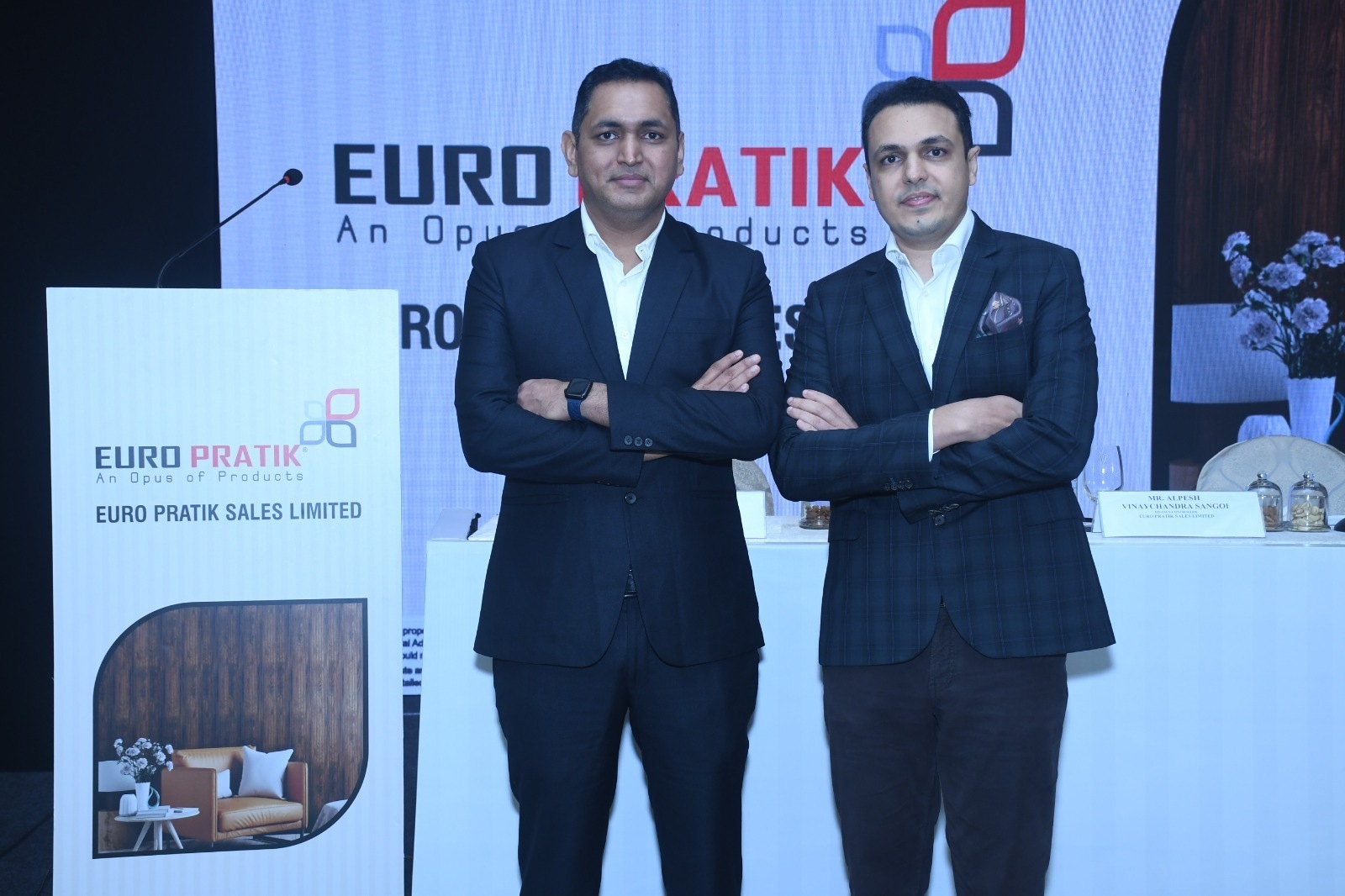
The world of interior design is no longer about “forever” teak wood and marble. It has shifted into a high-churn, trend-driven “fast-fashion” cycle where walls are treated like wardrobes. At the epicenter of this shift sits Euro Pratik Sales Ltd, a company that has managed to command a 15.87% market share in the organized decorative wall panels industry without owning a single heavy manufacturing plant. By leveraging a ruthless asset-light model and a distribution network that spans 138 cities, the company is attempting to prove that in modern finance, brand and design velocity trump heavy machinery.
However, the numbers tell a story of high-octane growth clashing with the realities of working capital. While the company recently reported a Q4 FY26 revenue of ₹93.5 Crore—a 28% YoY jump—the underlying mechanics of its expansion, fueled by a series of aggressive acquisitions like URO Veneer World and Chawla Brothers, suggest a management team in a hurry to conquer the retail front-end. With a Stock P/E of 31.1 and a price trading at 8.3 times its book value, the market is pricing in a perfection that leaves little room for execution errors.
1. At a Glance
The financial profile of Euro Pratik is a study in high-margin distribution. The company reported a PAT of ₹82.9 Crore on sales of ₹335 Crore, reflecting a business that knows how to extract value from the “aesthetic premium” of its 3,000+ designs. Investors have been drawn to the staggering ROCE of 38.4%, a figure that typically signals an efficient machine. But beneath this efficiency lies a growing complexity.
The management is currently on an acquisition spree, transitioning from a pure-play distributor to a retail-facing powerhouse. In late 2025 and early 2026, they moved south with URO Veneer World and north with Chawla Brothers. While these moves are framed as “forward integration,” they fundamentally alter the risk profile of the company. You are no longer just looking at a lean marketer; you are looking at an entity that is now absorbing the overheads and inventory risks of retail footprints.
Red flags are subtle but present. The Inventory Days have ballooned to 255 days in Mar 2026, up from 103 days just two years prior. In the world of “fast fashion,” high inventory is a double-edged sword; if trends shift, that “premium design” inventory becomes expensive scrap. Furthermore, the Cash Conversion Cycle has stretched to 320 days. The company is growing, yes, but it is doing so by locking up massive amounts of capital in the system.
The “fast-fashion” moniker is catchy, but it demands relentless innovation. Euro Pratik launches over 1,000 new designs every year. This constant treadmill of SKU creation is what keeps the 188 distributors engaged, but it also creates a high barrier to entry for the company itself—it cannot afford to slow down. The teaser for the skeptical investor: Is this a scalable design empire, or a working-capital-heavy warehouse business dressed in Hrithik Roshan’s marketing glow?
2. Introduction
Euro Pratik Sales Ltd is not your grandfather’s plywood company. Founded in 2010, it has spent the last decade and a half positioning itself as a “curator” of surfaces rather than a manufacturer. It operates under two primary brands: Euro Pratik and Gloirio.
The company’s strategy revolves around identifying global trends—often from South Korea and Europe—and bringing them to the Indian middle class at scale. By outsourcing production to 36 contract manufacturers globally, they avoid the “black hole” of capital expenditure that plagues traditional industrial firms.
This flexibility allowed them to survive regional shocks, such as the GRAP 4 pollution restrictions in North India during Q3 FY26. While their North India business (contributing ~22.4%) took a hit, the management pivoted focus to the South (42.2% of sales) to maintain momentum.
However, the recent listing in September 2025 marked a new era. The capital structure has changed, and the pressure to deliver “consistent” quarterly growth is now at odds with the seasonal and regulatory whims of the construction industry. As a reader, you must ask: can a company maintain a 33.8% Operating Profit Margin while scaling into the low-margin retail segment?
3. Business Model – WTF Do They Even Do?
Think of Euro Pratik as the “Zara” of wall panels. They don’t cut the wood; they design the look.
- Design First, Asset Second: They manage branding and merchandising in-house but outsource the “dirty work” of manufacturing. This keeps their balance sheet light on “Plant and Machinery” and heavy on “Design Catalogues.”
- The 3,000 SKU Trap: They offer a dizzying array of products—from Charcoal sheets to Miga Edge panels. While this creates a “one-stop shop” for architects, it creates a massive logistical headache for the warehouse team.
- The Sourcing Arbitrage: They source from South Korea, Turkey, China, and Vietnam. They effectively play the currency and logistics game to find the cheapest way to deliver high-end aesthetics.
- Dual Brand Cannibalization: They run Euro Pratik and Gloirio as separate teams. Management claims they “compete with each other” to gain more market share. It sounds like a bold strategy, but it also doubles the sales overhead.
Financial Wisdom: In an asset-light model, your real “asset” isn’t what you own, it’s what you control. Euro Pratik controls the distribution channel and the architect’s mindshare. The moment a competitor offers a “prettier” catalogue, the moat vanishes.
4. Financials Overview
The latest results show a company that is successfully pushing volume, but at the cost of margin volatility.
| Metric | Q4 FY26 (Latest) | Q4 FY25 (YoY) | Q3 FY26 (QoQ) |
| Revenue | ₹93.5 Cr | ₹73.0 Cr | ₹80.4 Cr |
| EBITDA | ₹25.6 Cr | ₹18.6 Cr | ₹34.6 Cr |
| PAT | ₹21.5 Cr | ₹14.4 Cr | ₹23.6 Cr |
| EPS (Quarterly) | ₹2.15 | ₹1.44 | ₹2.36 |
Annualised EPS Calculation:
Since this is a Q4 result, we use the full-year EPS provided in the consolidated data.
Full Year FY26 EPS = ₹7.54
Management “Walk the Talk” Analysis:
In the February 2026 Concall, management guided for a “minimum 25%” YoY growth for Q4. They delivered 28.1%. They “walked the talk” on the top line. However, they also aimed for EBITDA margins of “40% plus minus 2-3%.” Q4 EBITDA margin came in at 27.3%—a significant miss compared to their stated goal and the 43.1% seen in Q3. This margin compression likely stems from the integration of lower-margin retail acquisitions.
5. Valuation Discussion – Fair Value Range
We will evaluate Euro Pratik using three distinct lenses. All calculations use the latest consolidated data.
Method 1: P/E Multiple
- FY26 EPS: ₹7.54
- Industry Average P/E: 27.6
- Company P/E: 31.1
- Relative Valuation: ₹7.54 * 27.6 = ₹208
Method 2: EV to EBITDA
- EV: ₹2,586 Cr
- FY26 EBITDA: ₹113 Cr
- EV/EBITDA Multiple: 22.8x
- Peer Median Multiple: ~20x
- Relative Valuation: (₹113 Cr * 20) / 10.2 Cr shares = ₹221
Method 3: DCF (Simplified)
- Free Cash Flow (FY26): -₹14 Cr (Negative due to massive inventory buildup)
- Note: DCF is highly volatile here due to negative FCF. If we normalize FCF to 5% of Revenue (₹16.7 Cr) and use a 12% discount rate with 5% terminal growth:
- Estimated Fair Value: ₹185 – ₹210
Fair Value Range: ₹190 — ₹225
Disclaimer: This fair value range is for educational purposes only and is not investment advice.
6. What’s Cooking – News, Triggers, Drama
The company is currently acting like a hungry shark in a small pond.
- The URO Acquisition: They spent ₹76.5 Crore for 51% of URO Veneer World. Why? Because they want to talk directly to the 2,000 architects in South India. It’s a move away from pure wholesaling.
- The Chawla Brothers Deal: Closing on March 31, 2026, for ₹33.2 Crore, this gives them a massive footprint in Punjab and Haryana. Management expects this to add ₹80 Crore to the top line in FY27.
- The “Fire” Excuse: Management referenced a fire in Q1 FY26 that disrupted operations. While they claim to have recovered, such incidents often highlight gaps in operational risk management.
- Hrithik & Kareena: The brand spends are high. They are buying credibility through celebrity faces. It works for the Tier-II consumer, but it adds a fixed cost layer that doesn’t disappear if sales slow down.
Are these acquisitions strategic brilliance or an attempt to mask slowing organic growth?
7. Balance Sheet
The balance sheet is expanding rapidly as the company absorbs its recent acquisitions and prepares for a retail push.
| Row | Mar 2024 | Mar 2025 | Mar 2026 |
| Total Assets | ₹174 Cr | ₹274 Cr | ₹397 Cr |
| Net Worth | ₹156 Cr | ₹234 Cr | ₹310 Cr |
| Borrowings | ₹13 Cr | ₹19 Cr | ₹24 Cr |
| Other Liabilities | ₹5 Cr | ₹20 Cr | ₹62 Cr |
| Total Liabilities | ₹174 Cr | ₹274 Cr | ₹397 Cr |
- The “Net Worth” has doubled in two years, but “Other Liabilities” have gone up 12x. Someone is waiting to be paid.
- Borrowings are low at ₹24 Crore, but when your “Other Liabilities” are ₹62 Crore, you aren’t exactly “debt-free” in the eyes of a supplier.
- Total assets have surged, mostly sitting in “Other Assets” (Inventory/Receivables). It’s a balance sheet made of paper and plastic panels.
8. Cash Flow – Sab Number Game Hai
The cash flow statement is where the “asset-light” dream meets the “working capital” nightmare.
| Item | Mar 2024 | Mar 2025 | Mar 2026 |
| Operating Cash Flow (CFO) | ₹-75 Cr | ₹-3 Cr | ₹41 Cr |
| Investing Cash Flow | ₹– | ₹-28 Cr | ₹-39 Cr |
| Financing Cash Flow | ₹– | ₹42 Cr | ₹-20 Cr |
- Operating Cash Flow: Finally turned positive in FY26, but only because they stopped the bleeding from the massive ₹115 Cr working capital hit in FY25.
- Investing: They are spending aggressively on acquisitions (URO/Chawla) and “Fixed Assets” (which increased to ₹85 Cr). So much for being purely asset-light.
- Free Cash Flow (FCF): At -₹14 Cr for FY26. The company is literally consuming cash to grow.
9. Ratios – Sexy or Stressy?
The ratios tell two different stories: one of high efficiency and one of growing pain.
| Ratio | Mar 2026 | Mar 2025 | Witty Judgement |
| ROE | 30.5% | 30.5% | Sexy, but declining from previous highs. |
| ROCE | 38.4% | 38.0% | Still top-tier efficiency. |
| Debt to Equity | 0.08 | 0.08 | Practically non-existent debt. Good. |
| Inventory Days | 255 | 227 | Stressy. That’s a lot of dust on the panels. |
| Debtor Days | 106 | 123 | Improving slightly, but still slow. |
10. P&L Breakdown – Show Me the Money
| Year | Revenue | EBITDA | PAT |
| Mar 2026 | ₹335 Cr | ₹113 Cr | ₹77 Cr |
| Mar 2025 | ₹284 Cr | ₹101 Cr | ₹76 Cr |
| Mar 2024 | ₹221 Cr | ₹81 Cr | ₹63 Cr |
Revenue grew 18%, but PAT only grew 1.3%. This is the classic “growth at the cost of margin” trap. While they sold more panels, the costs of acquisitions, marketing, and interest (Other Liabilities) ate the lunch. The company is working harder just to stay in the same profit spot.
11. Peer Comparison
| Name | Revenue (Qtr) | PAT (Qtr) | P/E |
| Sheela Foam | ₹1,050 Cr | ₹91.8 Cr | 38.7 |
| Euro Pratik | ₹93.5 Cr | ₹21.5 Cr | 31.1 |
| Responsive Ind | ₹311 Cr | ₹22.5 Cr | 24.1 |
| Hardwyn India | ₹49 Cr | ₹1.8 Cr | 97.5 |
- Sheela Foam is the sleeping giant, winning on scale but crying on margins.
- Euro Pratik is the aggressive mid-weight, commanding a higher P/E than Responsive because of its high ROCE.
- Hardwyn India is currently in a valuation stratosphere that defies gravity.
12. Miscellaneous – Shareholding and Promoters
| Category | Mar 2026 (%) |
| Promoters | 70.49% |
| DIIs | 4.61% |
| FIIs | 0.49% |
| Public | 24.43% |
Promoter Roast: The Singhvi family (Pratik and Jai) hold the majority stake. They increased their holding slightly (0.39%), showing they are willing to eat their own cooking. However, FII interest is vanishing (dropped from 1.57% to 0.49%). It seems the big global money is worried about the inventory pile-up.
13. Corporate Governance – Angels or Devils?
Euro Pratik’s governance is a mixed bag of aggressive consolidation and independent director churn. Dhruti Apurva Bhagalia, an independent director, resigned in December 2025 after a short stint. Frequent exits from the board are rarely a sign of “smooth sailing.”
The company uses MUFG as its investor relations advisor, which adds a layer of institutional polish. However, the sheer number of related party entities (Millennium Decor, Euro Pratik Laminate LLP, etc.) merged or acquired recently makes the audit trail look like a bowl of spaghetti. Investors should watch if these acquisitions were done at fair market value or simply to clean up the promoter’s personal balance sheets.
14. Industry Roast and Macro Context
The decorative wall panel industry is currently benefiting from the “I-want-my-home-to-look-like-Pinterest” trend. It’s a sector driven by vanity and renovation. But let’s be real: this is a commoditized market with a fancy coat of paint.
New players are entering every day, and the “unorganized” sector is still the 800lb gorilla. Macro-economically, as interest rates stay high, the secondary housing market (renovations) might slow down. If people stop buying new apartments, they stop buying charcoal fluted panels. The industry is effectively a leveraged bet on India’s urban aspirational spending.
15. EduInvesting Verdict
Euro Pratik is a fascinating case of a company trying to “brand” its way out of a commodity business. The asset-light model is its greatest strength, allowing for a 38% ROCE, but its recent retail pivot is its greatest risk.
SWOT Analysis:
- Strengths: High design churn (1,000+ per year), 15.8% market share, strong promoter skin in the game.
- Weaknesses: Massive inventory days (255), negative free cash flow for FY26, margin compression in Q4.
- Opportunities: Expansion into the US and UAE, integration of Chawla Brothers to dominate North India.
- Threats: Regulatory halts like GRAP 4, rising crude-based raw material costs, high competitive intensity.
The company has successfully “walked the talk” on revenue, but failed on the EBITDA margin guidance for the latest quarter. For a company trading at 31x earnings, the market will eventually demand that “Revenue Growth” converts into “Cash in the Bank.” Currently, that cash is sitting in a warehouse in Bhiwandi.
Final Financial Wisdom: Revenue is vanity, Profit is sanity, but Cash is reality. Euro Pratik has the vanity and the sanity, but it’s still searching for the reality of consistent positive free cash flow.
This fair value range and analysis are for educational purposes only and are not investment advice.