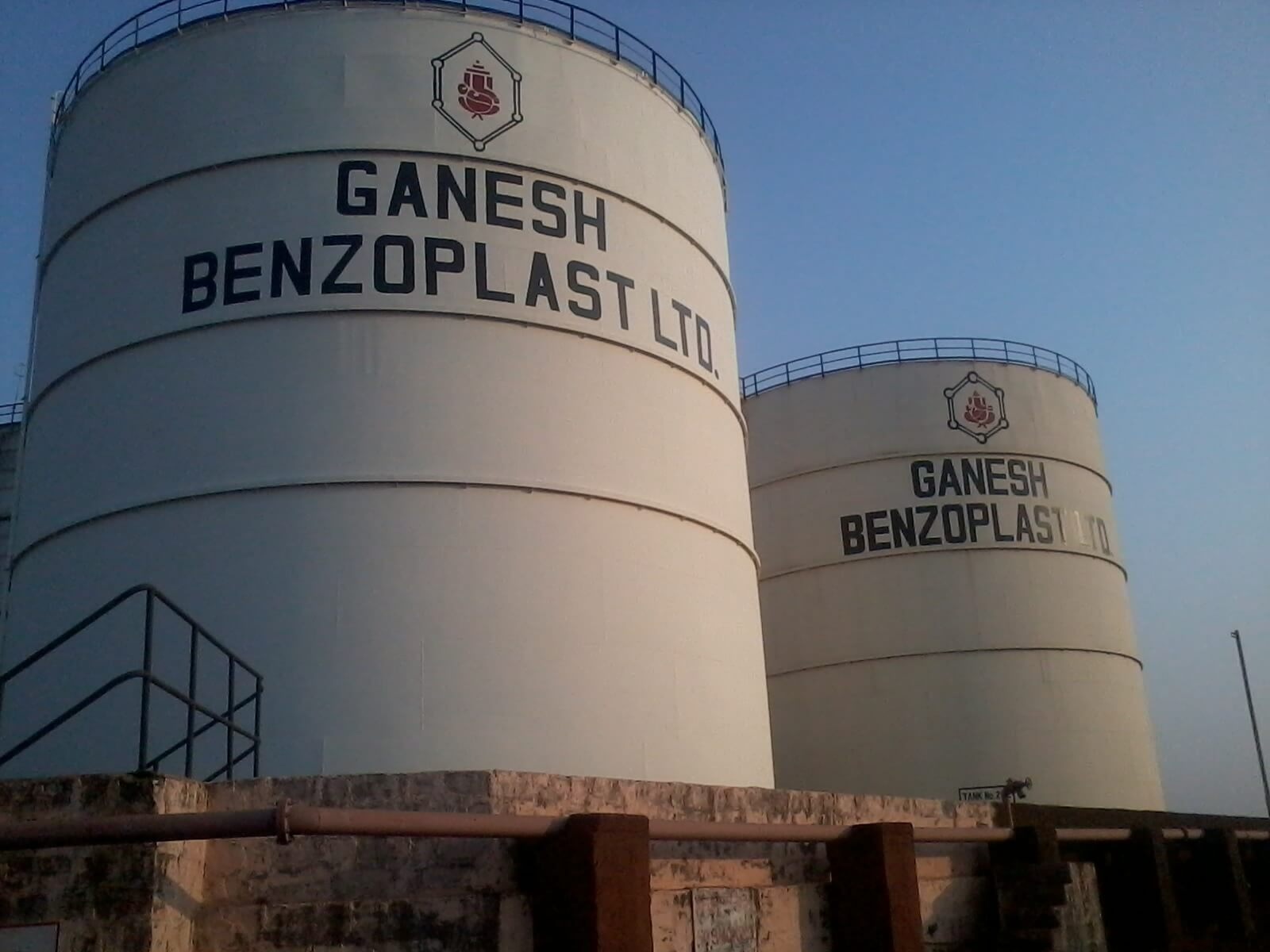
Ganesh Benzoplast FY26: +92.5% EPS Growth That Asks More Questions Than It Answers
Section 1 — At a Glance
Ganesh Benzoplast reported FY26 PAT of ₹73.34 Cr against ₹38.09 Cr in FY25 — a 92.5% surge in earnings. EPS bounced from ₹5.29 to ₹10.19. Sales grew a modest 9.9% to ₹411.42 Cr. Debt stands at ₹75.8 Cr with net cash of ~₹3.7 Cr (down from ₹35 Cr in FY25). ROE is 12%, ROCE is 14.6%. The stock trades at 10.99x P/E — a valuation that sits below historical peer averages but above growth-adjusted multiples in the liquid logistics sector.
What makes FY26 noteworthy isn’t profit growth; it’s why it happened and what remains unresolved afterward. The liquid storage business continues its rent-and-utility operations. The chemical division delivered 11% revenue growth to ₹139.9 Cr. And then there’s the ₹169.24 Cr JSW order win, the CFO’s departure, the income tax searches, and the peculiar structural cost hit the company still hasn’t fully passed through to customers.
This is the story of a business that showed rapid earnings recovery while structural cost headwinds and governance questions remain open.
Section 2 — Introduction
Ganesh Benzoplast operates three core verticals: liquid storage terminals (LST) at JNPT, Cochin, and Goa; specialty chemical manufacturing at Tarapur; and, more recently, rail logistics through a majority stake in Infrastructure Logistic Systems. Founded in 1986, the company pivoted from pure chemical manufacturing into port-linked tank farming in the mid-1990s. The founder, Ramesh Pilani (now CFO, resigning in May 2026), and his son Rishi (Chairman & MD) structured the company across these three business divisions.
On paper, straightforward. In reality, FY26 has been a year of structural change, governance turbulence, and a profit surge that masks deeper questions about sustainability and capital allocation.
Section 3 — Business Model: WTF Do They Even Do?
Three separate-ish operations. The LST division — 80% of revenue — leases stainless steel, mild steel, and pre-coated tanks at premium ports to companies importing and exporting bulk liquids. Rent, handling charges, blending, barging. Stable, contract-backed, 50%+ EBITDA margins on rental income. JNPT operates at 100%+ occupancy. Cochin hums at 95%. Goa? Languishing at low utilization, pending regulatory approvals for new product types.
The chemical division makes benzoic acid, sodium benzoate, lubricant additives, petroleum sulfonates—the kind of specialty inputs you buy from India because they’re cost-effective and the company has near-monopoly pricing on pure benzoic acid. Exports go to 9+ countries. Margins are thinner than LST (15% EBITDA) but growing. 11% growth in FY26.
Rail logistics is the newest dance partner — acquired 86.5% of Infrastructure Logistic Systems (formerly Stolt Rail) to handle customer cargo from port to plant via Indian railways. Twenty percent of LST revenue now routes through this subsidiary. Synergy story, though execution details remain sparse.
Four guesses what happens if you ask management whether they’re truly a logistics play, a chemical manufacturer, or a port landlord. They’ll probably answer yes to all three.
Section 4 — Financials Overview
Figures are consolidated, in ₹ crore.
Metric
Q4 FY26
YoY
FY26
FY25
Revenue
111.47
+10.8%
411.42
374.30
EBITDA
~52
–
127.78
108.98
PAT
15.29
-49.4%
73.34
38.09
EPS
2.12
–
10.19
5.29
Q4 delivered 10.8% revenue growth but a 49.4% PAT collapse. Don’t panic yet — management explicitly pegged this to one structural bullet: the JNPT land lease reset. The old lease cost ~₹2 Cr annually. The reset? ~₹24 Cr per annum. That’s a ₹22 Cr annual cost step-up. For 9M, the company took ~₹17–18 Cr of this as a provision, which is why Q4 PAT looks anemic. Full-year numbers benefited from the fact that the reset doesn’t kick in until Q1 FY27 calendar-wise.
Strip out the lease reset hit from Q4, management estimates PAT would have been north of ₹19 Cr instead of ₹15.29 Cr. The validity of this adjustment depends on accepting management’s allocation of the lease-reset provision to Q4. The reported FY26 full-year profit is cleaner than the Q4 quarterly view suggests because the lease reset’s full impact is expected to begin in FY27.
Concall Takeaway (Feb 2026): Management is explicit about the lease reset as a structural headwind and equally explicit about the plan to recover margins through rental escalations to customers. Rishi Pilani: “within 2 years we catch up to those margins.” Translation: you’re watching a slow game of pass-the-cost-forward. Success is not guaranteed. Timing is fuzzy.
Section 5 — Valuation: The Fair Value Range Conversation
Annualised EPS: ₹10.19 (FY26 full-year, so no annualisation needed — Q4 is booked.)
P/E Method: Peers in oil & gas logistics trade at 10–68x (Aegis Vopak at 67.87x, GBL at 12.07x). Mid-range for a stable, contract-backed LST player: 14–18x.
₹10.19 × 15x = ₹152.85
₹10.19 × 18x = ₹183.42
EV/EBITDA Method: Annualised EBITDA ~₹128 Cr. Port LST players typically trade 6–8x EBITDA (Aegis at 6.74x). GBL’s implied EV/EBITDA: 6.3x.
₹128 × 6.5x = ₹832 Cr EV → subtract net debt (↓₹3.7 Cr) → equity value ₹828 Cr ÷ 7.2 Cr shares = ₹115 per share
₹128 × 7.5x = ₹960 Cr EV → ≈ ₹133 per share
Synthesis: Fair value range ₹115–₹183, with midpoint around ₹150. Current price of ₹112 reflects governance uncertainty and the lease reset as structural cost factors. The current price sits at the lower end of the calculated range.
This fair value range is for educational purposes only and is not investment advice.
Section 6 — What’s Cooking: The Drama File
JSW Jaigarh Order (April 2025): ₹169.24 Cr EPC contract over 27 months. This is manufacturing + installation work—tank farm engineering—not core LST rental. Margin profile: 5–10% management flagged. Why accept single-digit margins? Account deepening. JSW is already storing with GBL; the EPC job is a way to lock in future storage revenue.
Reliance Carbon Fiber Project (Feb 2026): ₹51.33 Cr mechanical & piping EPC order, 11-month duration. Again, 5–10% margin. Again, the customer stores chemicals with GBL. Again, management using EPC as a wedge to deepen wallet share.
GBC LPG JV Termination (Nov 2025): GBL had a joint venture with BW Confidence to develop an LPG import terminal at JNPT. The JV is dead. GBL sold its stake and received a ₹99.50 Cr non-compete fee. This was supposed to unlock massive growth. Instead, management decided the returns weren’t bankable and walked. Lesson: they prefer certain, long-tenor contracts over speculative sector bets.