General information and entertainment, not investment advice. The author is not a SEBI-registered adviser or research analyst. No recommendation, no promised returns. Markets carry risk including loss of capital. Figures may not be current. Consult a registered adviser before acting.
1. At a Glance
ECOS mobility rode a 29% trip spike to ₹808 Cr revenue in FY26, a respectable 24% YoY beat. But the market paid the price: EBITDA margins compressed 251 basis points to 11.6%, and PAT margins fell 202 bps to 7%. A company chasing scale without the profitability tailwind. The stock cratered 60% in twelve months.
Fleet expanded to 20,000 vehicles (90% vendor-owned, capital-light in theory). Active client base hit 1,750. Orders remain healthy—GCC demand surging, corporate sectors still rely on organized ground transport—yet margins tell a grimmer story: competitive pressure in ETS, higher manpower costs, and tech investments all compressed the bottom line.
The company holds ₹312 Cr in cash, a healthy buffer against ₹78 Cr debt. ROCE at 30% suggests capital deployed efficiently, but a 24% ROE (down from 29% in FY25) hints that equity earnings per rupee are weakening. No dividend was declared.
Central tension: the market is watching whether ECOS can grow profitably or whether it will remain a high-revenue, low-margin operator in a race it did not ask for.
2. Introduction
ECOS was incorporated in 1996, one of the earliest professional car rental outfits in India. Thirty years in and it remains the largest chauffeur-driven mobility provider in the country, listing on NSE and BSE in September 2024 at a spectacular entry point that the market has since rejected with prejudice.
The business split into two legs: Chauffeured Car Rentals (CCR)—corporate bookings, luxury cars, trained drivers—and Employee Transportation Services (ETS)—daily commuting for office staff and factory workers. The mix has shifted: ETS grew to 58% of FY26 revenue, up from historical 50%–55%. This is no accident. IT majors and Global Capability Centers (GCCs) are expanding in India faster than anyone expected, and ECOS has capitalized on that shift.
Recent milestones landed heavily. In March 2026, ECOS signed an exclusive partnership with SIXT, the German car rental giant, to serve ECOS corporate customers seeking self-drive rentals across 100+ countries. In May 2026, a new core backend platform went live, aimed at speeding up bookings and integrating customer workflows. These are infrastructure plays, not revenue boosters—at least not yet.
The fundraise in 2024 pulled in ₹601 Cr, a splurge that has since gone into fleet expansion, technology, and hiring. Whether that capital finds a home in margin recovery is the open question.
3. Business Model: WTF Do They Even Do?
ECOS operates two interlocking loops. The first is Chauffeured Car Rentals: the company offers vehicles ranging from budget Maruti Dzires to Mercedes E-Class sedans and Range Rovers, all piloted by full-time, uniformed, background-checked chauffeurs. Clients are corporates, events, B2B travel platforms, and hotels. The second is Employee Transportation: ECOS owns or co-opts thousands of drivers and minivans, ferrying employees between homes and offices on daily multi-shift contracts, mostly for IT/ITES firms and manufacturing plants.
The vehicle portfolio runs from economy (Maruti Dzire, Ciaz) through premium (Toyota Innova, Honda City) to luxury (Audi A6, Range Rover) and buses (Volvo, Mercedes V-Class). A small fleet of EV vehicles exists (Tata Tigor, BYD E6), but penetration remains negligible.
The kicker: ECOS owns roughly 1,000 vehicles. The rest—90%, or ~20,000 units—are vendor-owned. ECOS functions as a marketplace, not a fleet owner. It curates vendors (currently ~5,400), sets pricing, verifies drivers, handles customer experience, and keeps a commission or markup. No capex burden, no depreciation cliff, no asset stranding. On paper, it is asset-light. In practice, it means ECOS is a logistics and compliance orchestrator, and when competition is fierce, margins compress because ECOS must pass price cuts to vendors to retain work.
Revenue splits geographically: Bangalore (22%), Delhi (14%), Mumbai (13%), Gurgaon (13%), Hyderabad (11%), others trailing. The company operates in 130+ cities, but the bulk of profits come from ten metros where corporate density is highest.
The technology stack matters. RentNet is ECOS’s proprietary transport management system, stitching together a customer app, a driver app (CabDrive Pro), an API for corporate clients, an online booking tool, and a 24/7 contact center of ~50 staff. Digital CCR bookings hit just 14% of volume in Q4 FY26. Most corporate clients still email or call. The company is pushing a direct-booking web portal launched in Q4, explicitly not aimed at mass-market B2C (that would be Uber), but at premium individuals and SMEs wanting the “ECOS experience.”
The business depends on three levers: (1) existing customer wallet-share expansion (sell more trips to the same 1,750 accounts), (2) new customer acquisition (the company added 223 in FY26), and (3) pricing power. Only the first two are working well right now.
4. Financials Overview
Figures are consolidated, in ₹ crore.
| Metric | Latest Q (Q4 FY26) | YoY | QoQ |
|---|---|---|---|
| Revenue | 206.8 | +16.7% | −3.3% |
| EBITDA | 24.2 | −8.7% | −1.6% |
| PAT | 15.7 | −12.9% | +12.8% |
| EPS | 2.62 | −12.9% | +12.8% |
FY26 Annual Snapshot:
Revenue reached ₹808 Cr, up 24% from ₹642 Cr in FY25. Trip volume surged 29% to 5.23 million, yet the company’s ability to monetize that volume cratered. EBITDA ticked up barely 2% to ₹939 Cr (from ₹924 Cr in FY25), leaving EBITDA margin at 11.6%, a 251 bp collapse from FY25’s 14.1%. PAT fell 4% to ₹576 Cr (from ₹601 Cr), with margin compressed another 202 bp to 7%, mirroring the story.
Management’s FY26 concall (May 2026) attributed margin pressure to:
- “Continued investment towards business expansion, technology, and strengthening organization capabilities”
- “Higher manpower cost” and “expanding leadership bandwidth”
- “Competitive pricing environment, especially in the ETS segment”
- A one-time doubtful debt provision of ~₹80 Cr (flagged as a “prudent approach”), recovery likely in FY27 or later
EPS fell to ₹9.60 from ₹10.02 in FY25. The company said FY27 guidance targets revenue growth of 18–20% and EBITDA margins of 11–13%, implying management expects the margin floor to hold but no quick recovery.
Q4 was weaker than Q3: revenue of ₹207 Cr vs ₹214 Cr in Q3. Management blamed “West Asia crisis in March, which did affect our CCR business,” though “a good bounce back” was noted ahead.
5. Market Expectations & Historical Multiples
This section describes how the market is currently pricing the company and how that compares with its own history and peer group. It is descriptive, not predictive.
| Metric | Current | Historical Average | Peer Median |
|---|---|---|---|
| P/E | 13.2 | 23.6 | 13.3 |
| EV/EBITDA | 7.0 | — | — |
| P/B | 2.87 | — | — |
| ROCE | 30.3% | — | — |
| ROE | 23.7% | 29.2% (3Y avg) | 19.7% |
The market currently pays ₹127 on a ₹9.60 annualized EPS, delivering a P/E of 13.2, in line with peer median of 13.3. The stock has shed 60% over twelve months—a gut punch that repriced the IPO’s euphoria into current scepticism. The five-year average P/E stands at 23.6, suggesting the stock now trades at a 44% discount to its own history.
EV/EBITDA sits at 7x, tight by mobility services standards. The company’s ROCE of 30% (capital efficiency) and ROE of 23.7% (shareholder returns per rupee of equity) are creditable—both exceed the cost of capital and peer benchmarks—yet ROE fell 5.5 percentage points from FY25’s 29.2%, and three-year average stands at 29.2%, hinting at persistent deterioration.
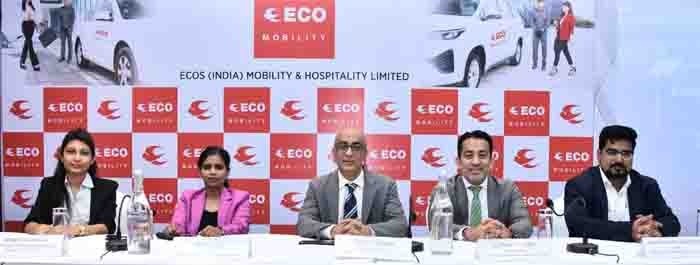
The market appears to be pricing in modest growth, margin compression acceptance, and a wait on whether ECOS can stabilize profitability. The compressed multiple relative to history reflects a loss of confidence that the scale being achieved will translate into sustainable margin.
6. What’s Cooking
GCC expansion tailwind (quantified): Global Capability Centers in India grew from 1,580 to 1,900 between 2023 and 2025 and are expected to reach 2,400 by 2030. Each GCC requires employee transport, and ECOS is feeding that growth. ETS is the beneficiary.
SIXT partnership (March 2026): Exclusive India General Sales Agent arrangement gives ECOS customers access to SIXT’s self-drive fleet across 100+ countries. Appears to be a cross-sell opportunity and international presence validation, but revenue impact is immaterial in FY26 and likely will remain so unless corporate travel accelerates.
New core backend platform (Q4 FY26): Launched to “optimize process efficiencies” and reduce digital friction. Adoption is slow—only 14% of corporate CCR bookings now flow via CabDrive Pro, API, or the app. Email and phone calls remain entrenched, and the 50-person contact center carries overhead.
Fleet expansion to 20,000 vehicles (FY26): Added ~2,000 vehicles (113 owned in Q1 FY26 alone) to the vendor network. Capital efficiency is high on paper (vendor-owned), but vendor recruitment and quality control add operational drag.
Client base at 1,750 (+223 in FY26): New client wins frame as “structured and lengthy evaluation processes,” implying long sales cycles and sticky contracts. The company reported 55% of FY26 revenue came from customers associated for >5 years, up from 57% in FY25 (a dip, suggesting new customer mix is diluting sticky base).
Shareholder returns held: No dividend declared. Management said a separate board meeting would “consider dividend or other alternate ways” to enhance shareholder value—corporate-speak for deliberation, not commitment.
7. Balance Sheet
| Item | FY24 | FY25 | FY26 |
|---|---|---|---|
| Total Assets | 296.7 | 341.4 | 413.5 |
| Net Worth (Equity) | 177.5 | 221.8 | 265.9 |
| Borrowings | 29.8 | 14.4 | 7.8 |
| Other Liabilities | 89.5 | 105.3 | 140.8 |
| Total Liabilities | 296.7 | 341.4 | 413.5 |
The balance sheet tightened neatly. Debt fell from ₹30 Cr to ₹7.8 Cr, a near-elimination. Equity swelled from ₹177 Cr to ₹265.9 Cr (reserves adding ₹43 Cr despite a PAT fall, courtesy retained earnings and FY25’s ₹15 Cr dividend payout). The Debt/Equity ratio collapsed from 0.12 to 0.03, a textbook de-leverage.
Yet total assets rose faster than equity: other liabilities (current payables, accruals, lease obligations) jumped 34% to ₹141 Cr. Working capital expanded as the company scaled operations and held higher trade payables (mostly to vendors and creditors). Net cash stood at ₹312 Cr (cash of ₹311 Cr less debt of ₹7.8 Cr), a fortress.
Three observations: (1) The balance sheet hides operational distress—assets are inflating faster than earnings, a sign of either poor capital deployment or inventory/receivables buildup. (2) Borrowings are nearly gone, so debt service is a non-issue, freeing cash flow for capex or (theoretically) dividends. (3) Other liabilities spiked, suggesting vendor payables and accrued expenses rose sharply as the company expanded fleet and headcount mid-year.
One wisdom line: A fortress balance sheet can mask a business that is bleeding margin to chase revenue. ECOS has the liquidity to survive any downturn, but the question is whether it has the pricing power to recover.
8. Cash Flow: Sab Number Game Hai
| Year | Operating | Investing | Financing |
|---|---|---|---|
| FY24 | 67.1 | −54.2 | −10.8 |
| FY25 | 75.2 | −19.2 | −29.7 |
| FY26 | 68.2 | −45.8 | −22.1 |
Operating cash flow dipped to ₹68 Cr from ₹75 Cr in FY25, a 9% fall despite 24% revenue growth. The culprit: higher working capital absorption. Receivables grew ₹24 Cr (debtors at 48 days of sales), payables rose but not fast enough, and cash conversion stayed tepid at 97% of operating profit.
Investing cash outflow spiked to ₹46 Cr from ₹19 Cr, driven by fleet expansion and capex. The company spent ₹13 Cr in Q1 FY26 on 113 vehicles and flagged a ₹6 Cr order for 60–70 more vehicles in the pipeline, with a full-year capex run-rate of ₹35 Cr expected.
Financing saw ₹22 Cr outflow—debt repayment and dividend payments combined. Free cash flow (OCF minus investing) sagged to ₹22 Cr from ₹56 Cr in FY25.
The money story: ECOS is generating cash, but the trip growth is not converting to profit growth, so absolute cash generation is flagging. Capex remains moderate (35 Cr annualized, less than 5% of revenue), but the company cannot invest faster without cash build—a constraint that may slow fleet expansion.
One wisdom line: Cash flow trailing profit growth is a flag that working capital is eating returns. Management’s target of 60–65% of growth coming from new client wins (vs. wallet share) will demand sustained capex, which cash flow can support but only narrowly.
9. Ratios: Sexy or Stressy?
| Ratio | Value |
|---|---|
| ROE | 23.7% |
| ROCE | 30.3% |
| P/E | 13.2 |
| PAT Margin | 7.0% |
| D/E | 0.03 |
ROE at 23.7% is solid—the company generates ₹23.7 of profit per ₹100 of shareholder equity annually. But it fell 5.5 percentage points from FY25, signaling declining returns per rupee deployed. A three-year average of 29.2% underlines the slide.
ROCE at 30.3% suggests capital is being deployed efficiently, earning 30 paise on every rupee of invested capital (equity plus debt). This exceeds the 8–10% cost of capital by a wide margin and peers’ median of 20%, so on paper, the company is creating value. Yet ROCE has fallen from 43% in FY24, hinting that recent capital (the ₹600 Cr IPO proceeds and fleet expansion) is earning lower returns.
P/E of 13.2 is the market’s verdict: investors will pay ₹13.20 per rupee of annual profit. This matches peers but lies 44% below ECOS’s own five-year average, suggesting either the market is punishing recent earnings miss or it believes profit growth will be slower than in the past.
PAT Margin at 7% is anaemic for a mobility services company aiming for scale. Peers in the transport space sit at 8–11%, so ECOS is below band. The margin has fallen from 9% in FY25 and 11% in FY24, a three-year downslide despite rising scale, the opposite of expected.
D/E of 0.03 is fortress-like, essentially zero-debt. The company has no leverage stress and is unaffected by rate hikes. But it also signals capital that could be deployed into growth (debt to fund capex) is sitting idle—capital efficiency could be higher if the company were willing to lever modestly.
10. P&L Breakdown: Show Me the Money
| Year | Revenue | EBITDA | PAT |
|---|---|---|---|
| FY24 | 547.0 | 90.0 | 62.5 |
| FY25 | 641.5 | 92.4 | 60.1 |
| FY26 | 808.2 | 93.9 | 57.6 |
Revenue is climbing smartly: FY26 at ₹808 Cr represents a 26% CAGR over three years (FY24–FY26). Scale is not the issue; the company is growing faster than the market demands.
EBITDA tells the story: despite 48% cumulative revenue growth over three years (FY24–FY26), EBITDA is essentially flat (₹90 Cr to ₹94 Cr, a 4% rise). Margins have compressed relentlessly. Operating leverage, which should emerge at scale, has not. Every additional rupee of revenue is delivering fewer paise of operating profit.
PAT has actually shrunk 8% over the same period, from ₹62.5 Cr to ₹57.6 Cr. Revenue +48%, profit −8%. The divergence is stark and deliberate—management is plowing cash into capex, tech, and competitive pricing to grab market share, betting that profitability will follow. This is a growth-at-cost posture. Whether it pays off depends on whether ECOS can stabilize pricing power or cut costs when scale matures.
11. Peer Comparison
| Company | Revenue | PAT | P/E |
|---|---|---|---|
| ECOS | 808 | 57.6 | 13.2 |
| Voler Car | 52.8 | 3.5 | 73.5 |
| Wise Travel | 826.5 | 29.5 | 8.0 |
| Ashwini Container | 93.8 | 10.9 | 13.4 |
| Shree OSFM | 152.5 | 7.6 | 10.2 |
| Median (4 Co.) | 451.0 | 20.2 | 13.3 |
ECOS is the largest by revenue in the peer set—nearly double the median. Yet PAT is almost triple the median, a sign of either stronger execution or a different service mix (likely the latter; ECOS serves corporates, many peers serve B2C or bulk logistics).
Wise Travel is the runner-up in revenue (₹826 Cr, close to ECOS), but PAT is half (₹29.5 Cr), meaning ECOS is more profitable. Yet ECOS trades at a 13.2x P/E, while Wise Trade at 8x—the market is pricing Wise Travel as a value play, possibly on higher growth or better margin trajectory. Neither story is obvious from the data.
Voler Car trades at a crushingly high 73.5x P/E but on a tiny ₹3.5 Cr profit base, likely reflecting a micro-cap liquidity and growth-story illusion. Ignore.
Takeaway: ECOS is the class leader in scale but trades at median multiple, having lost the valuation premium the IPO command. Peers with lower profit are trading cheaper multiples, a red flag that ECOS may be a value trap if margins don’t recover.
12. Miscellaneous: Shareholding & Promoters
| Holder | % |
|---|---|
| Promoters | 67.8% |
| DIIs | 12.7% |
| FIIs | 1.8% |
| Public | 17.7% |
Rajesh Loomba (Chairman, 32.3%) and Aditya Loomba (JMD, 25.5%) together hold 57.8%, with trust and family structures adding another ~10%. The family owns the majority and has retained control post-IPO (no dilution).
Promoter snapshot: Rajesh has 30+ years in mobility services, a Commerce degree and PGM from S.P. Jain, and was inducted into the “Global Hall of Fame” by the World Auto Forum. Aditya is lower-profile, previous roles in telecom and shared services. Neither has red flags—no financial crime, no equity pledges (0% pledged as of Mar 2026), no dramatic exits.
Yet the founding family has taken only ₹15 Cr in dividends in three years (FY24–FY26), despite controlling a ₹763 Cr market cap. This could signal either capital discipline (reinvesting for growth) or confidence that future earnings will be higher. Or simply that the margin situation is tighter than the family expected post-IPO.
FII holding has crumbled from 7.8% in Dec 2024 to 1.8% in Mar 2026, a 78% walk-out. DIIs hold steady at 12.7%. The public float is 17.7%, tight and illiquid. This is a family company with institutional credibility, not a widely-held franchise.
13. Corporate Governance: Angels or Devils?
Board reconstituted on May 29, 2026, when Vandana Chamaria was added as an independent director. Rajeev Vij resigned as independent director in August 2025, citing “personal reasons”—a data point but not a scandal.
Auditor: No credit rating downgrades or qualification notes in audit reports. Crisil rates the company BBB+/Stable, reaffirmed in June 2025. The rating notes “steady business risk profile supported by growth in revenue and moderation in EBITDA margins,” exactly what has happened. No covenant breaches or red lights.
Related-party transactions: None flagged prominently in disclosures. Vendor payments and transport services go to vendor network, not family concerns.
Pledges: Zero. The promoters have not mortgaged their equity to secure loans, a vote of confidence (or indifference).
Taxation: No material tax demands or legal tussles flagged in announcements or credit reports.
Summary: Governance is clean. The company is well-audited, the promoters are untroubled, and there are no structural red flags that would justify a credit downgrade or suspect insider dealings. The margin pressure is operational, not governance-driven.
14. Industry Roast & Macro Context
The corporate ground transport market in India is fractured and largely unorganized. According to F&S, the organized Corporate Car Rental (CCR) market is ₹98 Cr (2023e), expected to grow to ₹227 Cr by 2030—a 15% CAGR. Employee Transportation Services (ETS) organized market is ₹503 Cr (2023e), expected to reach ₹1,098 Cr by 2030—an 12% CAGR.
ECOS operates at the intersection. It has market size tailwinds: Global Capability Centers (GCCs) are proliferating, air connectivity is improving, and IT/ITES companies are expanding campuses in Tier-II cities. These are structural greases.
Yet the sector itself is commoditizing. Pricing wars are real: aggregator-style apps (Uber, Ola) have trained corporate buyers to expect on-demand pricing, and new entrants are undercutting incumbents to grab contracts. Management noted “competitive pricing pressure” in ETS and a “certain threshold beyond which it doesn’t make sense” for sustainable operators, implying a race to the bottom that only scale and operational discipline can survive.
Regulation is light-handed. No price capping, no license restrictions (bar state-level permits). The sector benefits from rising formalization—corporates prefer organized operators for compliance and safety—but that tailwind is already baked into ECOS’s growth. The next wave requires pricing power, which is evaporating.
Fuel pass-through: ECOS contracts include fuel escalation clauses (typically triggered above 5% price rises), so the company is hedged against crude shocks. Lags are temporary (days to weeks). Management downplayed this risk post-concall.
The sector joke: ECOS is one of the few companies that can serve both Fortune 500 CEOs and factory workers on the same balance sheet, a skill that rivals have tried and failed to replicate. The “organized” framing of ECOS’s brand—compliance, tech, trained drivers—is genuinely differentiated. But differentiation does not survive a price war, and the ETS segment is heating up fast.
15. EduInvesting Verdict
| Strengths | Weaknesses |
|---|---|
| Market-leading scale: ₹808 Cr revenue, 5.23m trips, 1,750+ clients, 131 cities. | Margin compression: EBITDA margin at 11.6%, PAT margin at 7%—both falling despite 26% 3Y revenue CAGR. |
| Capital-efficient: 30.3% ROCE, 23.7% ROE, though both declining. | ETS pricing pressure: competitive intensity rising, YoY revenue per trip falling. |
| Asset-light model: 90% vendor-owned fleet, low capex burden. | Profitability lag: PAT down 8% over 3 years despite revenue +48%. |
| Clean balance sheet: ₹312 Cr net cash, D/E of 0.03, zero pledges. | Deteriorating returns: ROE fell 5.5 pts YoY; ROCE fell 13 pts in 2 years. |
| Structural tailwinds: GCC expansion, IT/ITES growth, formalization. | Growth-at-cost posture: betting on future pricing power that has not materialized. |
| Shareholder returns held: no dividend despite ₹312 Cr cash, no clear plan to return capital. |
| Opportunities | Threats |
|---|---|
| Wallet-share expansion: 223 new clients in FY26; room to deepen existing relationships. | Commoditization: organized ETS market growing 12% CAGR; ECOS growth 29% is unsustainable without pricing power. |
| Platform digitization: only 14% of bookings digital; adoption could drive yield and reduce contact center cost. | Geopolitical shocks: March 2026 West Asia crisis dented CCR; future disruptions could hit hard. |
| EV fleet transition: EVs remain <5% of fleet; potential upside if TCO improves and customer demand rises. | Working capital stress: debtors at 48 days, payables rising slower; cash conversion declining. |
| International expansion: SIXT partnership and 30+ country presence nascent; B2B travel may explode. | Margin recovery uncertain: FY27 guidance (11–13% EBITDA) suggests floor, not bounce-back. |
The close:
ECOS is a balance sheet with nothing to hide and a multiple with everything to prove. The company has built the largest, most profitable chauffeur-driven mobility network in India, a feat that rivals have not replicated. Yet that lead is being eroded in real-time by pricing pressure, particularly in ETS, the faster-growing and higher-margin segment. The stock trades at fair value (13.2x P/E, in line with peers) after a 60% crash from IPO, but the market is clearly pricing in a long stay in single-digit margin territory.
The next two years will determine whether ECOS can stabilize profitability while maintaining growth or whether it becomes a high-revenue, low-return operator trapped between organized logistics companies (who will scale faster) and ride-share aggregators (who will undercut on price). Management is betting on digital adoption and new-customer acquisition to drive leverage. The margin data suggests that bet is behind schedule. The balance sheet, promoter conduct, and corporate governance are not the problem—execution is.
Until EBITDA margin trends upward while revenue still grows at mid-to-high teens, the stock is unlikely to re-rate. The company has time, cash, and brand to find the answer. But time is moving fast, and the market is patient only as long as the numbers do not get worse.
