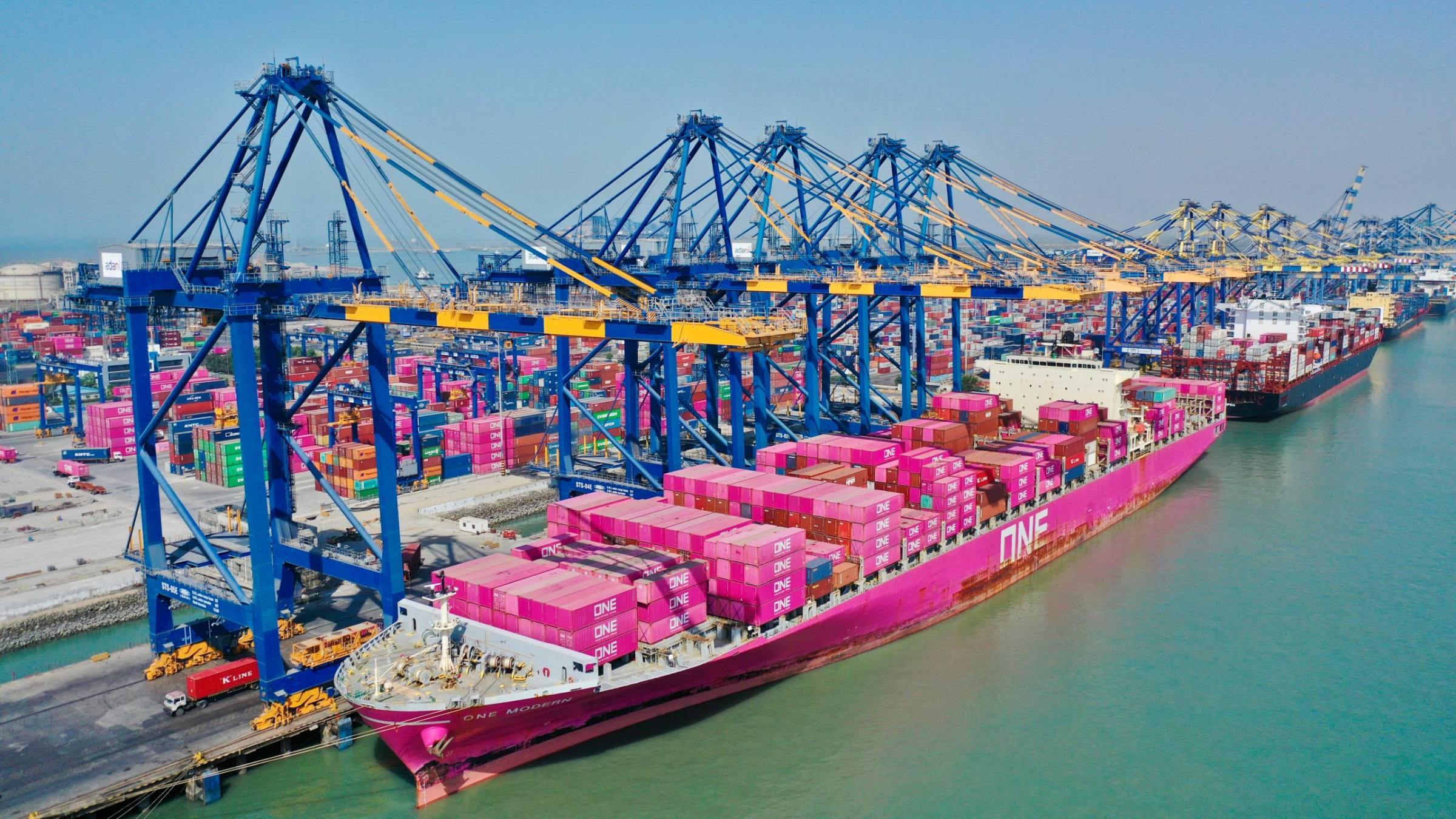
Adani Ports & Special Economic Zone: FY26 — 500 Million Tonnes: Not a Statistic, An Inflection
General information and entertainment, not investment advice. The author is not a SEBI-registered adviser or research analyst. No recommendation, no promised returns. Markets carry risk including loss of capital. Figures may not be current. Consult a registered adviser before acting.
1. At a Glance
FY26 delivered what management called “an India’s infrastructure moment”: the company crossed 500.8 million metric tonnes of cargo throughput for the first time, a feat that took a decade to build but happened amid geopolitical volatility and West Asia disruption that sank competitors’ earnings.
Revenue climbed ₹38,736 Cr, up 25% YoY from ₹30,475 Cr. Net profit grew 15% to ₹12,806 Cr. EBITDA rose 21% to roughly ₹22,900 Cr (calculated from operating profit plus depreciation minus other income). The company reiterated it hit guidance across revenue, EBITDA, and capex spend.
Prices referenced are not live. As of mid-June 2026, the stock trades at ₹1,805.
The tension: a company moving from “build more capacity” to “run existing capacity harder,” while debt hits ₹63,566 Cr and leverage sits at 2.3x net debt to EBITDA (reported by India Ratings). ROCE improved to 16% and ROE to 16.4%. Yet margin volatility persists at port level—a sign of mix headwinds, not weakness.
The stock trades at 32.1x P/E. The peer median is 23.55x.
2. Introduction
Adani Ports & Special Economic Zone operates 15 domestic ports, 4 international terminals (Haifa, Dar-es-Salaam, Colombo, Australia), and a logistics arm with 132 rakes, 937 trucks, and 12 multi-modal logistics parks nationwide.
The company was spun out of the Adani Group’s broader empire but has matured into a standalone credit-rated entity—India Ratings affirmed it at ‘IND AAA’/Stable in April 2026, the highest rating available, citing strong cash generation and operational performance.
FY26 brought three acquisitions and three strategic moves. In May 2026, the company completed a ₹1,500 Cr acquisition of Jaypee Fertilizers. In April, the company acquired 51% of Argentina’s Meridian Transportes for USD 444.49 Mn through its marine arm. Earlier, it committed $70 Mn for a 10-year marine services contract in Argentina.
Management also won a concession to operate North Queensland Export Terminal in Australia (50 MTPA capacity) via a non-cash deal. The company’s Haldia terminal—billed as India’s first fully automated dry-bulk facility—opened in March 2026 with 4 MTPA capacity, flagged by the Prime Minister as a national infrastructure milestone.
Debt buybacks accelerated: the company repurchased $199 Mn of 2027 and 2031 maturity bonds in March 2026, up from ~$100 Mn the prior year. The company is comfortable with its debt mix and currency exposure, citing a “natural hedge” from dollar-linked cargo and marine revenue.
3. Business Model: WTF Do They Even Do?
Three legs: Ports, Marine, Logistics.
Ports handles 27.4% of India’s cargo—the largest private operator. Mix is 45.6% containers, rest bulk and liquid. Domestic volumes rose to 451 MMT in FY26 from 420 MMT in FY25. International ports grew sharply: Colombo West’s container terminal ramped, Tanzania’s throughput hit 26 MMT annualised, Australia’s North Queensland Export Terminal contributes 50 MTPA of coal export capability. Haifa (Israel) runs steady at ~3 MTPA. Vizhinjam, Kerala’s deep-water transshipment port, operationalised in FY26 and immediately filled to 100% berth capacity.
Marine is the largest third-party vessel operator in India. Fleet of 136 vessels (tugs, offshore support vessels, dredgers). Revenue surged 134% in FY26 to a level that management says sustains ~40% EBITDA margin annualised, despite quarterly swings from contract timing and dry-docking. The company is now expanding into Europe and the Mediterranean—a deliberate geographic hedge.
Logistics is the wild card: it grew revenue 55% to a run-rate of ~₹12,600+ Cr annualised, but EBITDA growth lagged revenue growth. ROCE improved to 10% from 6% in FY25, a deliberate pivot to profitability over volume. The company runs an “asset-heavy + asset-light + asset-zero” model: bulk terminals and warehouses (asset-heavy), truck franchises (asset-light), freight forwarding (asset-zero). Capital employed is roughly ₹6,000 Cr. Management’s tactic: profitability first, then push volume.
The moat isn’t hard—tariffs are set by state maritime boards or concession terms. But scale matters: the company handles 45.6% of India’s containers and owns multi-modal logistics nodes that lock in captive volumes. Mundra’s land bank is 18,250 hectares. Dhamra, Gangavaram, and Krishnapatnam are similarly vast.
4. Financials Overview
Figures are consolidated, in ₹ crore.
Annual Results (FY24, FY25, FY26):
Metric
FY24
FY25
FY26
Revenue
26,711
30,475
38,736
EBITDA (calc: OPT + Dep – Other Inc)
15,589
18,421
22,868
EBITDA Margin
58.3%
60.4%
59.0%
PAT
8,110
11,092
12,806
EPS (annualised)
37.55
51.35
55.58
Quarterly Context (Latest Quarter — Q4 FY26, Mar 2026):
Metric
Q4 FY26
QoQ change
YoY (vs Q4 FY25)
Revenue
10,738
+10.7%
+26.5%
EBITDA (Operating Profit)
6,020
+4.0%
+50.0%
PAT
3,328
+9.0%
+63.3%
EPS
14.45
—
+53.8%
Concall Colour (Apr 2026):
Management highlighted that FY26 revenue beat guidance due to “resilience + agility” in handling West Asia disruptions. The company extended free storage at Mundra (100+ acres) to manage transshipment overflow while shipping lines rerouted around the Red Sea. Cash conversion held steady at 85–90% of EBITDA to operating cash flow; CFO reached ₹20,356 Cr in FY26, up 18% YoY.
Seasonality hit Q4 EBITDA margin: consolidated margin was 56.1% in Q4 (vs 59–60% typical) due to mix reset at dry-bulk ports (Gangavaram, Hazira, Dhamra, Krishnapatnam) and investments in new infrastructure like warehouses at Gangavaram to capture fertilizer and agri-cargo. Management flagged this as deliberate, not structural.
5. Market Expectations & Historical Multiples
This section describes how the market is currently pricing the company and how that compares with its own history and peer group. It is descriptive, not predictive.
Metric
Current
Historical Average (5Yr)
Peer Median
P/E
32.1x
25.3x
23.55x
EV/EBITDA
18.7x
15.2x
~18x
ROCE
16.0%
14.2%
13.9%
ROE
16.4%
16.9%
—
Debt/Equity
0.66x
0.72x
~0.55x
The market currently pays 32.1x earnings, versus a peer median of 23.55x. This sits above its own 5-year average of 25.3x.
EV/EBITDA of 18.7x aligns with the peer set (infrastructure is capital-intensive; multiples compress slowly). But the earnings premium—7.5 points above peer median—reflects market expectations of: (i) the ramp of newly acquired international ports, (ii) Vizhinjam’s full operationalisation, (iii) logistics ROCE inflection to double digits (already achieved), and (iv) volume momentum toward the 1-billion-tonne aspiration by 2031.