1. At a Glance
The financial performance of ABans Enterprises Ltd is a paradox that would make even the most seasoned auditor do a double-take. We are looking at a company where the top line is moving at the speed of a rocket, while the bottom line seems to have forgotten to board the flight. In the latest quarter ended March 31, 2026, the company reported a consolidated revenue of ₹6,510.40 crore. To put that in perspective, just a year ago in March 2025, that number was a relatively modest ₹1,973.88 crore. We are talking about a 230% YoY growth in sales.
However, volume is vanity, and profit is sanity. While the revenue surged, the company managed to swing from a net profit of ₹4.28 crore in Q4 FY25 to a net loss of ₹7.95 crore in Q4 FY26. This is a massive 286% drop in profitability. When a company manages to sell goods worth over six and a half thousand crores in three months and still ends up losing money, you know the margins are thinner than a sheet of gold foil.
The “investor attention” this company is gaining is likely driven by these massive transaction volumes in the commodities and bullion markets. But the red flags are waving high. The Operating Profit Margin (OPM) has effectively evaporated, standing at -0.03%. In the high-stakes game of commodity trading, there is zero room for error. One bad hedge or a slight shift in market dynamics, and the entire house of cards feels the breeze.
The company also saw the withdrawal of a major merger scheme with its subsidiary, Abans Jewels Limited, after the NCLT gave its blessing for the exit in April 2026. Why would a company spend months planning a merger only to pull out at the last minute because the “benefits are not sufficiently demonstrable”? It smells like a strategic pivot, or perhaps, a realization that some things are better left separate on the books.
2. Introduction
ABans Enterprises Ltd, incorporated in 1985, is a veteran in the trading arena. It operates as a diversified powerhouse dealing in everything from castor seeds and coriander to platinum and gold. If it can be traded on an exchange or in the spot market, ABans is likely there. The company acts as a massive conduit for physical and derivative trading across agricultural commodities, precious metals, and financial instruments like currencies and bonds.
The scale of operations is staggering for a company with a market cap of just ₹216 crore. They are playing in the big leagues of turnover, yet their market valuation suggests the street isn’t entirely sold on the quality of those earnings. The business is essentially a high-volume, low-margin arbitrage machine.
In the world of finance, high turnover with low margins is a classic “detective” case. You have to look past the billions in sales to find the few crores in actual value. The recent quarters have shown a company struggling to keep its head above water despite the flood of revenue.
The management has been a revolving door lately. We’ve seen the resignation of the Chairman and Managing Director, Abhishek Bansal, in late 2023, and a series of CFO changes, with Ankit Joshi recently taking the reins. Frequent changes in the cockpit while the plane is flying through a storm of negative margins is rarely a signal of stability.
3. Business Model – WTF Do They Even Do?
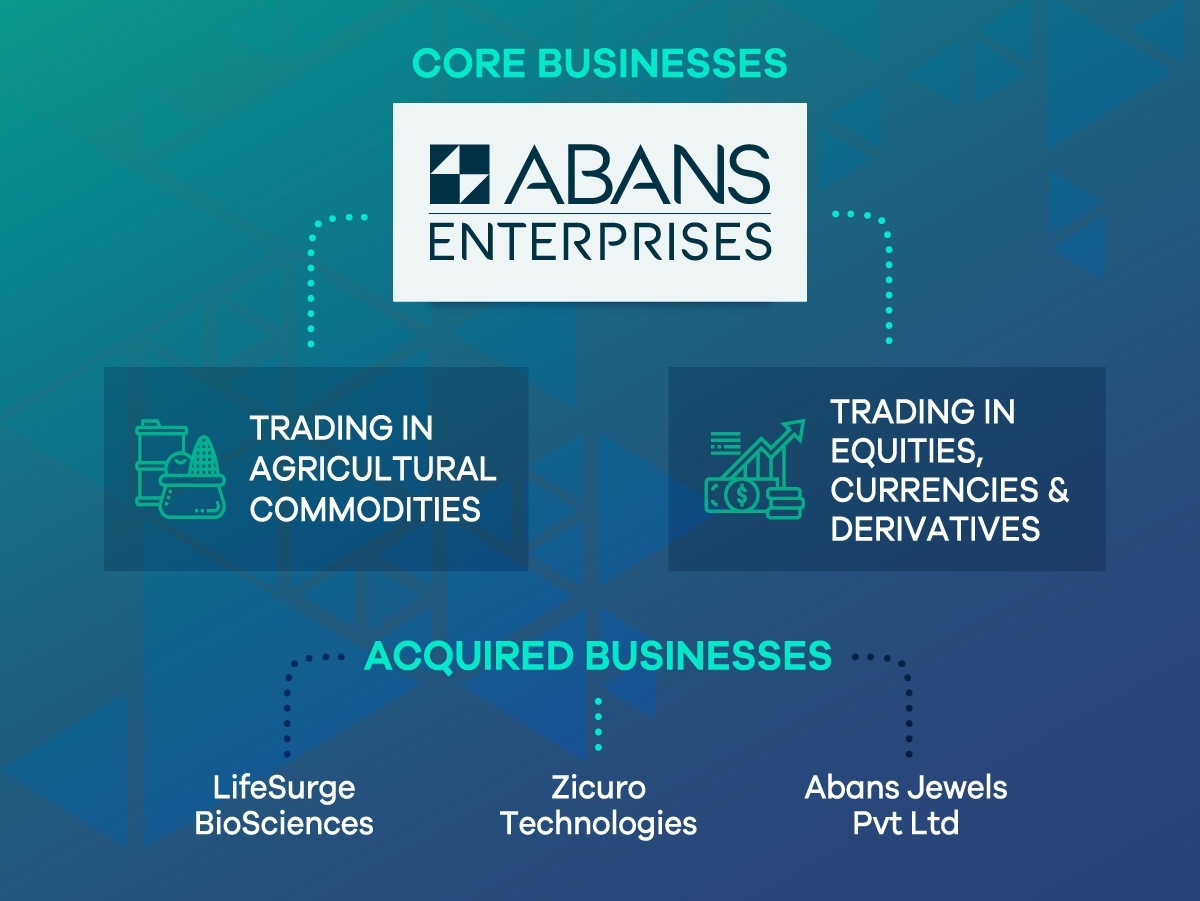
At its heart, ABans is a middleman on steroids. They don’t make the gold; they move it. They don’t grow the coriander; they trade it. The business model is split into three main buckets:
- Commodity Trading: This is the elephant in the room. They trade agri-commodities (Jeera, Chana, Castor seeds) and non-agri commodities (Bullion, Aluminium, Lead) on both exchanges and spot markets.
- Financial Trading: They are active in the stock market, dealing in equities, derivatives, F&O, and currencies.
- Manufacturing: A small slice of the pie involves actual manufacturing, though trading remains the undisputed king of their revenue.
The business is essentially a play on market volatility and spreads. They make money when there is movement. However, the latest figures suggest that while the movement was massive, the spreads were working against them. When your revenue is ₹13,813 crore (TTM) and your profit is just ₹3.96 crore, you are essentially running a multi-billion dollar charity for the benefit of the exchanges and your suppliers.
A smart investor would ask: if you are moving ₹6,500 crore worth of goods in a quarter and can’t keep even ₹10 crore as profit, what happens when the market turns even slightly? This is a business where you are picking up pennies in front of a steamroller.
4. Financials Overview
The numbers for the quarter ended March 2026 tell a story of “Profitless Prosperity.” The company is doing more work than ever for less reward than ever.
Quarterly Performance Comparison (Consolidated)
| Particulars (₹ Cr) | Q4 FY26 (Latest) | Q4 FY25 (YoY) | Q3 FY26 (QoQ) |
| Revenue | 6,510.40 | 1,973.88 | 3,456.52 |
| EBITDA | -1.90 | -8.82 | -20.30 |
| PAT | -7.95 | 4.28 | 2.36 |
| EPS (Annualized) | -4.56* | 1.71 | 1.36 |
Note: Annualized EPS calculated as Q4 actual (no annualization for final quarter) vs previous quarters’ performance.
The Stock P/E is currently quoted at 54.6, but that is a trailing number that will likely look much worse once this loss-making quarter is fully digested by the market. The management previously talked about “synergies” and “growth,” yet the operating profit has been negative for the last two quarters. They “walked the talk” right into an operating loss.
5. Valuation Discussion – Fair Value Range
Valuing a company like ABans is like trying to value a casino based on the total amount of bets placed rather than the house’s winnings. Standard metrics often fail because the margins are so minuscule.
1. P/E Method
The current P/E of 54.6 is nearly double the industry average of 28.0. For a company with falling profits and negative margins, this is an expensive neighborhood.
- Calculation: TTM EPS of ₹0.57 × Industry P/E of 28 = ₹15.96.
2. EV/EBITDA Method
With an Enterprise Value (EV) of ₹350 Cr and a TTM EBITDA that is essentially flickering between positive and negative, this method yields high volatility. Using the FY25 EBITDA of approx ₹23 Cr:
- Calculation: 10x EBITDA = ₹230 Cr / 6.78 Cr shares = ₹33.92.
3. DCF (Discounted Cash Flow)
Given the unpredictable nature of commodity trading spreads, a DCF is speculative. If we assume a conservative 5% terminal growth and a high discount rate (due to the risk), the value leans toward the book value.
- Book Value: ₹31.0.
Fair Value Range: ₹16.00 – ₹34.00
Disclaimer: This fair value range is for educational purposes only and is not investment advice.
6. What’s Cooking – News, Triggers, Drama
The drama at ABans is mostly in the boardroom and the legal chambers.
First, the Merger U-Turn. On February 5, 2026, the board decided to withdraw the amalgamation scheme with Abans Jewels Limited. They claimed the benefits were “not sufficiently demonstrable.” Translation: It was probably more trouble than it was worth, or the auditors raised too many eyebrows.
Second, the KMP Musical Chairs. We have a new CFO, Ankit Joshi, who was also recently appointed as an Additional Whole-Time Director. The registered office was also shifted to Nariman Point. New office, new bosses, same old negative margins.
Third, the Related Party Transactions. The postal ballot in March 2026 saw the approval of multiple “material related-party transactions.” In a company where the promoter holds 74.56%, keeping an eye on where the money flows—and to which sister concern—is priority number one.
How do you feel about a company that moves billions in goods but changes its top management every few months?
7. Balance Sheet
The balance sheet has shrunk slightly as the company presumably cleared some positions or adjusted its trading book.
| Particulars (₹ Cr) | Mar 2026 (Consol) | Mar 2025 (Consol) | Mar 2024 (Consol) |
| Total Assets | 392 | 490 | 445 |
| Net Worth | 216 | 216 | 175 |
| Borrowings | 157 | 252 | 155 |
| Other Liabilities | 19 | 22 | 115 |
| Total Liabilities | 392 | 490 | 445 |
- Borrowings dropped from ₹252 Cr to ₹157 Cr. Apparently, paying back debt is more fun than making a profit.
- The Net Worth is stagnant at ₹216 Cr. When you don’t make money, your equity stays in the basement.
- The Debt-to-Equity ratio sits at 0.72. Not alarming, but not “debt-free” either.
8. Cash Flow – Sab Number Game Hai
Cash flow is the only truth in a world of accounting estimates. For ABans, the cash flow statement is a wild ride.
| Particulars (₹ Cr) | Mar 2026 | Mar 2025 | Mar 2024 |
| Operating Cash Flow (CFO) | 161 | -193 | -25 |
| Investing Cash Flow (CFI) | -37 | 184 | 27 |
| Financing Cash Flow (CFF) | -120 | 14 | 11 |
The company managed to generate ₹161 Cr in operating cash flow this year, primarily by liquidating inventory (₹200 Cr change). This cash was immediately used to pay down borrowings (₹120 Cr outflow in financing). They aren’t growing the business with this cash; they are just cleaning up the mess from previous years.
9. Ratios – Sexy or Stressy?
The ratios are definitely in the “stressy” category.
| Ratio | Value | Commentary |
| ROE | 1.87% | Your savings account probably works harder than this. |
| ROCE | 4.98% | Barely covers the cost of inflation. |
| Debt to Equity | 0.72 | The only thing that looks “normal” here. |
| PAT Margin | 0.03% | One wrong trade away from a disaster. |
| Interest Coverage | 1.68 | Dangerously low. One bad quarter and they can’t pay the bank. |
The Return on Equity (ROE) of 1.87% is an insult to the capital deployed. Why bother with the risk of global commodity markets for a return that is lower than a fixed deposit?
10. P&L Breakdown – Show Me the Money
Let’s look at the three-year trend to see if there is any method to the madness.
| Particulars (₹ Cr) | Mar 2026 | Mar 2025 | Mar 2024 |
| Revenue | 13,813 | 3,850 | 1,771 |
| EBITDA | -5 | 23 | 30 |
| Net Profit | 4 | 19 | 10 |
The revenue has exploded by nearly 8x in two years, yet the EBITDA has gone from ₹30 Cr to negative ₹5 Cr. This is a classic “Scale at any Cost” model, except the “cost” is the actual survival of the company’s margins. It’s like a restaurant serving 10,000 people a day but losing ₹1 on every thali.
11. Peer Comparison
How does ABans stack up against the other players in the “moving things around” business?
| Company | P/E | Market Cap (₹ Cr) | Sales Qtr (₹ Cr) | Net Profit Qtr (₹ Cr) |
| Lloyds Enterprises | 38.1 | 1,090 | 719 | 68.5 |
| SG Mart | 68.1 | 7,567 | 1,822 | 41.4 |
| ABans Enterprise | 54.6 | 216 | 6,510 | -7.9 |
ABans has the highest quarterly sales in this group (₹6,510 Cr) but is the only one reporting a loss. Lloyds Enterprises is doing a fraction of the sales but making a massive profit. ABans is essentially the high-volume, low-iq cousin in this family of stocks.
12. Miscellaneous – Shareholding and Promoters
The shareholding pattern is as concentrated as a shot of espresso.
- Promoters: 74.56% (Abhishek Bansal).
- FIIs: 20.30% (Up from 9.8% a year ago).
- Public: 5.14%.
Promoter Roast: Abhishek Bansal holds almost the entire company. He recently resigned as CMD, perhaps to focus on the broader “Abans Group” or maybe because being the captain of a ship with 0.03% margins is exhausting. The FIIs (like Astute Investment Management) have been buying in, which is the only reason the stock price hasn’t hit the floor. Why FIIs are attracted to a company with negative operating margins is a mystery that only they can solve.
13. Corporate Governance – Angels or Devils?
The governance signals are mixed. On one hand, the auditors (CLASS & CO. LLP) gave an unmodified opinion. On the other hand, the withdrawal of the merger and the constant shuffling of KMPs (Chief Financial Officers and Company Secretaries) create an environment of instability.
The company also passed several resolutions for Material Related Party Transactions. When the promoter is the primary owner and the company is trading commodities, the risk of “transfer pricing” or moving profits to other group entities is a constant shadow.
The board recently appointed Ankit Joshi as an Additional Whole-Time Director for three years. He’s now the CFO and a Director. That’s a lot of hats for one person to wear.
14. Industry Roast and Macro Context
The metals and minerals trading industry is essentially a game of “who can survive on the lowest margins.” It’s a sector where being “big” is a disadvantage because you carry more risk.
Global commodity prices have been volatile, and in a high-interest-rate environment, carrying large amounts of inventory or debt is a recipe for a headache. The entire sector is being disrupted by digital exchanges and direct-to-consumer models, leaving traditional trading houses like ABans scrambling for whatever crumbs of margin are left.
Macro-wise, the bullion market is the only thing keeping these companies relevant. But if you can’t make money when gold is hitting all-time highs, when will you make money?
15. EduInvesting Verdict
ABans Enterprises is a company that proves Revenue is a Vanity Metric. You can sell 13,000 crores worth of goods, but if you only keep 4 crores, you are essentially a pass-through entity.
SWOT Analysis:
- Strengths: Massive scale and presence in diversified commodity segments.
- Weaknesses: Pathologically low margins; frequent management changes; negative operating profit in recent quarters.
- Opportunities: Potential for margin expansion if they move from “trading” to “value-added services” (though there’s no sign of that yet).
- Threats: Commodity price crashes; regulatory changes in derivative trading; high reliance on promoter-led group dynamics.
The company has successfully reduced its debt, which is a positive sign of financial discipline. However, the withdrawal of the merger and the swing into quarterly losses suggests that the internal strategy is still in flux.
Is this a sleeping giant or just a very busy ant moving a giant leaf for no reward? Only the next few quarters of margin performance will tell. For now, the numbers are screaming louder than the management’s “synergy” claims.
Disclaimer: This analysis is for educational purposes only. Investing in stocks involves significant risk. Always consult with a qualified financial advisor before making any investment decisions. We do not provide buy, sell, or target price recommendations.