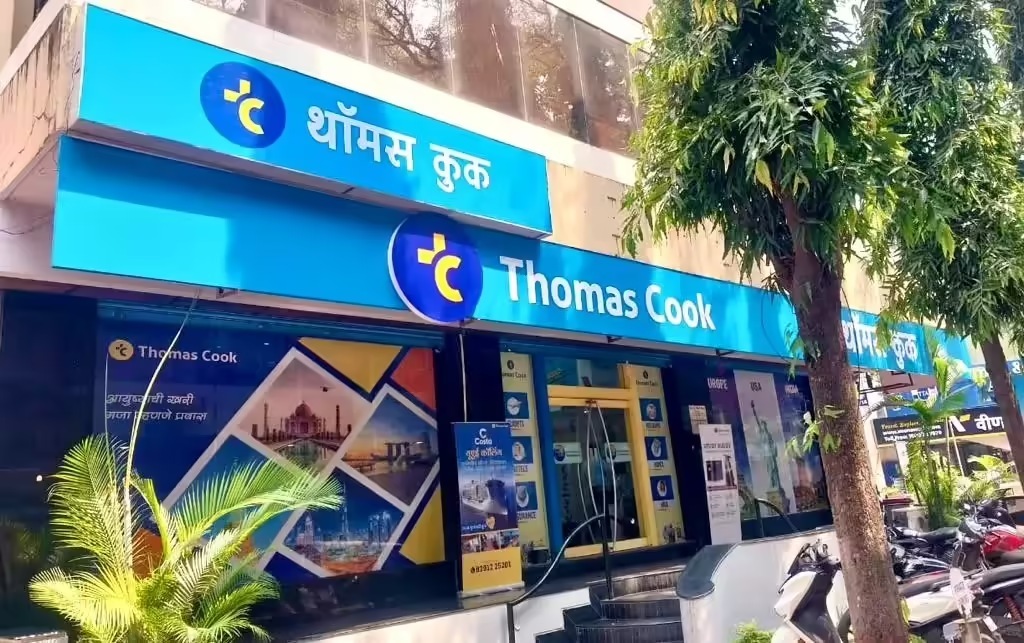
Thomas Cook (India) Limited (TCIL) isn’t just a travel company; it is a financial machinery disguised as a holiday planner. With a history stretching back to 1881, it has survived world wars, pandemics, and the digital revolution. Today, it stands as a multifaceted conglomerate under the Fairfax umbrella, operating across 28 countries. But the latest numbers tell a story of a business fighting “truncated” operating periods and massive geopolitical shifts. While the top line shows a modest 3.3% growth for the full year FY26, reaching ₹85,578 million, the cracks in the travel and digital imaging segments are hard to ignore.
The company is currently in the middle of a massive structural overhaul. It has announced a demerger of its hospitality powerhouse, Sterling Holiday Resorts, into a separate listed entity. Simultaneously, it’s consolidating its own equity through a 4:1 share consolidation and subsequent face value reduction. This isn’t just accounting gymnastics; it’s a desperate attempt to unlock “shareholder value” and improve an EPS that has been under pressure from global instability. When a company with over ₹2,300 crore in cash starts cleaning its balance sheet this aggressively, you know they are preparing for a much leaner, more volatile future.
1. At a Glance
Thomas Cook India is currently a paradox of massive liquidity and shrinking margins. The group reported a consolidated total income of ₹85,578 million for FY26, but the “good performance” narrative touted by management needs a forensic look. Operating profit (EBIT) for the full year fell by 10.9% to ₹4,276 million. The culprit? A brutal Q4 where net profit tanked by 53.5% year-on-year.
The primary engine, Travel & Related Services, which accounts for roughly 80% of the pie, is facing a identity crisis. While domestic and short-haul travel (like Vietnam and Japan) are booming, the high-value long-haul business is being throttled by a depreciating Rupee and sluggish European demand. Even more concerning is the Digital Imaging Solutions (DEI) segment, which saw its EBIT collapse by nearly 60% for the full year. Management blames the Middle East conflict for suspending UAE operations, but when 50% of your revenue comes from one volatile region, “geopolitical risk” is an understatement—it’s a structural vulnerability.
Investors are currently mesmerized by the company’s “unassailable moat” in Forex and the impending Sterling demerger. However, the core travel business is operating on razor-thin margins. The consolidated OPM (Operating Profit Margin) has slipped to 5% from 6% a year ago. The company is leaning heavily on “Other Income”—largely interest on the massive Forex float—to keep the bottom line respectable.
The red flags are flying in plain sight:
- Segment Concentration: DEI and Middle East DMS (Destination Management Services) are bleeding due to external shocks.
- Margin Compression: Despite “cost-saving” measures, employee benefits and other expenses are rising faster than revenue.
- Geopolitical Fragility: Management admits the sales period was effectively truncated from 12 months to less than 9 months due to disruptions.
How long can a “Forex moat” carry a struggling global travel network?
2. Introduction
Thomas Cook (India) Ltd is the quintessential “old money” of the Indian travel sector. Majority-owned by Prem Watsa’s Fairfax Financial Holdings, the company has transformed from a simple travel agent into an integrated travel and financial services giant. It holds a rare Authorized Dealer Category II license from the RBI, allowing it to dominate the non-bank forex market.
The group’s portfolio is a sprawling map of acquisitions: SOTC, Sterling Holidays, DEI, and various international DMCs. This diversification was supposed to provide “resilience,” yet the FY26 results show that when global airspaces close and currencies fluctuate, even a massive footprint can become a liability.
The current fiscal year has been a test of management’s agility. They have pivoted toward “asset-light” expansion in the resort business and “AI-led” efficiency in travel. But the real story is the restructuring. By demerging Sterling, TCIL is essentially cutting off its fastest-growing, debt-free limb to let it run on its own. For the parent company, this leaves a core travel and forex business that must now prove it can generate superior returns without the hospitality cushion.
3. Business Model – WTF Do They Even Do?
Think of Thomas Cook as a financial broker that also happens to book your flight. They operate through four primary engines:
- Financial Services (Forex): This is the crown jewel. They sell currency, load prepaid cards, and handle remittances. It’s a high-float, low-capex business where they earn on the “spread” and the interest on the money you haven’t spent yet. They have over 200,000 active cards with a float exceeding ₹1,500 crore.
- Travel & Related Services: This is the high-volume, low-margin grind. It includes B2B services (MICE – Meetings, Incentives, Conferences, Events) and B2C (Leisure Holidays). They handle everything from corporate flight bookings to group tours to Europe.
- Leisure Hospitality (Sterling): They own or manage 78 resorts. This is a classic “rooms and F&B” business that has finally turned consistently profitable after years of struggle.
- Digital Imaging (DEI): They are the people who take your photo at the top of the Burj Khalifa or at a theme park and sell it back to you at a premium. It’s a high-margin souvenir business that is currently getting hammered by the Middle East crisis.
The business model is essentially an attempt to capture every rupee a traveler spends—from the moment they buy currency to the photo they take at the destination, to the resort they sleep in.
4. Financials Overview
The latest results show a significant disconnect between “sales” and “margins.” While people are traveling, the cost of moving them is skyrocketing.
| Metric (Consolidated) | Latest Qtr (Mar ’26) | Same Qtr LY (Mar ’25) | YoY Var (%) | Prev Qtr (Dec ’25) | QoQ Var (%) |
| Revenue | ₹1,771 Cr | ₹1,969 Cr | -10.1% | ₹2,146 Cr | -17.5% |
| EBITDA | ₹78 Cr | ₹98 Cr | -20.4% | ₹114 Cr | -31.6% |
| PAT | ₹31 Cr | ₹51 Cr | -39.2% | ₹45 Cr | -31.1% |
| EPS (Annualised) | ₹3.28 | ₹5.56 | -41.0% | ₹3.56 | -7.9% |
Note: EPS for Mar ’26 is the full-year reported figure as per strict annualisation rules.
Management “Walk the Talk” Analysis:
In previous concalls, management promised that structural cost reductions would protect margins. However, in Q4 FY26, the OPM dropped to 4%. While they cite “geopolitical disruptions” and “airspace issues,” the rising employee benefit expenses (up 12% YoY) suggest that the “lean” model is getting heavier. The “Forex moat” is holding, but the Travel EBIT collapsed by 59% in the latest quarter. Management’s reliance on “Other Income” (₹154 Cr for the year) is now a critical pillar of their profitability rather than just a bonus.
Does a “one-stop shop” model actually provide synergy, or does it just mean you have four different ways to lose money when a crisis hits?
5. Valuation Discussion – Fair Value Range
To determine where Thomas Cook stands, we look at the numbers without the rose-tinted glasses of “legacy.”
1. P/E Method:
The current TTM EPS is ₹4.65. The industry PE for leisure services is roughly 43x. However, TCIL’s historical PE has been lower due to its complex structure.
- Calculation: $4.65 \times 20$ (Conservative PE) = ₹93
- Calculation: $4.65 \times 25$ (Optimistic PE) = ₹116
2. EV/EBITDA Method:
Current EBITDA is approximately ₹587 Cr. With an Enterprise Value (EV) of ₹3,795 Cr, the EV/EBITDA stands at 6.46x. For a service company, this is relatively low, reflecting the market’s skepticism about the travel segment’s growth.
- Target EV at 8x EBITDA = ₹4,696 Cr
- Adjusted for Net Cash (~₹780 Cr), Fair Value = ₹110 – ₹120 per share.
3. DCF Method (Discounted Cash Flow):
Given the erratic cash flows (CFO dropped in FY26 compared to FY25), we assume a 5% terminal growth rate and a 12% discount rate.
- Estimated Fair Value: ₹85 – ₹105.
Fair Value Range: ₹88 – ₹115
This fair value range is for educational purposes only and is not investment advice.
6. What’s Cooking – News, Triggers, Drama
The biggest “drama” is the Demerger and Restructuring. TCIL is essentially doing a “split and shrink.”
- The Swap: For every 1 share of TCIL, you get 0.81 shares of Sterling Holiday Resorts (SHRL).
- The Shrink: They are consolidating shares 4:1. If you had 400 shares at ₹1, you’ll end up with 100 shares at ₹4. Then, they are reducing the face value to ₹3.
- The Reason: They claim this will “optimize the balance sheet.” In plain English, it’s an attempt to boost the EPS figure and make the stock look “higher quality” to institutional investors who hate “penny-stock” optics.
On the business front, they’ve partnered with Blinkit to deliver Forex cards in 12 cities. Imagine ordering a pizza and 1,000 Euros at the same time. It’s a bold move to capture the “last-minute traveler,” but whether it moves the needle on a ₹8,000 crore revenue base remains to be seen.
7. Balance Sheet
TCIL is sitting on a mountain of cash, but the “Total Assets” figure is bloated by the nature of the Forex business.
| Row (Consolidated) | Mar 2026 (₹ Cr) | Mar 2025 (₹ Cr) | Mar 2024 (₹ Cr) |
| Total Assets | 7,899 | 7,028 | 6,364 |
| Net Worth | 2,546 | 2,260 | 2,057 |
| Borrowings | 539 | 465 | 418 |
| Other Liabilities | 4,813 | 4,303 | 3,889 |
| Total Liabilities | 7,899 | 7,028 | 6,364 |
- Cash is King, but it’s borrowed: A huge chunk of the liabilities is “Other Liabilities,” which includes the customer money sitting in Forex cards.
- Debt is creeping up: Borrowings rose from ₹418 Cr to ₹539 Cr in two years. For a “cash-rich” company, this is an odd trajectory.
- Equity Growth: Reserves are growing steadily, which is the only thing keeping the auditors from reaching for the antacids.
8. Cash Flow – Sab Number Game Hai
The cash flow statement is where the “real” Thomas Cook lives.
| Particulars (₹ Cr) | FY26 | FY25 | FY24 |
| Operating Cash Flow (CFO) | 643 | 717 | 829 |
| Investing Cash Flow (CFI) | -408 | -325 | -437 |
| Financing Cash Flow (CFF) | -189 | -183 | -291 |
Where is the money? The company generated ₹643 Cr from operations, but notice the trend: it has been declining every year for the last three years.
Where did it go? They spent ₹126 Cr on fixed assets and another ₹151 Cr on “investments.”
Where did it come from? Mostly from customer advances (Working Capital changes added ₹183 Cr). The company is essentially running on the “float”—using the cash travelers give them today for trips they will take tomorrow.
If CFO is dropping while revenue is “growing,” is the company getting more efficient or just better at hiding its struggles?
9. Ratios – Sexy or Stressy?
| Ratio | Mar 2026 | Mar 2025 | Witty Judgement |
| ROE | 9.27% | 11.5% | Lower than a FD in some years; not exactly a wealth compounder. |
| ROCE | 14.8% | 19.0% | Dropping faster than a tourist’s interest in a rainy destination. |
| Debt to Equity | 0.21 | 0.21 | At least they aren’t drowning in debt… yet. |
| PAT Margin | 2.62% | 3.18% | Razor-thin. One wrong airfare hike and the profit disappears. |
| P/E Ratio | 19.5 | 16.7 | Getting “expensive” for a company with falling profits. |
10. P&L Breakdown – Show Me the Money
| Year | Revenue (₹ Cr) | EBITDA (₹ Cr) | PAT (₹ Cr) |
| Mar 2024 | 7,299 | 437 | 271 |
| Mar 2025 | 8,140 | 478 | 258 |
| Mar 2026 | 8,398 | 428 | 223 |
The Stand-Up Comedy Take:
Look at that revenue growth—up ₹1,100 crore in two years! Now look at the PAT—down ₹48 crore. It’s like a restaurant that opens ten new branches, doubles its customers, but somehow manages to make less money because they started giving away free napkins. Management is running faster and faster just to stay in the same place.
11. Peer Comparison
| Company | Revenue (Qtr ₹ Cr) | PAT (Qtr ₹ Cr) | P/E |
| IRCTC | 1,449 | 394 | 31.2 |
| BLS International | 736 | 170 | 16.6 |
| Thomas Cook (I) | 1,771 | 31 | 19.5 |
| Easy Trip Planners | 152 | 3 | 114.3 |
Sarcastic Notes: * IRCTC: The undisputed king. They have a monopoly and margins that make TCIL look like a charity.
- BLS International: Making nearly 6x the profit of Thomas Cook on less than half the revenue. Efficiency, anyone?
- Thomas Cook: The “Grandpa” of the group. Lots of stories, lots of luggage, but very little cash left in the wallet at the end of the day.
12. Miscellaneous – Shareholding and Promoters
- Promoters: 63.83% (Fairbridge Capital Mauritius – Fairfax). They’ve been steady, but let’s be real, they’ve also been selling off bits (like the Quess demerger) over the years.
- FIIs: 7.56% (Rising significantly from 1.83% in 2023. Someone likes the story).
- DIIs: 6.54% (Decreasing slightly. Domestic funds are getting shy).
- Public: 21.01%.
Promoter Roast: Fairbridge Capital has been “restructuring” this company since 2012. It’s like a home renovation that never ends. Every time you think it’s finished, they decide to move the kitchen (demerge Sterling) or change the floorboards (share consolidation). They are masters of the “corporate action,” but can they actually make the travel business profitable?
13. Corporate Governance – Angels or Devils?
TCIL’s governance is generally viewed as high-standard, given the Fairfax backing. However, the recent tax litigations (a ₹134 crore demand resolved recently) and GST disputes are a reminder that a global footprint comes with a massive legal headache.
The auditor, BSR & Co. LLP, is a Big-4 affiliate, which adds credibility. But the sheer complexity of 63 subsidiaries, 4 associates, and 3 JVs is an auditor’s nightmare. When you have this many moving parts, “administrative costs” aren’t just a line item; they are a lifestyle. The merger of dormant subsidiaries like TCVSL and JTSL is a late but welcome sign that they are trying to kill the “zombie” entities.
14. Industry Roast and Macro Context
The travel industry is currently the “Golden Child” of the post-pandemic world, yet it’s a brutal place to make a buck. Airlines are raising prices, hotels are at capacity, and customers are switching from high-margin “Europe Tours” to “Short-Haul” trips like Vietnam because their wallets are feeling the pinch.
Thomas Cook is caught in the middle. They are betting on “Spirituality” (Ayodhya, Char Dham) and “Senior Travel” (GenS). It’s a smart pivot, but let’s face it: the industry is one geopolitical tweet away from a shutdown. The Middle East conflict isn’t just a “headwind”; it’s a structural threat to the DEI and DMS segments.
Why book a long-haul flight when the Rupee is weaker than a wet paper towel and the destination might be in a “travel advisory” zone by next Tuesday?
15. EduInvesting Verdict
Thomas Cook India is a company in transition. It is shedding its “weight” (Sterling) to become a pure-play travel and forex powerhouse. The past performance shows a resilient top line but a struggling bottom line. The headwinds—geopolitics and currency volatility—are real and persistent.
SWOT Analysis:
- Strengths: Massive cash float, dominant Forex market share, Fairfax backing.
- Weaknesses: Thin margins in core travel, high sensitivity to external shocks.
- Opportunities: Sterling demerger value unlocking, spiritual tourism boom.
- Threats: Prolonged Middle East crisis, digital disruption from leaner OTA (Online Travel Agency) players.
The company’s history is one of survival, and they will likely survive this too. But for the general public, the question isn’t whether they will survive, but whether they can ever turn a ₹8,000 crore revenue into meaningful, sustained profit without needing a “restructuring” every few years.
Do you think demerging the most profitable part of the business (Sterling) is a genius move for focus, or a desperate move to hide the core business’s struggles?
This fair value range is for educational purposes only and is not investment advice.