Powerica Ltd Q4 FY26: ₹801 Cr Revenue, Wind Margins Doing the Heavy Lifting
General information and entertainment, not investment advice. The author is not a SEBI-registered adviser or research analyst. No recommendation, no promised returns. Markets carry risk including loss of capital. Figures may not be current. Consult a registered adviser before acting.
1. At a Glance
Powerica marked its first full year post-IPO with a milestone: ₹3,012 Cr revenue, the first time past ₹3,000 Cr. Yet the story is split.
The generator business (83% of sales, ₹2,502 Cr) grew 10.9% year-on-year but operated at 9.1% EBITDA margins — steady but not exciting. The real margin hero is wind: ₹512 Cr revenue (+28.6% YoY) at 31.3% EBITDA margins. Without wind, the company is a mid-teen margin generator OEM. With wind, it’s a diversified renewable play scaling fast.
Debt dropped ₹525 Cr post-IPO, and interest cost is set to fall sharply in Q1 FY27 as the benefit flows through the P&L. Net profit for FY26 was ₹277 Cr, +61% YoY—but that includes a one-time ₹51 Cr deferred tax credit from the new budget regime. Strip that out and underlying earnings growth is meatier but less explosive.
The tension: A company learning to live at ₹3,000+ Cr, but margins compressed by geopolitical noise in Q4. Will the wind business justify a premium multiple, or does the bond-like nature of DG backup power limit upside?
2. Introduction
Powerica is old money masquerading as new. Founded in 1984, listed only in April 2026, it has spent 40+ years married to Cummins engines and the bread-and-butter job of keeping factories, data centers, and hospitals alive when the grid fails. The generator business is the steady heartbeat.
In the last five years, management has done something less obvious: it built a wind power arm. Today, Powerica operates 330.85 MW of wind in Gujarat, supplies balance-of-plant for another 435 MW under construction, and dreams of scale. It also owns a slice of Platino Automotive, a retrofit-emission-control retrofit play chasing India’s tightening CPCB standards.
The IPO raised ₹1,100 Cr in April, with ₹700 Cr as primary and ₹400 Cr as an offer for sale by the Oberoi family. Post-listing, the company immediately paid down ₹525 Cr of debt, leaving ₹558 Cr in net borrowings (down from ₹789 Cr at FY25 end). The cash pile now sits near ₹961 Cr—a war chest.
The market is watching: at ₹467 per share (as of June 10, 2026), Powerica trades at 22x FY26 earnings. For context, the heavy electrical equipment peer band sits at 35x (median), meaning Powerica is priced like a steady grower, not a turbo. Whether that holds depends on whether wind margins hold and DG demand stays robust through geopolitical headwinds.
3. Business Model: WTF Do They Even Do?
Powerica sells backup power solutions. More precisely, it sells three things.
Diesel Generator Sets (DG Sets): The bread and butter. Powered by Cummins engines (7.5 kVA to 3,750 kVA), these are industrial-grade gensets sold to hospitals, data centers, factories, construction sites, and farms. The business is standardized, fast-moving (24 hours to 12 months lead time), and has customers everywhere. Margins are thin (9.1% EBITDA in FY26) because the market is commoditized and Powerica competes on brand, delivery reliability, and the Cummins franchise. Data centers are the new growth obsession—they contributed ~12% of DG revenue in FY26, and the order book is reported as “9 months to a year.” That’s code for: strong visibility.
Medium Speed Large Generators (MSLG): The exotic sibling. These are 3 MW to 10 MW units built in association with Hyundai, used for continuous-process industries (cement, steel, nuclear plants, refineries). Orders take 2–4 years to deliver. FY26 saw ₹126 Cr revenue (5% of generator sales). Current live projects include a 63 MW nuclear power plant deal for NPCIL and a 10 MW emergency genset for an Australian fertilizer plant. MSLG is a margin creator if you don’t mind the gestation and lumpy earnings.
Wind Power: The high-margin, lumpy, seasonal business. Powerica owns and operates 330.85 MW of wind (in Gujarat) backed by 25-year power purchase agreements with state utilities (GUVNL) and the central entity (SECI). These are fixed-tariff contracts (₹2.4–₹4.19 per kWh), so they’re bond-like: visible, stable, not volatile. The IPP (independent power producer) business generated 31.3% EBITDA in FY26 and contributed ₹402 Cr in revenue. Powerica also builds balance-of-plant (BoP) infrastructure for third-party wind projects—both roles (IPP owner and EPC executor) are expanding in parallel.
The company also dabbles in allied businesses (EMI shelters, Schneider Electric PRISMA panels, military-grade gensets) and owns 50% of Platino Automotive, which makes retrofit emission-control devices to help old DG sets pass newer CPCB4 emissions norms. Platino revenue was ₹95 Cr in FY26 (associate company).
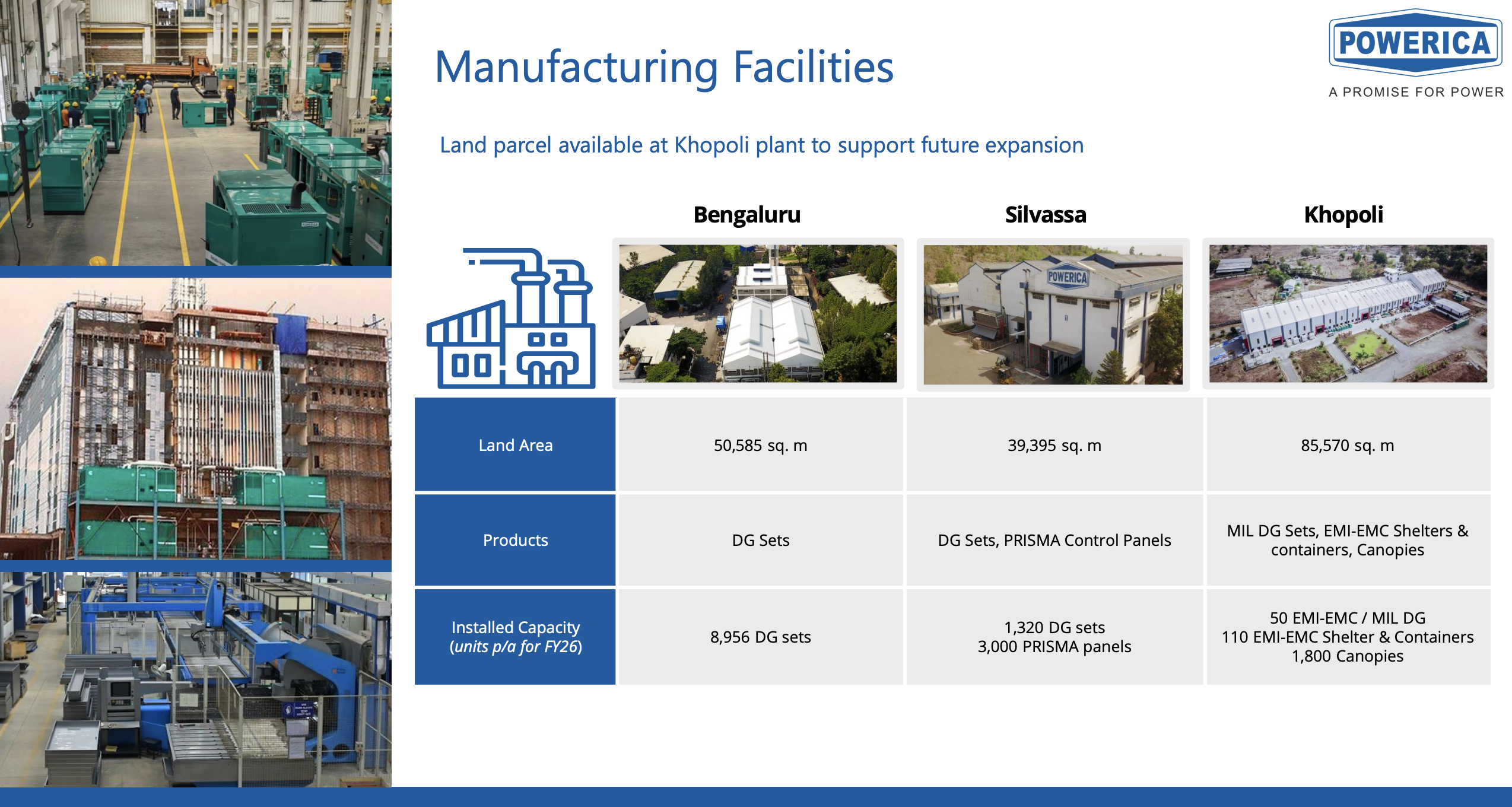
The manufacturing base spans three plants: Bangalore (8,956 DG units/year capacity), Silvassa (1,320 DG units), and Khopoli (defense and specialty shelters). Except for engines and alternators, Powerica makes most components in-house—a vertical integration play that matters when supply chains wobble.
4. Financials Overview
Figures are consolidated, in ₹ crore. Result type: Quarterly; latest period: Q4 FY26 (Mar 2026).
Metric
Q4 FY26
Q4 FY25
YoY
FY26
FY25
YoY
Revenue
801
722
+10.9%
3,012
2,653
+13.5%
EBITDA
86
72
+20.2%
386
346
+11.8%
PAT
45
37
+20.4%
277
172
+61.0%
EPS
3.36
3.39
-0.9%
21.12
14.93
+41.5%
Quarterly commentary (Q4 FY26): Revenue grew 10.9% year-on-year to ₹801 Cr, with EBITDA margin of 10.8% (vs. 9.9% in Q4 FY25). PAT margin of 5.6% signals geopolitical headwinds weighed on profitability. Management attributed Q4’s margin softness to “geopolitical uncertainties, rising energy prices, and supply chain pressures.” Notably, EPS printed at ₹3.36 when annualized (₹3.36, not multiplied by 4, since Q4 is the final quarter of the fiscal year and full-year EPS is ₹21.12).
FY26 full-year commentary: Revenue crossed ₹3,000 Cr for the first time (+13.5% YoY). EBITDA margin of 12.8% was strong but compressed from FY25’s 13.0%. The 61% PAT growth is inflated by the ₹51 Cr deferred tax credit from the new tax regime adopted mid-year. Stripping that, underlying PAT was roughly ₹226 Cr, a more modest ~31% growth. Management framed the year as “the highest ever performance with sustained margin growth”—a half-truth on margins, a full truth on scale.
Segment performance (FY26):
Generator Set Business: ₹2,502 Cr revenue (+10.9% YoY), EBITDA margin 9.1%. Within this, Cummins-powered DG sets were ~66% of generator sales. MSLG contributed 5%, allied businesses 12.5%.
Wind Power Business: ₹512 Cr revenue (+28.6% YoY), EBITDA margin 31.3%. IPP (independent power producer) revenue was ~40% of wind, EPC and O&M ~60%. Wind seasonality means Q1 and Q2 are margin-heavy (wind generation stronger in