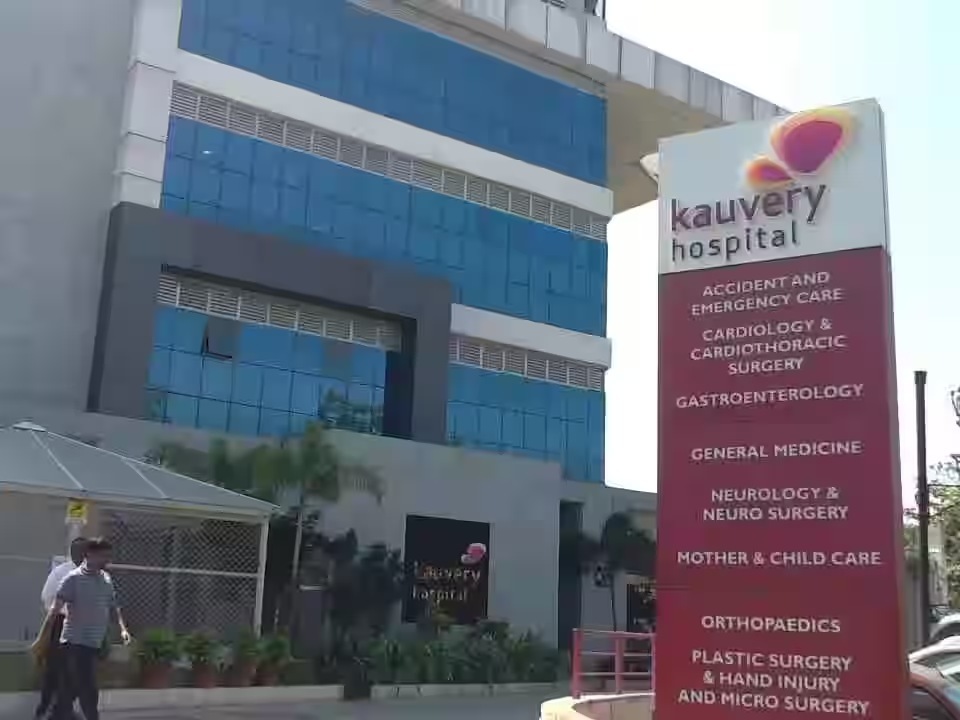
KMC Speciality Hospitals (India) Ltd, FY26: The New Facility Arrived. Now What?
General information and entertainment, not investment advice. The author is not a SEBI-registered adviser or research analyst. No recommendation, no promised returns. Markets carry risk including loss of capital. Figures may not be current. Consult a registered adviser before acting.
1. At a Glance
A 450-bedded Trichy hospital split two ways—one legacy, one brand-new. The new facility, Maa Kauvery, opened January 2024 with 200 beds and ₹71 Cr of debt on its neck. FY26 saw both units fire on almost all cylinders: revenue jumped 32% to ₹306 Cr; PAT doubled to ₹47 Cr. But look closer. The new facility is barely profitable, the old one’s earnings quality matters now more than ever, and the market trades this at 41× trailing earnings—above the peer median of 46×. (Price referenced: ₹117.55 as of 10 June 2026, lagged.)
The company broke even at occupancy. If mother-and-child care holds, ROCE could climb past 26% again. If it doesn’t, the debt overhang and the ceiling on scale in a 450-bed footprint become live concerns.
Question: A Trichy hospital owns 76% occupancy, high-margin specialties, and two decades of operating history. Does the new debt wipe that out, or is it a bridge into real scale?
2. Introduction
KMC belongs to the Kauvery group, a 25-year-old chain running 12 hospitals across Tamil Nadu and Bengaluru with 2,355 beds at end-December 2025. The parent, Sri Kauvery Medical Care (India) Limited, owns 75% of the listed subsidiary. Doctors S. Chandrakumar and S. Manivannan—who together with their families hold roughly 47% of the parent—have built the group via acquisitions and organic expansion.
The Trichy hospital traces to 2008, when the parent acquired it with 250 beds. Over a decade, it layered neuroscience, paediatrics, liver transplant programs, and bone marrow transplants. Then in January 2024, the company bolted a 200-bed mother-and-child care block onto the legacy building, using debt. FY26 was the first full financial year with both running.
India Ratings upgraded the bank loan facilities to IND AA- (Stable) in March 2026, citing strong execution and improved profitability at new hospitals. The rater expects net leverage to sit above 2.0x for a year or two as the capex works itself through, but not a crisis. The group’s target: 4,000+ beds by FY29, funded 70% debt.
In May 2026, the board approved a ₹62.5 Cr land purchase in Tiruchirapalli for a 300-bed expansion. The company is also eyeing Kerala and Andhra Pradesh. Ambition is clear. Execution so far has held.
3. Business Model: WTF Do They Even Do?
KMC is a speciality hospital anchored to two geographic clusters—Trichy and Bengaluru—with a portfolio of income streams. The Trichy bundle leans heavily into mother-and-child care (neonatology, obstetrics, paediatrics: 27% of FY26 revenue), neuroscience (17%), and gastro-sciences (12%). Oncology, orthopedics, critical care, and transplant programs fill the margin. Average revenue per occupied bed hit ₹32,838 in Q4 FY26, up from ₹30,586 in Q4 FY25. Average length of stay held steady at 5 days, typical for a tertiary care setup.
Sixty-nine percent of revenue is cash (walk-in patients and self-pay). Twenty-two percent is TPA and corporate tie-ups. Nine percent is government schemes. That cash skew is a strength—no insurance denials, no negotiation delays—but it also means occupancy and ARPOB matter more than billing clout.
Occupancy in Trichy rose to 76% in FY26 (from 68% a year prior). The new facility’s mother-and-child block achieved 82% occupancy by Q4 FY26 and drove revenue per patient up 13% year-on-year. The legacy building’s occupancy sat at 72%. The group’s broader Kauvery chain works at 62% occupancy across 12 hospitals; newer units take 12–15 months to turn EBITDA-positive, a threshold KMC’s new facility hit ahead of plan.
4. Financials Overview
Figures are consolidated, in ₹ crore.
Metric
Latest Q (Q4 FY26)
YoY
QoQ
Revenue
82.2
+35.0%
+1.1%
EBITDA
27.8
+71.4%
+7.4%
PAT
14.6
+223.5%
+6.6%
EPS (₹)
0.90
+225%
—
Full-year FY26 revenue reached ₹305.8 Cr, up 32% from ₹231.6 Cr in FY25. EBITDA margin expanded to 30.4% in Q4 FY26 from 26.3% a year prior, a 410 basis point jump driven by higher volumes and better absorption of the new facility’s depreciation and interest. PAT swung from ₹4.5 Cr (Q4 FY25, 7.3% margin) to ₹14.6 Cr (Q4 FY26, 17.4% margin)—a jump so steep it warrants parsing.
The concall commentary in the investor presentation flagged three drivers: (1) consolidation of ramp-up gains at the new facility; (2) improved volumes at the legacy hospital, with occupancy rising as the new facility proved the catchment depth; (3) tariff increases of 2–3% blended across procedures. Finance costs fell 12% YoY (₹2.3 Cr in Q4 FY25 to ₹2.0 Cr in Q4 FY26) because the new facility’s moratorium period on principal repayment—a two to three-year grace—is still in effect.
FY26 full-year EPS at annualised Q4 rate would be ₹3.60 (₹0.90 × 4). The full-year reported EPS for FY26 was ₹2.87. The gap signals Q4 outperformance.
5. Market Expectations & Historical Multiples
This section describes how the market is currently pricing the company and how that compares with its own history and peer group. It is descriptive, not predictive.
Metric
Current
Historical Average
Peer Median
P/E
41.0x
45.7x
45.8x
EV/EBITDA
20.9x
—
18.2x
ROE
24.9%
23.1% (5-yr)
13.2% (30-co. median)
ROCE
26.0%
21.8% (5-yr)
14.7% (30-co. median)
The market currently pays 41× earnings here, against a peer median of 46×. The current multiple sits below both the company’s 5-year average (45.7×) and the sector’s median (45.8×), suggesting the market is pricing in either faster earnings growth or some offset to the new facility’s near-term dilution. ROE of 24.9% and ROCE of 26% sit well above the peer median of 13.2% and 14.7% respectively, a gap that reflects the company’s marginal asset base and its ability to service debt quickly out of operating cash. EV/EBITDA at 20.9× is modestly above the sector’s 18.2×, pointing to the market’s confidence in EBITDA’s sustainability as debt is repaid.
The market appears to be pricing in steady occupancy (72–82%), stable tariff inflation (2–3%), and the new facility’s breakeven as a given within 12–15 months of opening—which it achieved.
6. What’s Cooking
Land Purchase for ₹62.5 Cr. Board approved a 1-acre parcel in Tiruchirapalli in May 2026 for a 300-bed expansion. This sits inside the group’s broader capex plan: ₹13,000 Cr to add 1,600 beds across FY26–FY29, funded 70% debt. The group expects cost per bed to land at ₹8.1 Cr. The Trichy parcel thus signals confidence in the catchment.
Credit Rating Upgrade to IND AA-. India Ratings upgraded the bank loan facilities from IND A+ to IND AA- (Stable) on 18 March 2026. The rater cited improved operational metrics at new hospitals and a turnaround in profitability faster than expected. The short-term rating stayed IND A1+. Rated facilities sit at