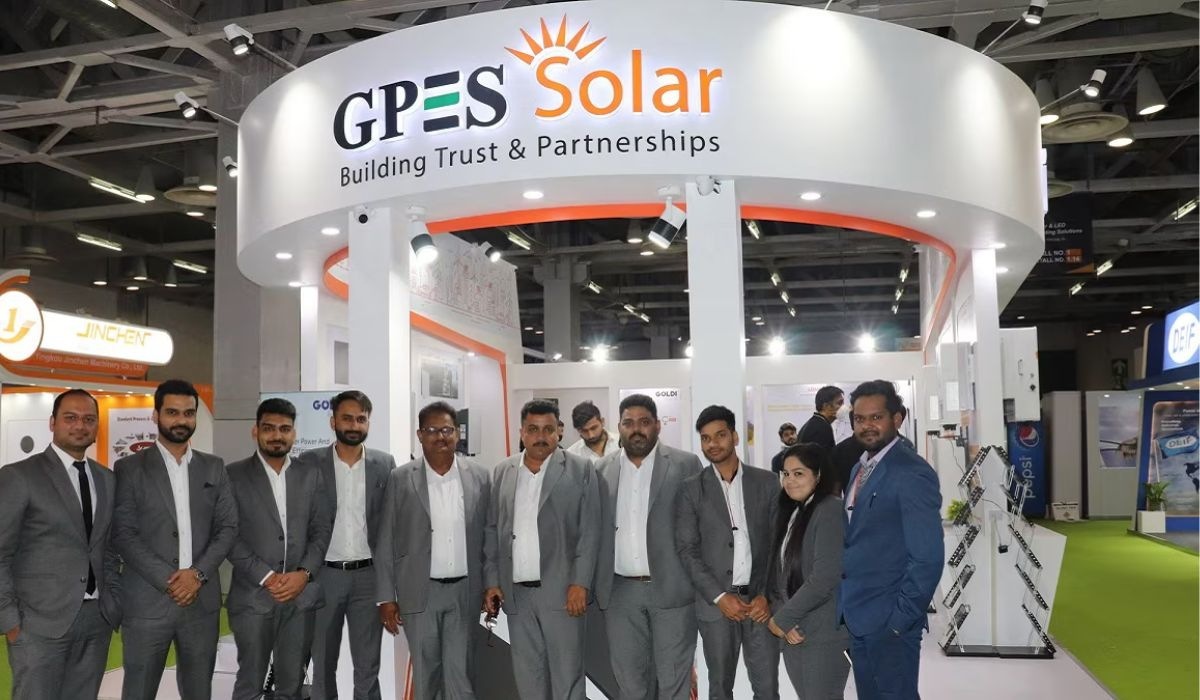
GP Eco Solutions India Ltd: FY26 Earnings—Distribution Still Driving, BESS Manufacturing Finally Real
General information and entertainment, not investment advice. The author is not a SEBI-registered adviser or research analyst. No recommendation, no promised returns. Markets carry risk including loss of capital. Figures may not be current. Consult a registered adviser before acting.
1. At a Glance
The numbers are pulled from data as of June 10, 2026; prices referenced are lagged.
GP Eco Solutions reported FY26 revenue of ₹414.38 Cr—growth of 68%—with PAT at ₹40.12 Cr, a 287% jump year-over-year. The company operates as a solar distribution-and-services outfit expanding into energy storage manufacturing.
Distribution (inverters, panels) remains the bulk of the model: lower margins, heavy working capital. EPC projects are picking up. The real story is the BESS manufacturing ramp at the subsidiary Invergy—500 MWh legacy base, 3 GWh facility targeted by Q2 FY27.
The tension: can the company execute the jump from distributor margins (10–15% operating) to manufacturing/tech play (17–18% target EBITDA margin)? The balance sheet has tripled debt in a year. Debtor days sit at 172.
2. Introduction
GP Eco Solutions was incorporated in 2010, bouncing between LED and solar. Since 2013, the company has chased EPC (solar project delivery). In 2021, it launched Invergy—the OEM arm. By FY26, it had gathered 1.18 Cr adjusted share count after bonus issues and private placements.
The listing came in 2024 on the NSE SME platform. Two promoters (Deepak and Anju Pandey) hold 61.9% as of Mar 2026. The leadership is salted with renewable energy veterans—Deepak carries 20+ years in the sector.
Recent moves (FY26–FY27): the company shifted tone. Management reframed itself as “transitioning from distribution-led to manufacturing and tech-driven.” The BESS factory at Dasna, UP, is in commissioning phase (targeted Jan–Feb FY26 entry into commercial production). The June 2026 announcement flagged a preferential issue—5.53 Lakh shares + 28.47 Lakh warrants at ₹364/unit—totalling ₹123.76 Cr to fuel capex.
Peer set spans Waaree Energies, Apar Industries, Premier Energies, Emmvee Photovoltaics, Waaree Renewables, and Diamond Power. Most sit in the 20–35x P/E band; GPESL trades at 13.6x.
3. Business Model: WTF Do They Even Do?
Distribution is the spine: solar inverters (Sungrow authorized distributor for North India), solar panels (Saatvik, LONGi authorized), allied equipment.
FY24 revenue mix: Sungrow inverters ~73%, Saatvik panels ~12%, Invergy hybrid inverters ~15%. Geography is clubbed—UP, Uttrakhand, Punjab, Delhi account for >80%. Small dealer and installer base; also direct-to-EPC contractors and institutional clients.
The EPC arm (GPES Green Projects, 51%-owned subsidiary) handles turnkey solar delivery. FY26 order book sits at ~120 MW under execution. Government contracts (KUSUM scheme) are layered in: 25+ MW across multiple projects. Gross margins on EPC are richer than distribution—30%+ vs. 15–20%—but execution is lumpy and capital-heavy.
Energy storage—the manufactured BESS—is the crescendo. Invergy produces residential and C&I inverter packs (1.5 kW to 80 kW), full BESS units (5 kWh to 5 MWh). Tech positioning is “AI/IoT-integrated smart energy” via Senergy (a SCADA/energy management platform) and Invergy Electric (LT/HT electrical panels).
The raw material is imported lithium-ion cells; management argues differentiation sits in “design, IP, and experienced manpower,” not factory setup. Margin claim: ~15% on BESS; upside from full automation and purchasing scale.
Scale claim: 500 MWh semi-automatic in Noida (historic); 3 GWh fully automated at Dasna (commissioning Q4 FY26–Q2 FY27). Target: 5 GWh by FY28. The company frames this as a play on India’s 236 GWh BESS target by 2031–32 and rising distributed renewable adoption.
Roast: the business is still 80%+ distribution with razor-thin competitive moat—anyone with a Sungrow franchise and cash can copy it. BESS manufacturing is unproven at scale. Debtor days at 172 mean working capital cycles are bloated; management cites custom terms and utility tender structures as the reason.
From the June 2026 concall transcript (reference): Management attributed the step-up to “strength of integrated model and execution excellence.” EBITDA margin expanded to ~14–15% in H2 FY26 on better product mix and scale. Tax rate normalized to ~21% (from 26% in FY25).
Profit grew faster than revenue due to (a) lower tax; (b) better operating leverage in distribution; (c) contribution from higher-margin EPC and early BESS traction. However, capex for the BESS factory (₹30–40 Cr) inflated depreciation and compressed free cash flow.
5. Market Expectations & Historical Multiples
This section describes how the market is currently pricing the company and how that compares with its own history and peer group. It is descriptive, not predictive.
Metric
Current
Historical Average (3 Yr)
Peer Median (58 Co)
P/E
13.6x
Data limited (new listing)
27.95x
EV/EBITDA
10.2x
Not comparable
21.28x
ROE
45.8%
39.5% (3 Yr)
18.73%
ROCE
38.3%
25% (FY25)
21.28%
The market currently pays 13.6x earnings here versus a peer median of 27.95x. The discount reflects execution risk on the BESS ramp and reliance on working capital-intensive distribution. ROE and ROCE are elevated—45.8% and 38.3%—but these are skewed by recent PAT growth and a shrinking equity base (capital deployment via warrants is pending, so tangible net worth remains tight relative to profits).
EV/EBITDA sits at 10.2x against a peer median of 21.28x. The multiple gap widens because the market assigns lower terminal margin expectations to a distributor-to-manufacturer transition. The peer set is already scaled manufacturers or established EPC players; GPESL is mid-journey.
6. What’s Cooking
BESS Giga Factory Ramp: Management targets 50 MWh supply in FY26 and 150–200 MWh in FY27 from the new 3 GWh facility. CapEx was ₹30–40 Cr. Commercial start was Jan–Feb 2026 per concall; actual commissioning will creep.
Oriana Power Orders: LOI dated Sep 24, 2025—5 MW / 10 MWh BESS supply + 500 MW Sungrow inverter deal. The BESS is a pilot; if performance validates by Dec 2025, a follow-on 20–30 MWh is “fixed.” This customer is the test case for utility-scale BESS adoption.
EPC Pipeline: 120 MW under execution. Management flagged ₹40–50 Cr handover in Dec 2025, with balance (Jan–Mar). KUSUM projects (₹60.5 Cr, 25 MW) are lumpy but contracted.