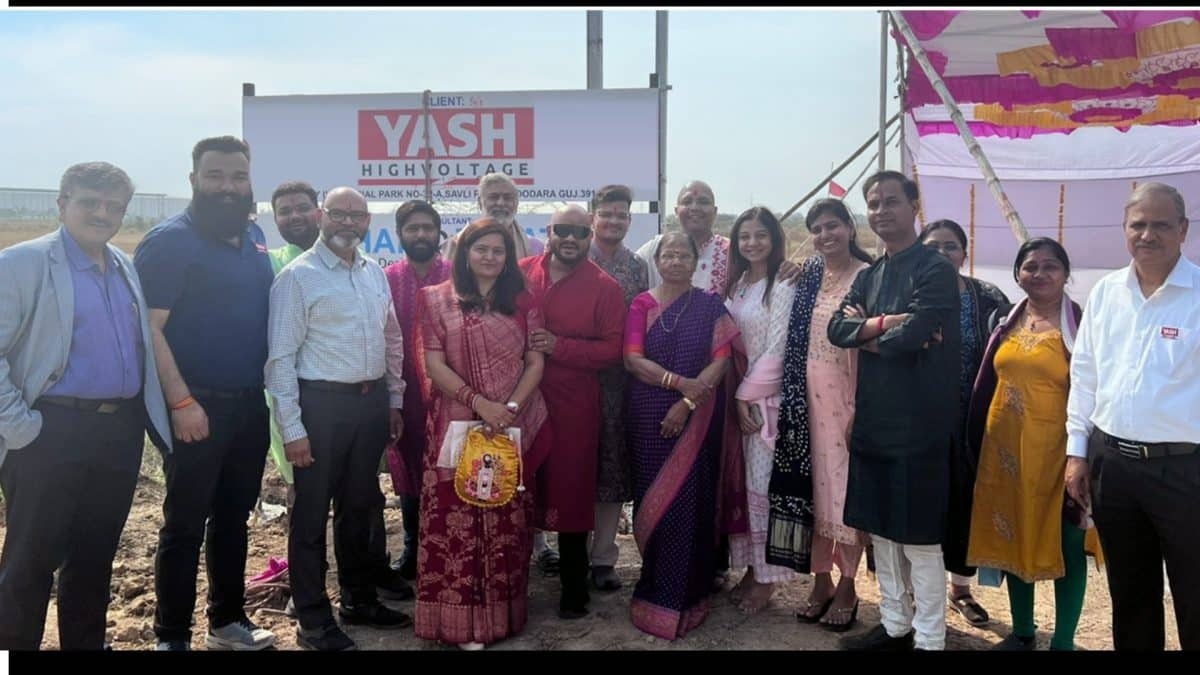
Yash Highvoltage Ltd H2 FY26: Operating Profit Scales 61% and Order Book Surges to ₹400 Crore to Drive High Voltage Transmission Expansion
1. At a Glance
The power engineering landscape is undergoing a massive structural transformation, and the corporate architecture of component specialists is shifting. With a market capitalization of ₹2,018 crore, Yash Highvoltage Ltd is capturing significant interest as a pure-play transmission and distribution component manufacturer.
The financial performance for the period ending March 31, 2026, reveals sharp operational growth metrics. Net sales reached ₹235.1 crore, marking a 57% year-on-year increase from ₹149.6 crore in the previous year. Operating profit climbed 75% to ₹60.4 crore, while net profit rose to ₹37.4 crore.
Behind this surface-level growth, severe concentration vulnerabilities persist. In the 2024 financial year, the top 10 customers accounted for approximately 80% of total revenue. This indicates a high level of counterparty dependence. A single contract termination or a delay in procurement by a major domestic transformer manufacturer could disrupt the company’s billing cycles.
Furthermore, the company recently experienced a cross-border cyber fraud incident involving an amount of ₹2.10 crore. This resulted in cash leakage via a compromised vendor communication channel. This highlight vulnerabilities in internal financial controls, balance sheet exposure to sudden operational shocks, and transaction verification frameworks.
Operational parameters are shifting as the company enters the final phase of its ₹153 crore greenfield facility execution in Vadodara, Gujarat. This structural expansion targets internal manufacturing of Resin Impregnated Paper (RIP) and Resin Impregnated Synthetic (RIS) cores. These components are currently imported from European suppliers.
The capital allocation strategy involves high execution risks, as commercial production is scheduled for the second half of the 2026–2027 financial year. The current order book has expanded to over ₹400 crore. This increases pressure on the existing factory asset base, which operates at an utilization rate exceeding 80%.
2. Introduction
Yash Highvoltage Ltd, incorporated in 2002, operates within the capital goods sector, specializing in the design, engineering, and manufacturing of condenser-graded high voltage and high current transformer bushings. These components serve as insulated electrical pathways. They facilitate the safe transfer of high voltage power through the grounded enclosures of power transformers without tracking electrical current across structural surfaces.
The organization entered public capital markets via a listing on the BSE SME platform on December 19, 2024. This marked a shift in its corporate capital structure. The company has moved from an entrepreneurial framework to a public entity subject to rigorous compliance mandates.
The current structural upcycle in the domestic transmission network provides a strong operational backdrop. Government outlays under the Revamped Distribution Sector Scheme (RDSS) and the National Electricity Plan (NEP) have driven capacity mandates for domestic transformer manufacturers. Because every transformer requires multiple specialized bushings, the demand for these components is directly tied to core grid expansion.
The enterprise maintains a critical engineering asset footprint in Vadodara, Gujarat. This center handles core product design, raw material testing, and high voltage insulation assembly. It accommodates an annual installed capacity of approximately 7,000 bushing units under its legacy infrastructure layout. This capacity is split into 3,700 Oil Impregnated Paper (OIP) bushings, 3,000 RIP units, and 300 high current application variants.
Expanding internationally remains a key strategic focus, though its execution is still in the early stages. For the 2024 financial year, domestic sales dominated operations, contributing 95% of total revenue, while exports accounted for just 4%.
The corporate expansion strategy involves establishing front-end execution offices in North America through Yash HV USA Inc. It also includes securing localized distribution channels via partnerships with Weidmann in Europe and North Africa, and Electrolink in the United Kingdom. These initiatives represent an effort to capture higher-margin international orders and reduce domestic concentration risks.
3. Business Model – WTF Do They Even Do?
To explain this clearly to a smart but lazy investor: a transformer is the heart of the electrical grid, and a transformer bushing is the essential artery that keeps it from exploding. Inside a transformer, massive voltages are churning through oil-soaked copper windings. To get that power out of the steel tank and into the transmission lines, it must pass through an insulated sleeve. That sleeve is the transformer bushing.
If a bushing fails, the electrical insulation breaks down, causing a catastrophic short circuit, followed by a transformer fire. Consequently, utility operators are highly risk-averse, often requiring 8 to 10 years of stringent type-testing and qualification histories before onboarding a component supplier.
The revenue model focuses on specialized configurations, categorized by insulation mediums:
Oil Impregnated Paper (OIP): Condenser cores wound with paper and filled with insulating mineral oil. This is a mature technology, but it requires routine maintenance to check for leaks and insulation degradation.
Resin Impregnated Paper (RIP) & Resin Impregnated Synthetic (RIS): The modern, dry alternative where the paper or synthetic core is impregnated with epoxy resin. This design is fire-retardant, maintenance-free, and 30% to 40% lighter, though it has historically relied on imported cores.
The company also generates high-margin revenue from repairing, retrofitting, and overhauling legacy operational bushings across aging utility networks.
The commercial structure operates through two primary channels. First, the company sells directly to large multinational and domestic transformer original equipment manufacturers (OEMs), including players like Apar Industries and Premier Energies. Second, it participates in direct institutional bidding for replacement contracts with state-owned transmission corporations, generation utilities, and nuclear power operators.
How sustainable is a business model where ten customers control 80% of your order pipeline, even if the regulatory barriers to entry keep new competitors out?
4. Financials Overview
The financial performance for the half-year ending March 31, 2026, highlights rapid top-line growth and expanding operating margins. To evaluate these numbers properly, we must analyze the data using standard accounting conventions under Ind AS. This ensures the financial statements reflect actual performance without distortion.
Standalone Half-Year Operational Metrics
The company reported financial statements on a standalone basis, with figures presented in ₹ millions for precise tracking. To maintain consistency with industry reporting conventions, these numbers are converted to crores within the analytical text.
Figures in ₹ Million (₹ 1,355.70 mn = ₹ 135.57 cr)
Financial Parameter
Latest Half-Year (Ended Mar 2026)
Same Half-Year Last Year (YoY Ended Mar 2025)
Previous Half-Year (QoQ Ended Sep 2025)
Revenue from Operations
₹1,355.70
₹925.24
₹995.91
EBITDA (Excl. Other Income)
₹372.01
₹231.13
₹231.99
Profit After Tax (PAT)
₹236.59
₹149.75
₹136.85
Earnings Per Share (EPS)
₹8.31
₹6.76
₹4.77
Note: The calculation of latest half-year figures uses balancing extractions between audited full-year disclosures and restated half-year statements.
The half-year revenue of ₹135.57 crore represents a 46.5% year-on-year expansion compared to the ₹92.52 crore recorded in the corresponding period of the previous fiscal year. This growth was driven by accelerated execution of domestic orders from infrastructure clients.
Operating profit (EBITDA) for the latest half-year reached ₹37.20 crore, representing a 61% increase over the ₹23.11 crore achieved in the same period last year. This highlights strong operating leverage as fixed factory overheads were distributed across larger production volumes.
Profit after tax stood at ₹23.66 crore, up 58% from the ₹14.98 crore reported in the prior year’s corresponding period.
During the October 2025 earnings call, management outlined several key objectives:
They guided for consecutive step-ups in production velocity for the latter half of FY26, citing strong seasonal demand in the utility procurement cycle. The reported revenues confirm this pattern, with half-year sales rising from ₹99.59 crore in September 2025 to ₹135.57 crore by March 2026.
Management committed to maintaining EBITDA margins within the 22% to 23% range over the short term due to component constraints. However, the audited results show that the half-year operating margin reached 27.4%, exceeding their guidance. This outperformance was driven by a favorable product mix and reduced processing scrap rates.
5. Valuation Discussion
To assess the company’s valuation, we must cross-reference its current market price of ₹707 per share against its audited financial position for the year ending March 31, 2026. This allows us to calculate core valuation metrics based on actual trailing data, rather than forward projections.
 VALUATION RATIO COMPASS (TTM MAR 2026)
======================================

[Trailing P/E: 54.0x] ─────────────► Industry Average: 27.4x
[EV/EBITDA: 33.7x] ────────────────► Capital Intensity Factor
[Price-to-Book: 11.0x] ────────────► Asset Premium Index
1. Trailing Price-to-Earnings (P/E) Realization
The paid-up equity capital consists of 2,85,51,249 shares outstanding before accounting for subsequent ESOP exercises. The audited full-year profit after tax for the year ending March 31, 2026, totaled ₹37.34 crore.
Standalone Annual Earnings Per Share (EPS) = (Net Profit of ₹37,34,01,000)/(Total Shares Outstanding of 2,85,51,249) = ₹13.08
Trailing P/E Ratio = (Current Market Price of ₹707)/(Trailing