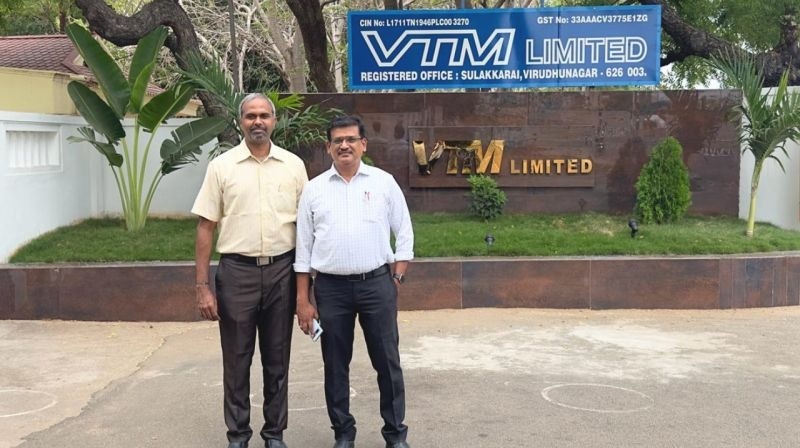
VTM Ltd Mar 2026: 60% Tariffs Evaporate FY26 PAT by 75% as US De Minimis Shield Shatters
Financial Year 2026 was supposed to be a victory lap for VTM Ltd. Following an extraordinary FY25 where net profit surged by 149% to ₹45.38 crore, the market had priced this textile player as a premium direct-to-consumer fulfillment powerhouse. Instead, a series of systemic trade shocks from Washington tore through the company’s export economics. The sudden abolishment of the US “De Minimis” exemption rule in late August 2025 retroactively exposed VTM’s home textile shipments to a massive 50% to 60% tariff umbrella.
As a consequence, VTM was forced to absorb substantial pricing discounts during the critical Black Friday and Christmas holiday shipping windows to preserve its platform partnerships. The financial damage is starkly laid bare in the latest full-year numbers. While top-line revenue expanded by 7.97% to reach ₹372 crore, full-year Net Profit plummeted by 75.7% from ₹45.37 crore down to ₹11.02 crore. The erosion of operating margins from 19.4% down to 7.45% triggered an immediate credit outlook revision to “Negative” by rating agencies, shifting investor focus entirely toward VTM’s urgent geographic diversification timeline.
Introduction
VTM Ltd is an established, south India-based manufacturer that has spent the better part of seven decades operating within the traditional grey fabric weaving sector. Part of the long-standing Thiagarajar Group, the company operates out of its primary manufacturing hub in Sulakkarai, Tamil Nadu. For decades, the business model was straightforward: convert raw cotton yarn into grey woven fabric for local processing houses and select industrial export accounts.
However, the modern investment narrative for VTM revolves around a massive downstream pivot executed over the last two fiscal years. The company established a specialized Home Textiles division, transforming its base grey fabric into premium bedsheets, high-end sateen pillowcases, and complex jacquard blankets. By bypassing traditional multi-layered export distribution networks and selling directly to high-end American e-commerce portals, VTM engineered a high-margin growth engine that completely altered its corporate profile—until global trade policy re-wrote the rules.
Business Model: WTF Do They Even Do?
To understand how a seven-decade-old mill from Tamil Nadu ended up exposed to American e-commerce policy, one has to look at how they redefined the supply chain. VTM does not just blast out container loads of cheap grey cloth anymore. Instead, they run an integrated weaving-to-fulfillment setup utilizing 258 advanced looms—including high-end Sulzer, Airjet, and fancy Belgian Picanol machinery—to churn out roughly 1.8 million meters of fabric every single month.
The real twist is their operational integration with premium US direct-to-consumer digital platforms like Quince. Rather than shipping a mass-market container and washing their hands of it, VTM operates essentially as an outsourced third-party logistics (3PL) partner. They handle everything in-house: weaving the fabric, managing the dyeing process through leased external facilities, stitching the finished home textiles, and maintaining warehouse inventory matched directly against digital purchase orders. They are equipped to fulfill individual “eaches”—meaning single pillowcase or sheet set orders—shipping them just-in-time straight to international doorsteps. It is a highly specialized, incredibly sticky model that takes up to a year in sampling and design approvals to set up. But as it turns out, holding two months of finished inventory on your own book means you carry all the valuation risk when a tariff wall is suddenly dropped on your head.
Financials Overview
Figures are standalone, in ₹ crore.
Metric
Latest Quarter (Mar 2026)
YoY
QoQ
Revenue
110.17
+72.76%
+10.23%
EBITDA / Operating Profit
7.27
+75.60%
+3.56%
PAT
0.90
-74.43%
-73.37%
EPS
0.09
-74.29%
-73.53%
Did Management Walk the Talk?
During their mid-year analyst sessions, management stood firm on the claim that their unique logistical integration and premium product profile would insulate them from mass-market textile pricing wars. To their credit, the volume machine is working perfectly; drawing ₹110.17 crore in sales for the final quarter represents a massive 72.76% jump over the depressed base of March 2025.
However, the true health of a business shows up in the net earnings line, not the volume counter. Quarterly net profit dropped to a microscopic ₹0.90 crore, burdened by a steep 32.58% tax rate and severe margin compression from trade discounts. Management admitted they had to bear massive pain to keep inventory moving through the US holiday pipeline. Volume commitments were fully met, but the financial toll proves that structural changes in trade regulation can instantly override any operational efficiency management puts in place.
Valuation Discussion: Fair Value Range Only
With a current market price of ₹63.50 and a full-year FY26 basic EPS of ₹1.11, VTM is trading at a trailing price-to-earnings (P/E) multiple of 57.2x. This represents a significant premium over the broader textile industry median P/E of 26.9x, and is heavily distorted by the sharp drop in full-year net earnings.
Using a normalized peer-band P/E valuation method matching mid-sized specialized textile players (ranging between 22x and 30x multiples) applied to the depressed FY26 EPS, the conservative value band lands between ₹24.42 and ₹33.30. Alternatively, applying a historical EV/EBITDA multiple range of 10x to 14x against the current normalized annual EBITDA of ₹28.00 crore,