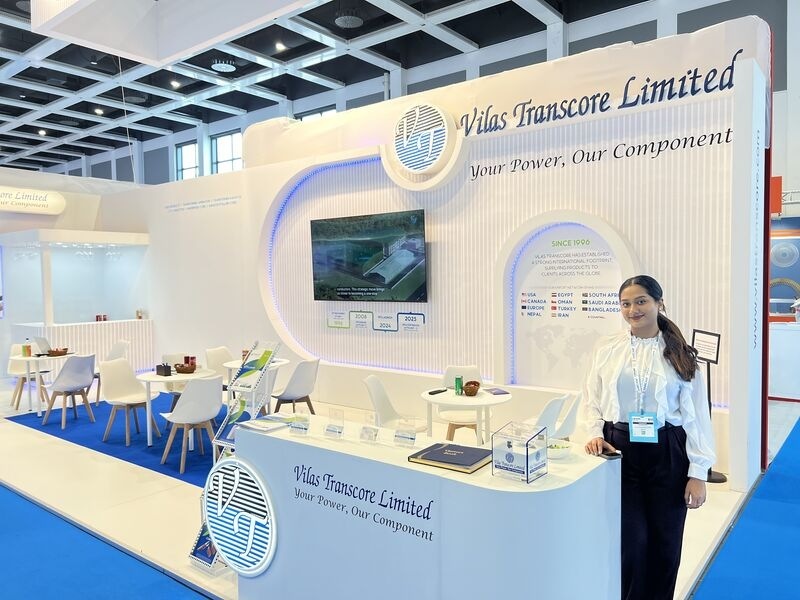
Vilas Transcore Ltd – H1 FY26 (Sep 2025): The Transformer Core King Triples Capacity, Doubles Drama, and Still Pays Zero Dividend
1. At a Glance
Vilas Transcore Ltd (NSE: VILAS), the transformer-core maestro from Baroda, just delivered a high-voltage performance that would make even PowerGrid blush. With H1 FY26 revenue at ₹229 crore and PAT at ₹24.4 crore, the company is literally magnetizing cash while expanding capacity from 12,000 MTPA to 36,000 MTPA. The stock trades at ₹408, down 21.6% in three months — apparently, investors needed a break from too much electricity.
The market cap sits at ₹999 crore, P/E at 22.2x, ROCE at 21.9%, and a ROE of 15.1%. The company is almost debt-free (D/E = 0.03), but its working capital days have stretched to 101 — meaning every transformer core they sell takes its sweet time to get paid for.
Despite a 74% jump in quarterly profit and 41% revenue growth YoY, Vilas pays zero dividends — because clearly, love for shareholders is still an “unassembled core.”
So, what happens when a company triples capacity, swaps CFOs like Netflix series cast members, and expands into radiators and nanocrystalline cores? Let’s decode this electric saga.
2. Introduction
If you thought transformers were only about Optimus Prime and Megatron, think again. Vilas Transcore Ltd (VTL) deals in CRGO coils, cores, laminations, and assemblies — the unglamorous but essential guts that make your local transformer hum quietly while frying mosquitoes in the background.
Founded in 2006, the Baroda-based company turned a humble transformer component business into a ₹999 crore market-cap machine. It operates two massive facilities spanning 142,000 sq. ft., running at ~90% utilization, and now building a third plant to triple capacity.
Financially, the company’s growth has been anything but static — Sales CAGR of 17% (5Y) and Profit CAGR of 57% (5Y) — that’s more wattage than most PSU transformers can handle.
Yet, the market’s reaction has been… neutral. The stock is down 13.5% in one year. Maybe investors are waiting for the radiators to cool before the price heats up again.
With exports forming just 1% of revenue, this is still a desi-heavy transformer story — Made in Baroda, sold across Bharat, and now spreading to Europe, Gulf, and Canada. The company even pulled off a ₹95 crore IPO in June 2024, just before the SME boom turned into a mild electric shock.
3. Business Model – WTF Do They Even Do?
Alright, let’s simplify: Vilas Transcore makes the metallic heart of your transformer. Those shiny steel cores that ensure your electricity doesn’t act bipolar every evening? That’s their domain.
They produce:
CRGO Mother & Slitted Coils – basically high-grade steel sheets that help in magnetic flux (and confuse commerce students).
Toroidal & Miniature Cores – used in measuring instruments and compact transformers.
Soon: Radiators & Nanocrystalline Cores – because even transformers need cooling and better energy efficiency.
These products go to Voltamp, Electrotherm India, Atlas Transformers, and Shilchar Technologies — basically every brand that keeps your lights on.
In FY24, 99% of revenue was domestic, but exports are slowly creeping in. The company’s expansion — from 12,000 to 36,000 MTPA — will finally give it scale to play internationally.
In short: if India’s power sector is a Bollywood film, Vilas Transcore is the quiet background artist — never in the trailer, always in the climax.
At CMP ₹408, P/E = 20.5x (annualised) — cheaper than the industry average (28.7x), but the market clearly wants more spark.
Commentary: Revenue up 41%, profit up 74% — that’s not growth, that’s grid overload. The company’s OPM improved from 11% to 14%, showing they’ve learnt how to convert steel into money efficiently. The new plant will likely shock us again next year (hopefully in a good way).
5. Valuation Discussion – Fair Value Range
Let’s ground the current through three circuits:
a) P/E Method Industry P/E = 28.7 Company Annualised EPS = ₹19.9 Fair Value Range = ₹19.9 × (18x to 28x) = ₹358 to ₹557
b) EV/EBITDA Method EV = ₹919 Cr | EBITDA (TTM) = ₹58 Cr EV/EBITDA = 15.8x Peer average (Capital Goods midcaps) ≈ 18–20x Fair Value Range = ₹380 – ₹520