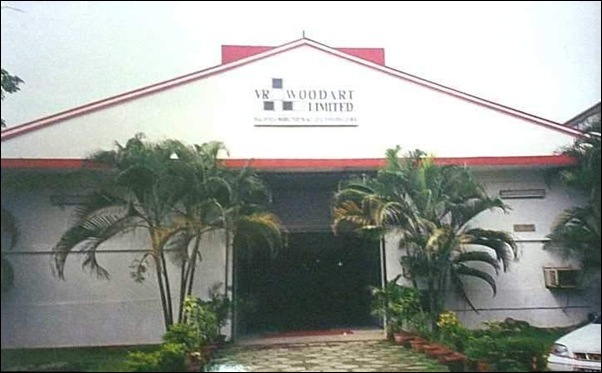
V R Woodart Ltd Q2 FY26 – From Sleeping Beauty to a Wild 1,070% Price Comeback: The Most Confusing Phoenix Rise in Indian Microcap History
1. At a Glance
Once upon a time, in the back alleys of Kakkanad, Cochin, stood a quiet little wood products maker called V.R. Woodart Ltd (VRWL). Incorporated in 1989, it made fancy finger-jointed glue-laminated boards — basically, wood that looked more disciplined than most promoters. Fast forward to FY26, the company’s revenues are ₹0 crore, PAT is a negative ₹0.27 crore, and its book value is literally -₹1.86 — yes, negative. Yet, the stock price decided to perform yoga and stretch from ₹4.56 to ₹56.1, a 1,070% return in a year.
The market cap is a spicy ₹83.6 crore, despite the business generating about as much income as an empty furniture showroom. Promoter holding? Just 6.04%, after a cliff drop from over 30%. The latest quarter ended September 2025 showed another loss, but traders didn’t care. Because why should cash flows matter when your company’s price-to-earnings ratio is mathematically undefined?
Welcome to the VR Woodart multiverse, where the furniture doesn’t exist, but the valuation sure does.
2. Introduction
Every once in a while, Dalal Street throws us a company so bizarre, it deserves a documentary. V.R. Woodart Ltd is one of those. It’s like watching a 1980s Doordarshan actor suddenly go viral on TikTok — nobody knows why, but everyone’s watching.
Founded to make fancy wooden furniture and laminated boards, the company’s operations have long since… well, stopped operating. For years, the revenue line has been a majestic zero. Yet somehow, the company’s share price decided to sprint past 1,000% this year. You know the story’s wild when a firm with zero turnover and negative reserves gets a market capitalization of ₹83 crore.
So what happened? A sudden wood renaissance? A rubberwood comeback? Not really. Instead, we got a full-blown management shake-up, auditor resignations, open offers, and preferential allotments — basically, a Bollywood-style reboot where everyone leaves and someone new shows up claiming to “restructure the business.”
The cherry on top? The stock still trades with a loyal fanbase who probably think “operational losses” are a temporary inconvenience before a multi-bagger comeback. Spoiler alert: VR Woodart’s current operations can’t even fund a new chair for its boardroom.
3. Business Model – WTF Do They Even Do?
Once upon a functioning time, VR Woodart was an exporter of treated finger-jointed glue-laminated rubberwood boards. Sounds fancy, right? They also made smaller homeware like mug trees, towel holders, kitchen boards, and cutting boards — basically, everything your grandma buys on her way to IKEA but never uses.
They had facilities in Kakkanad and Eloor (Kerala), where they seasoned and treated rubberwood. Eventually, the company tried its luck in bedroom furniture manufacturing. But as of today, it’s fair to say VRWL’s business model has moved from “manufacturing furniture” to “manufacturing corporate announcements.”
For years, the company hasn’t produced any meaningful goods. There’s no sales revenue, no exports, no domestic demand — just a constant trickle of losses and “other expenses.” If VR Woodart were a student, it’d be that kid who keeps submitting blank papers but still attends the award function for participation.
Their financials show consistent operating losses, no cash flow, and negative net worth of ₹17.6 crore. Yet, somehow, they managed to pull off a preferential allotment of ₹3.84 crore in FY26. Maybe that’s the new business model — woodworking with equity dilution.
4. Financials Overview
Let’s see how this “non-operational” miracle looks on paper. Figures in ₹ crore.
Metric
Latest Qtr (Sep ’25)
YoY Qtr (Sep ’24)
Prev Qtr (Jun ’25)
YoY %
QoQ %
Revenue
0.00
0.00
0.00
0%
0%
EBITDA
-0.09
-0.02
-0.38
-350%
-76%
PAT
-0.27
-0.02
-0.38
-1,250%
28.9%
EPS (₹)
-0.18
-0.01
-0.26
-1,200%
30.7%
So, how do you even calculate YoY growth when your revenue is zero? That’s right — it’s an existential math problem.
The company’s losses remain tiny in rupee terms, but huge in context. The annualized EPS (based on latest quarter) is about -₹0.72