Uttam Sugar Mills Ltd Mar 2026 : P/E Rebounds to 9.23 as Ethanol Restrictions Dissolve
The sugar sector has long been treated by the market as an unpredictable regulatory rollercoaster, where structural shifts are frequently masked by seasonal variations. For Uttam Sugar Mills Limited (USML), the conclusion of the fiscal year ending March 2026 represents a notable operational recovery. Following a challenging period in late 2024 and early 2025—marked by industry-wide sugarcane disease and policy-driven curbs on ethanol production—the structural earnings profile of the company has stabilized. Driven by a complete removal of the ban on B-Heavy molasses diversion and a significant recovery in operating cash generation, the company posted a full-year consolidated revenue of ₹2,209.92 crore and a net profit after tax of ₹100.59 crore. The market, previously factoring in deep cyclical distress, is currently pricing the equity at a trailing price-to-earnings (P/E) multiple of 9.23, reflecting an improving outlook on asset efficiency and capital reallocation.
Section 1 — At a Glance
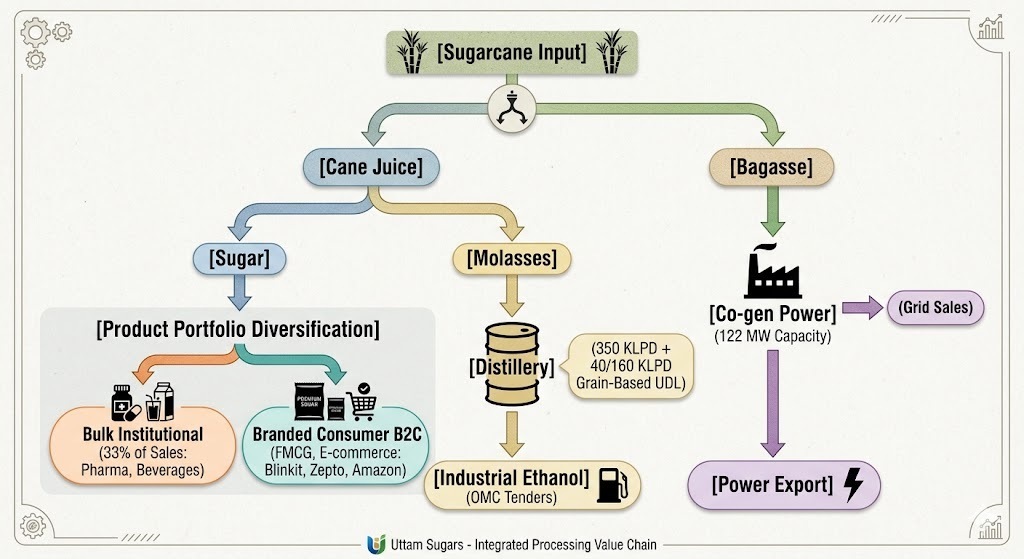
Uttam Sugar Mills entered the modern processing era by expanding its aggregate sugarcane crushing footprint across the northern agrarian belt to 27,000 tonnes of cane per day (TCD). This core asset base feeds a highly forward-integrated ecosystem consisting of a 350 kilolitres per day (KLPD) standalone distillery capacity and 122 megawatts (MW) of co-generation power infrastructure.
Financially, the company achieved an inflection point during the year. Standalone revenue from operations climbed to ₹2,110 crore, accompanied by an operating profit (EBITDA) of ₹221 crore. On a consolidated basis—incorporating its newly acquired subsidiary, Uttam Distilleries Limited (UDL)—total operating income reached ₹2,209.92 crore, while consolidated Profit After Tax (PAT) crossed the threshold to hit ₹100.59 crore. Consequently, reported standalone Earnings Per Share (EPS) settled at ₹25.89.
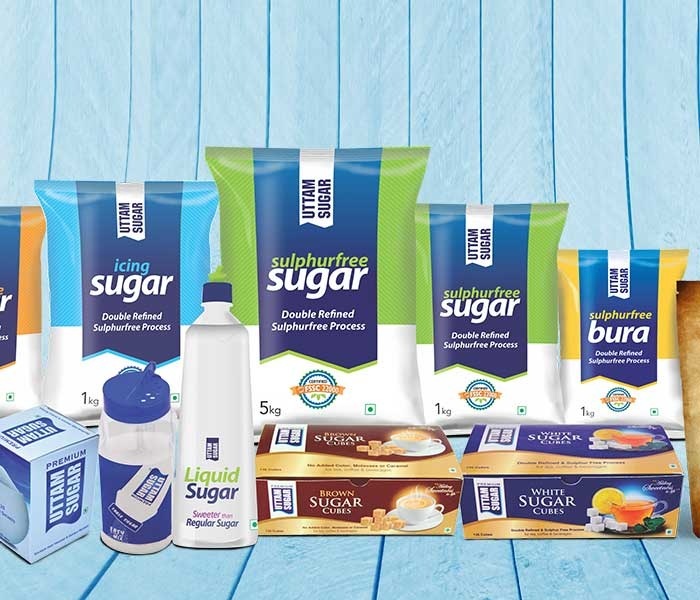
Investor attention is increasingly drawn to the company’s aggressive business-to-consumer (B2C) pivot within its branded and specialty sugar division, where monthly volumes have scaled to an average of 60,816 quintals. This higher-margin segment helps insulate the top-line from the volatile pricing cycles of bulk commodity sugar.
However, risks remain embedded within the operational model. Sugar inventories are structurally capital-intensive, which often requires significant short-term working capital debt during peak crushing periods. Furthermore, while cash generation from operating activities surged to ₹255 crore, asset returns remain closely tied to government-administered raw material costs and fixed domestic ethanol procurement prices.
Financial Wisdom Drop: Net profit provides an accounting summary of past performance, but sustainable corporate values are built on the regular conversion of accounting profit into operational cash flow.
The transition from a pure bulk refiner to an industrial alcohol and premium consumer products provider presents an interesting case study in capital reallocation.
Section 2 — Introduction
Uttam Sugar Mills operates four manufacturing facilities strategically placed in close proximity to major cane-producing regions: Libberheri in Uttarakhand, alongside Barkatpur, Khaikheri, and Shermau in Uttar Pradesh. This geographic positioning ensures access to raw agricultural inputs while optimizing logistical transport costs to major consumption hubs in Northern India.
The rationale for evaluating the business at this stage is driven by a shift in its corporate structure and product mix. In July 2024, USML completed the strategic acquisition of a majority stake in Uttam Distilleries Limited (UDL), integrating a 40 KLPD grain-based distillery into its existing molasses-led setup. Following this integration, management advanced plans to expand UDL’s capacity to 160 KLPD by March 2027 through a targeted capital layout of ₹110 crore. This structural transition reduces dependence on weather-dependent sugar crops by expanding feedstock flexibility into alternative grain grains.
Section 3 — Business Model: WTF Do They Even Do?
To the casual observer, a sugar mill simply crushes cane to produce a white commodity sweetening agent. For an integrated player like Uttam Sugar, the business model functions more like a structural processing chain designed to maximize value from every quintal of agricultural input.
The process begins with crushing sugarcane to separate raw juice from bagasse. The fibrous bagasse is directed straight to high-pressure boilers, driving a 122 MW co-generation grid that meets internal thermal energy needs and exports surplus power to regional grids. The cane juice is processed into distinct product tiers. On one end is traditional commodity white sugar. On the other are premium specialized grades, such as high-purity pharmaceutical-grade sugars and liquid invert syrups, supplied directly to institutional corporate accounts.