Utssav CZ Gold FY26: When Cubic Zirconia Outruns Your Free Cash Flow
Section 1 — At a Glance
The financial year 2026 has concluded for Utssav CZ Gold Jewels Limited, presenting a narrative of top-line expansion operating alongside significant cash consumption. Total income rose by 78.71% year-on-year to reach ₹1,157.46 crore, driven primarily by strong domestic demand, the onboarding of 112 new clients, and a structural product mix shift toward higher-value 22-karat jewellery. Net profit followed an identical trajectory, jumping 135.67% to close at ₹59.06 crore for the full year.
However, beneath this performance lies a capital structure experiencing rising capital intensity. While return on equity stands at a notable 29.84% and return on capital employed remains firm at 24.02%, the company’s operating cash flow deteriorated further, ending the year at negative ₹60.72 crore. This marks the third consecutive year of negative operating cash generation, driven entirely by structural inventory accumulation and an expanding receivables book. Short-term bank borrowings rose to ₹185.07 crore to fund this working capital gap, bringing the total debt pile to ₹186.22 crore. With plans to spend ₹50 crore on a 2.5-tonne capacity expansion and a new subsidiary in Dubai, capital allocation decisions will play a central role in sustaining operational viability.
Section 2 — Introduction
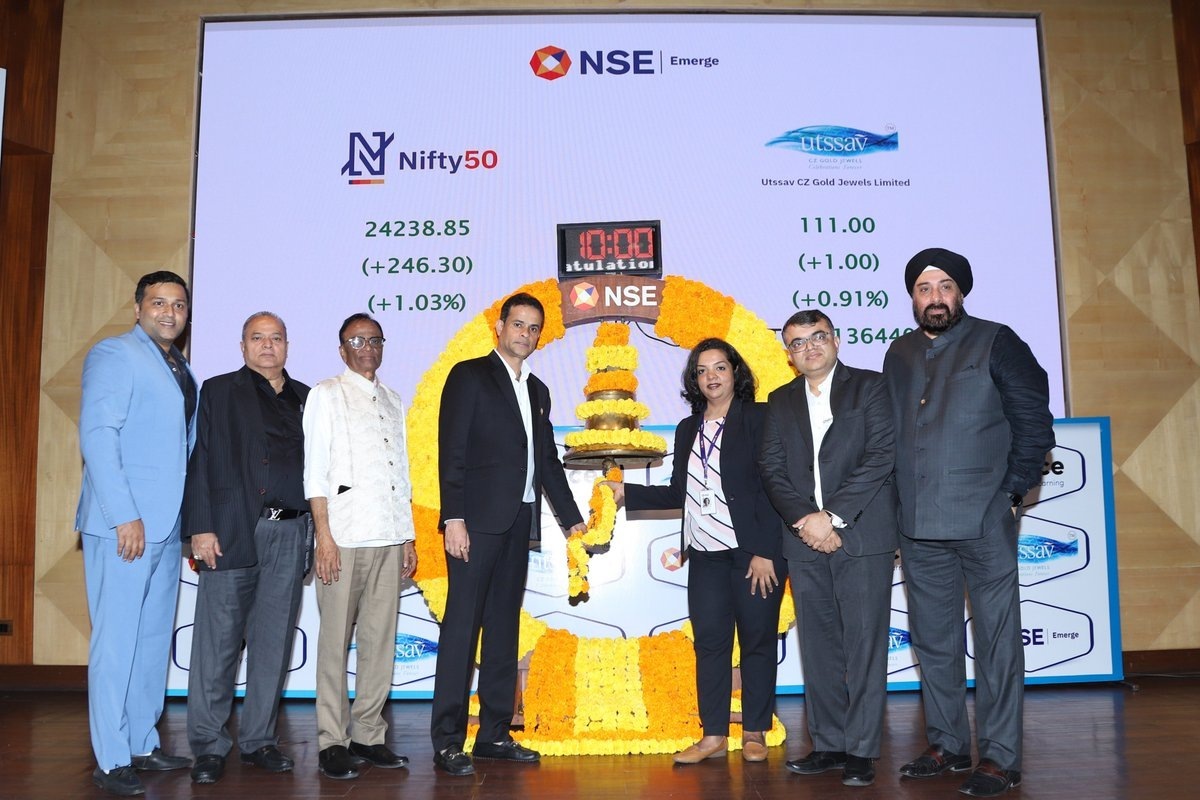
Utssav CZ Gold Jewels Limited entered the public eye with its listing on the NSE Emerge SME platform in August 2024. Operating out of an 8,275 square foot facility in Andheri East, Mumbai, the company began its journey in 2007 as a specialist manufacturer of lightweight Cubic Zirconia (CZ) studded gold and rose gold casting jewellery.
In a sector historically plagued by fragmented, unorganised regional workshops, the company has carved out a niche by offering a completely integrated B2B corporate manufacturing stack. This structure encompasses everything from computer-aided design (CAD) prototyping to vacuum casting and final Bureau of Indian Standards (BIS) hallmarking under one roof. Recently, management has embarked on an aggressive pivot, shifting away from its legacy lightweight synthetic stone roots into the highly competitive domains of plain casting gold, natural diamonds, and lab-grown sustainable luxury jewellery.
Section 3 — Business Model: WTF Do They Even Do?
Utssav is essentially a shadow factory for the retail jewellery sector, operating on a strict 100% B2B model. Instead of dealing with the retail public and handling storefront overheads, they sell directly to 430+ wholesalers and regional multi-store retail partners across 23 states and two union territories.
The corporate thesis revolves around design velocity as a defensive moat. Armed with 50 in-house CAD designers and a library containing over 70,000 architectural creations, the facility cranks out 400 to 500 new jewelry designs every single month to mimic shifting consumer tastes. Their average piece weight sits at a lean 10 grams, optimizing for affordability. However, the business model comes with a built-in bottleneck: client concentration. The top 10 retail buyers command roughly 50% of Utssav’s total sales volume. If a few large buyers decide to source their diamond-studded rose gold bracelets elsewhere, a meaningful portion of Andheri’s production pipeline clears out simultaneously.
Section 4 — Financials Overview
Figures are consolidated, in ₹ crore.
Metric
Latest Half (H2 FY26)
YoY (Same Half)
Previous Half (H1 FY26)
Revenue
679.49
87.81%
475.41
EBITDA
48.67
98.89%
45.03
PAT
29.64
95.13%
29.42
EPS
12.27
82.74%
12.18
What is Management Promising in the Coming Quarters?
During the May 2026 earnings conference call, management displayed notable confidence regarding forward volume demand, dismissing fears that all-time high gold prices would dent B2B purchase volumes. The executive team guided for a steady 60% revenue growth target for the upcoming financial year, backed by an expected 35% to 40% expansion in pure volume terms.
Crucially, management adjusted its long-term profitability framing due to structural product shifts. When questioned on why EBITDA margins aren’t expanding past the current 8.10% level despite massive operating scale, the CEO noted:
“Because now we started a plain gold jewelry also, there our EBITDA margin will go little low.”
The business is deliberately onboarding lower-margin plain gold casting to achieve mass scale, guiding investors to anchor their expectations to a normalized operating EBITDA margin of 7% to 8% and a net PAT margin of 4.0% to 4.5% going forward. To achieve their stated long-term goal of hitting ₹4,000 to ₹5,000 crore in revenue by 2030, management announced a capital expenditure plan of ₹50 crore for FY27 to