Ultramarine & Pigments FY26: A ₹250 Crore Bet to Wash Away the Blues
The market has spent the last year treating Ultramarine & Pigments Ltd like a fading fabric, knocking its stock down by over 22%. Yet, behind the scenes, management is acting like a hyperactive chemist, subscribing to massive preferential shares of its group company, doling out related-party loans, and capping the fiscal year by approving a massive greenfield pigment project that costs nearly a quarter of its entire market cap.
While the headline net profit crawled up to ₹80.77 crore in FY26 , the underlying cash flows tells a wildly different story of heavy capital deployment and a corporate treasury being emptied into strategic bets.
The cost of capital is never free, and building giant manufacturing plants for a single commoditised blue powder is an inherently high-stakes game.
Section 2 — Introduction
Ultramarine & Pigments Ltd has been a staple of the Indian chemical ecosystem since 1960. Best known for creating the blue powder that saved generations of white school uniforms from looking like old parchment, the company has quietly morphed into a multi-plant operator across Tamil Nadu and Andhra Pradesh.
With an installed capacity of 9,715 MTPA in pigments and a massive 62,000 MTPA in surfactants, it commands serious real estate in South India’s consumer supply chain.
But long histories don’t guarantee smooth quarters, and a recent corporate makeover has seen the company diving headfirst into heavy capital expenditures and intricate group-company financing.
Section 3 — Business Model: WTF Do They Even Do?
If you think this company is just about blue dye, your analytical framework is running on low capacity. Ultramarine operates three businesses disguised as one, and they don’t exactly share the same genetic code.
First, there is the legacy Pigments business (~32% of FY25 revenue), where they cook up Ultramarine Blue and Violet. It’s a high-grade, decent-margin product, but has severe product concentration risks.
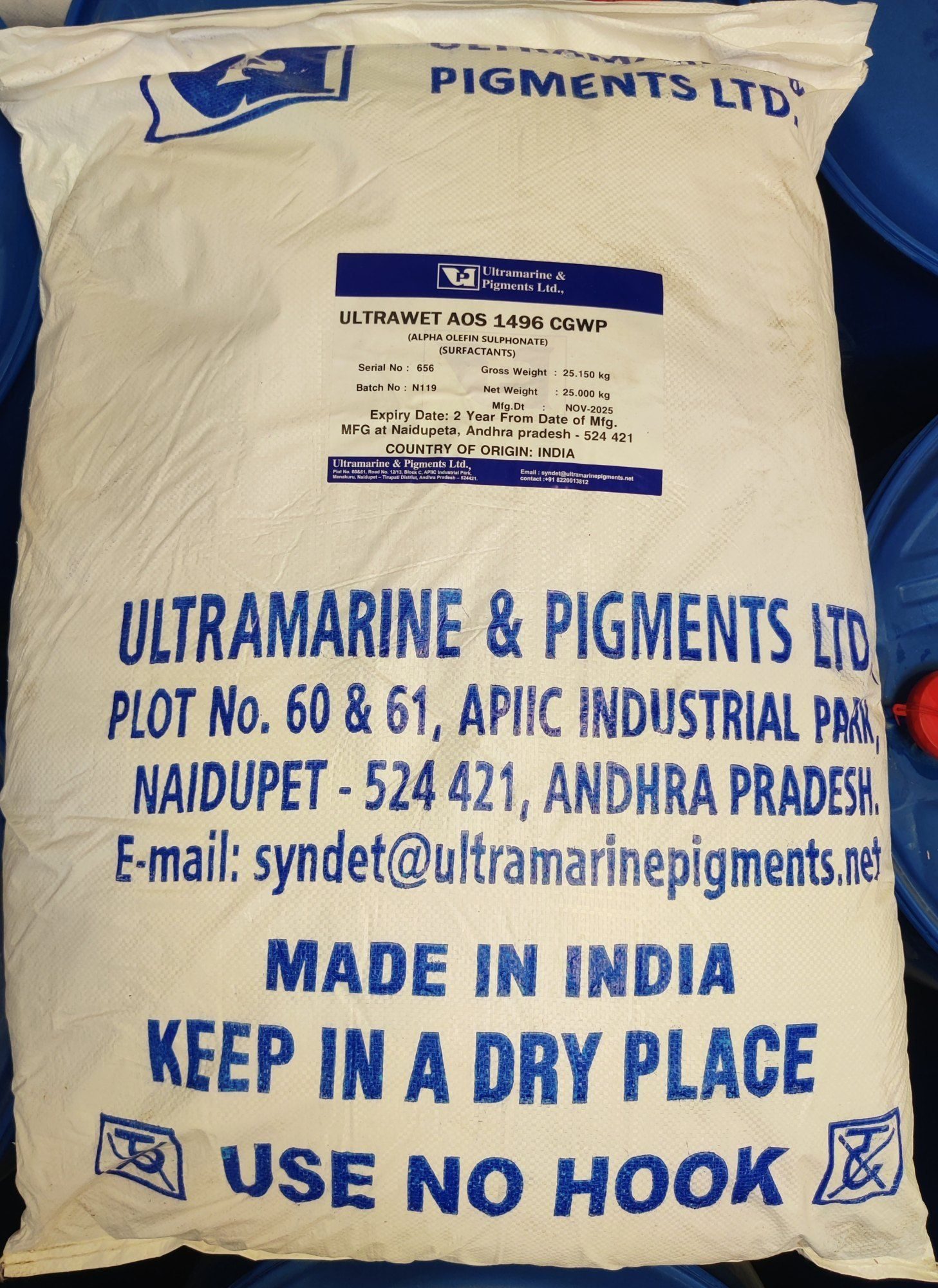
Then there is the Sulphonation/Surfactants business. This makes up a whopping 57% of their top line. They produce the raw materials that multinational FMCG players use to manufacture household detergents. It’s high volume, brutal competition, and carries the pricing flexibility of a wet noodle.
Finally, to make things truly eccentric, they run an IT-Enabled Services/BPO division (~6% of revenue) handling hospital billing and content publishing. Because nothing says “operational synergy” like manufacturing industrial chemical surfactants while simultaneously coding healthcare forms.
Section 4 — Financials Overview
Figures are consolidated, in ₹ crore.
Quarterly Performance Tracker
Metric
Latest Quarter (Mar 2026)
YoY
QoQ
Revenue
198.71
2.02%
1.59%
EBITDA / Operating Profit
26.20
-7.58%
-23.81%
PAT
14.15
-16.86%
-47.77%
EPS (₹)
4.85
-16.81%
-47.74%
The final quarter of FY26 was an absolute margin execution. While revenues remained perfectly flat sequentially at ₹198.71 crore, Operating Profits collapsed by 23.81% QoQ.
The culprit? A massive, unannounced spike in “Other Expenses” which rocketed to ₹87.75 crore for the full year.
When operating profit margins compress from 18% down to 13% in a single quarter, it tells you that volume growth is being achieved at the expense of pure pricing pain.
The sequential drop in PAT by nearly half is a sobering reminder that top-line stability is a vanity metric when raw material volatility decides to strike.
Section 5 — Valuation Discussion: Fair Value Range Only
To find where Ultramarine sits on the valuation spectrum, we take our master