TTK Prestige FY26: The Price of Premium Sizzling in a Volatile Pan
Date of Publishing -
Spotted a factual error — a wrong number, date, or fact? Tell us and we will check the source.
The ultimate litmus test for a premium consumer brand is not how elegantly it sells cookware during a bull market, but how comfortably it protects its margins when economic variables begin to boil over. For TTK Prestige Ltd, India’s quintessential kitchenware giant, financial year 2025–2026 proved to be an exercise in defensive structural remodeling. Faced with a classic double-whammy of severe raw material cost inflation and intensifying price-led competition from agile direct-to-consumer (D2C) players, management chose to bite a multi-year investment bullet.
A headline consolidated revenue growth of 9.53% year-on-year signals that the brand’s core distribution machinery remains incredibly potent. However, the real story lives inside the operating efficiency numbers. While the frontline sales engine marched upward to tap the ₹2,974 crore milestone, the reported profit after tax (PAT) felt the scorching burn of a ₹71 crore UK goodwill impairment and heavy structural transformation outlays, closing at ₹160.59 crore.
The corporate balance sheet has entered a critical transition phase. On one hand, a robust cash and liquid bank balance sheet sitting comfortably at ₹537 crore highlights defensive resilience. On the other hand, the business is deliberately depressing its near-term return profile to structurally rewrite its supply chain, design framework, and tier-two market visibility. In the luxury and small domestic appliance spaces, the long-term architectural thesis is being built, but public market patience is bound to be thoroughly tested.
When premium consumer durables experience compressed cash conversion capabilities and lower return metrics simultaneously, investor focus shifts entirely away from quarterly sales volume expansion and lands squarely upon long-term cost absorption capabilities.
Introduction
TTK Prestige Ltd is not merely a manufacturer of domestic kitchenware; it is an omnipresent corporate fixture across urban Indian households. Established as a private limited entity back in 1955, the flagship group turned into a publicly traded corporate engine in 1994, riding on its dominant domestic market position in pressure cookers, value-added gas tops, non-stick cookware, and small kitchen appliances.
Over the decades, the business transformed itself from a regional, south-focused manufacturer into an aggressive pan-India player, which now commands over 50% of its headline domestic real estate from non-south geographic territories. The structural evolution reached an international scale in 2016 through the acquisition of Horwood Homewares in the United Kingdom, followed by a domestic tactical integration of Ultrafresh Modular Solutions to target the integrated modular kitchen ecosystem.
Business Model: WTF Do They Even Do?
At its core, TTK Prestige operates a brand-monetization engine disguised as a hardware manufacturing operation. The business model is built on capturing maximum real estate inside the Indian kitchen, leveraging a massive omnichannel web that spreads across traditional general trade, major e-commerce storefronts, and a highly controlled footprint of over 700 “Prestige Xclusive” retail outlets.
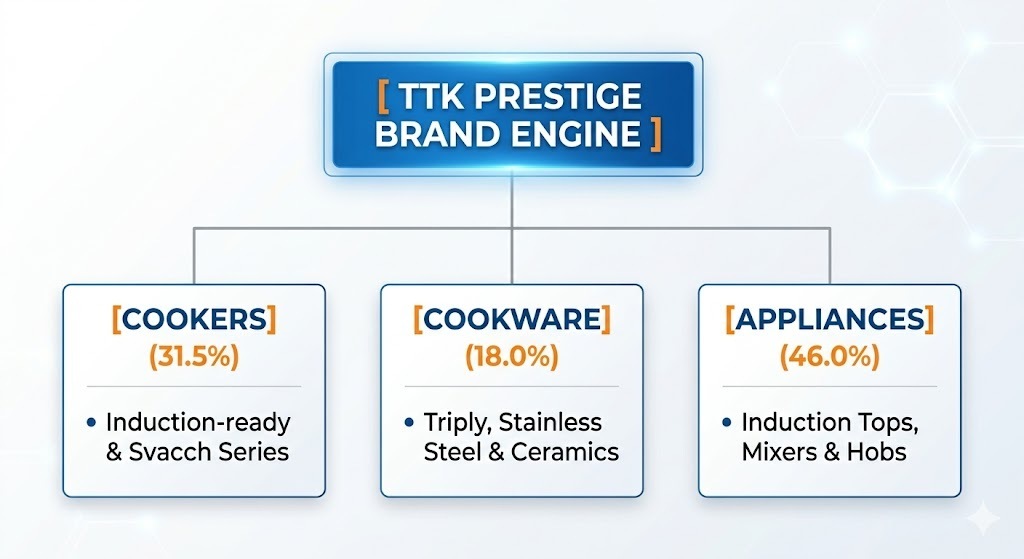
The underlying mechanics rest on three primary product blocks: Appliances (accounting for a hefty 46.0% of the sales architecture), closely chased by traditional Cookers at 31.5%, and Cookware bringing in 18.0%. The remainder of the P&L is tied together by miscellaneous cleaning tools and minor accessories. Rather than depending on basic commodity metal volumes, the business thrives on extraction premiums. They take standard stainless steel or aluminum, pack it with engineering concepts like the “Svacch” spillage-control lid, and demand premium price tags.
However, local manufacturing plants across six distinct geographical centers are currently running in parallel with complex global procurement lines. This structural exposure leaves them wide open to macroeconomic swings in global metal prices and logistical bottlenecks, forcing them to balance premium brand power against raw commodity volatility.
Financials Overview
Figures are consolidated, in ₹ crore.
Metric
Latest Quarter (Q4FY26)
YoY (%)
QoQ (%)
Revenue
₹729.17
17.12%
-9.01%
EBITDA / Operating Profit
₹66.94
-13.26%
-6.90%
PAT
₹36.82
-37.28%
11.91%
EPS (Reported)
₹2.69
-36.56%
12.08%
Did Management Walk the Talk?
Looking back at prior structural commentary, management had previously flagged that internal operating interventions and extensive external consultant programs would temporarily depress the income statement. Reviewing the full-year layout, that guidance has played out exactly as promised—albeit with more raw P&L friction than external observers anticipated.