Transport Corporation of India Mar 2026: An ₹82 Cr Tax Notice Meets a ₹250 Cr Cash Pile
Date of Publishing -
Spotted a factual error — a wrong number, date, or fact? Tell us and we will check the source.
Section 1 — At a Glance
TCI just closed FY26 with a topline of ₹4,917 crore and a PAT of ₹460 crore, rounding out 23 consecutive quarters of growth. In an industry notoriously plagued by asset-heavy balance sheets and working capital stress, TCI operates with a remarkably light ₹242 crore debt load against an equity base of ₹2,154 crore. It yields an ROE of 19.3% and trades at a P/E of 15.7x — a stark contrast to peers demanding double or triple that multiple.
Yet, it’s not entirely smooth sailing. The freight division is facing margin compression, and a sudden ₹81.96 crore tax demand for AY2024-25 adds a sudden dent to the corporate armor. A resilient balance sheet doesn’t prevent operational speed bumps; it merely absorbs the shock. With the company navigating fierce pricing wars in its traditional segments while doubling down on coastal shipping, the real question is whether this multimodal giant is actually a value play, or simply a cyclical trap in disguise.
Section 2 — Introduction
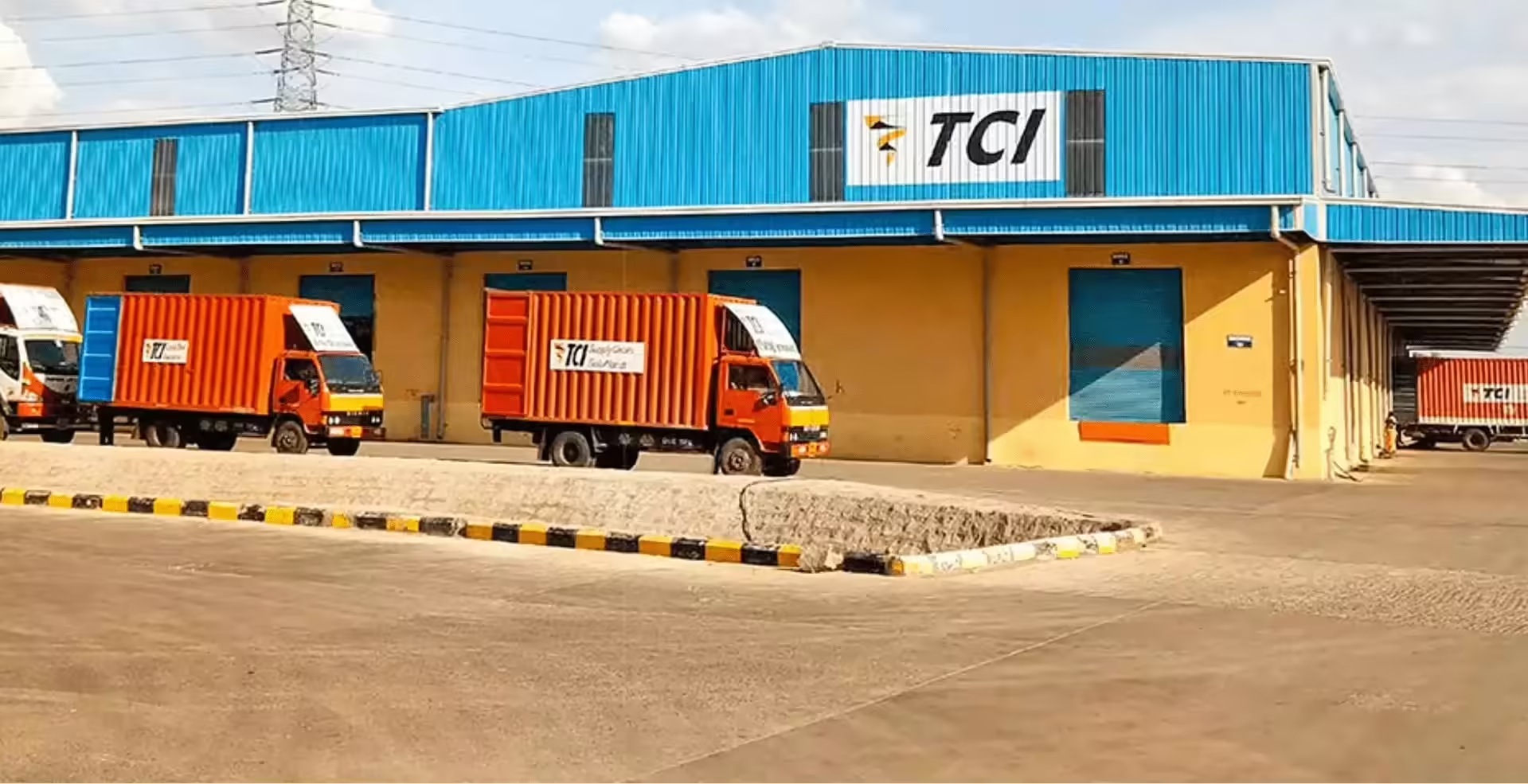
The Transport Corporation of India (TCI) has been around since 1958, moving roughly 2% of India’s GDP by value. Unlike new-age logistics start-ups that burn venture capital to subsidize package delivery, TCI is an old-school multimodal behemoth operating across road, rail, and sea. They manage 16.5 million square feet of warehousing, run over 10,000 trucks, and command six coastal cargo ships. Recently, they’ve been strategically tilting away from commoditised plain-vanilla trucking towards supply chain solutions and seaways, where margins don’t completely evaporate the moment diesel prices twitch.
Section 3 — Business Model: WTF Do They Even Do?
TCI is essentially three businesses wearing a trench coat.
First, the Freight Division. This is the traditional Full Truck Load (FTL) and Less than Truck Load (LTL) business. They move stuff from Point A to Point B, while praying that local MSME demand holds up and competitors don’t slash prices to zero just for the thrill of it.
Second, Supply Chain Solutions. Here, TCI acts as the nervous system for automotive and retail giants. They don’t just move boxes; they design networks, manage inventory, and charge a premium for saying words like “Dynamic network optimization.”
Third, Seaways. They own six ships and 8,500 containers moving cargo along India’s coasts. Coastal shipping is an excellent business—until you have to pull a ship out of the water for dry-docking and watch your revenue temporarily sink.
Section 4 — Financials Overview
Figures are consolidated, in ₹ crore.
Metric
Latest Quarter
YoY
QoQ
Revenue
1,324
12.3%
6.0%
Operating Profit
142
11.8%
11.8%
PAT
124
7.8%
6.8%
EPS
16.11
7.8%
6.8%
TCI ended Q4 FY26 with a ₹1,324 Cr topline, a 12.3% jump YoY that proves there’s still juice in the logistics engine despite a sluggish macro environment. The 11.8% sequential bump in operating profit is what we’d call a quietly excellent finish to the fiscal year. Margin resilience in a highly fragmented market is the ultimate proof of pricing power.
Did Management Walk the Talk?
In earlier quarters, management explicitly refused to chase profitless volume to artificially inflate the topline. The CEO noted that in the freight segment, “discounting doesn’t work… everyone is trying to race to the bottom.” They walked the talk by refusing to participate in the margin-destructive pricing wars, protecting the bottom line even as competitors bled.
Section 5 — Valuation Discussion: Fair Value Range Only
TCI is currently trading at a P/E of 15.7x, which looks oddly reasonable in a market where some competitors demand triple-digit multiples for a fraction of the returns.
P/E Method: With a full FY26 EPS of ₹59.5, applying a conservative logistics