General information and education, not investment advice. The author is not a SEBI-registered adviser or research analyst. No recommendation, no promised returns. Markets carry risk including loss of capital. Figures may not be current. Always consult a SEBI-registered adviser.
1. At a Glance
Anup Engineering builds large metal equipment for process plants, and has done so for sixty-four years. Consolidated revenue for the three months to June 2026 was ₹125.25 crore. The same three months a year earlier brought ₹175.23 crore. The quarter immediately before this one brought ₹207.86 crore. Operating profit was ₹9.47 crore and net profit was ₹0.57 crore. Earnings per share for the quarter, not annualised, came to twenty-eight paise. Total assets stand at ₹971 crore.
Operating margin came in at 7.56%, against 23.03% in the same quarter a year earlier. Management says the performance reflects planned lower execution after low order booking in the previous year. It also points to global uncertainties, supply chain challenges and elevated freight and energy costs. Those, management says, added pressure on raw material availability and prices. Per management, EBITDA margins were hit entirely by lower revenue. EBITDA is profit before interest, tax, depreciation and amortisation. Lower revenue left fixed costs spread across fewer sales, which management calls under-absorption. Gross margin, management says, remained intact.
The same three months brought the highest quarterly order intake in the company’s history, at roughly ₹315 crore. The pending order book, including letters of intent, reached ₹985 crore. A letter of intent is a customer’s written statement that it means to place an order. Management states that new orders booked in the current financial year to date stand at ₹538 crore. The inquiry pipeline is about ₹1,100 crore.
2. Introduction
The Anup Engineering Limited was incorporated in 1962. It was demerged from its holding company, Arvind Limited, in 2018. The company sits inside the Lalbhai Group. Anup’s own investor presentation describes that group as a USD 3 billion diversified enterprise. The presentation says it spans fashion and retail, engineering, real estate and textiles. It traces the lineage back to a textiles firm founded in 1897, and to Arvind Mill, established in 1931.
The listed company has been rearranging itself steadily. In March 2024 it acquired all of Mabel Engineers, a Tamil Nadu manufacturer, for ₹33 crore. That purchase added silos, tanks and site-service capability. In August 2024 it signed a manufacturing and supply agreement with Graham Corporation of the United States. Under that agreement Anup is the exclusive manufacturer and supplier of certain critical products on Graham’s behalf. The arrangement covers India and international business. The board approved a 1:1 bonus issue in March 2024, meaning one free share for each one already held. In November 2023 the company filed a scheme amalgamating Anup Heavy Engineering into itself.
The board has also changed at the top. On 10 November 2025 Sanjay Lalbhai stepped down as Chairman and Punit Lalbhai was appointed Chairman. Kulin Lalbhai was added as a director with effect from the same date. A postal ballot on 6 February 2026 confirmed Kulin S. Lalbhai’s appointment as a Non-Executive Director. Nilesh Hirapara was appointed chief financial officer in April 2023. Reginaldo Dsouza signs the results as Managing Director.
The physical footprint has grown alongside. The Ahmedabad plant covers 45,000 sq m of shop area and handles single pieces up to 500 tonnes. The Kheda facility runs to 125,000 sq m, with single-piece capacity up to 1,000 tonnes. Production lengths there reach 100 metres. Phase 1, of two bays, was commissioned in June 2023. Phase 2A was commissioned across the three months to September 2025 and in January 2026. Phase 3, of three bays, remains a future plan. The results announcement for the year to March 2026 noted that Phase 2 commissioning takes capacity to 20,000 tonnes. An engineering centre operates at Vadodara.
The recent diary is short. An analyst call was held on 6 August 2026, with the transcript filed two days ago. The company met investors at the Equirus Annual India Conference on 10 August. CARE, a credit-rating agency, issued a ratings update the same day.
US
Now live
US Stocks terminal is live
13,000+ US tickers · EDGAR fundamentals · screener and filings feed — the same terminal, for American markets.
Explore →
3. Business Model: WTF Do They Even Do?
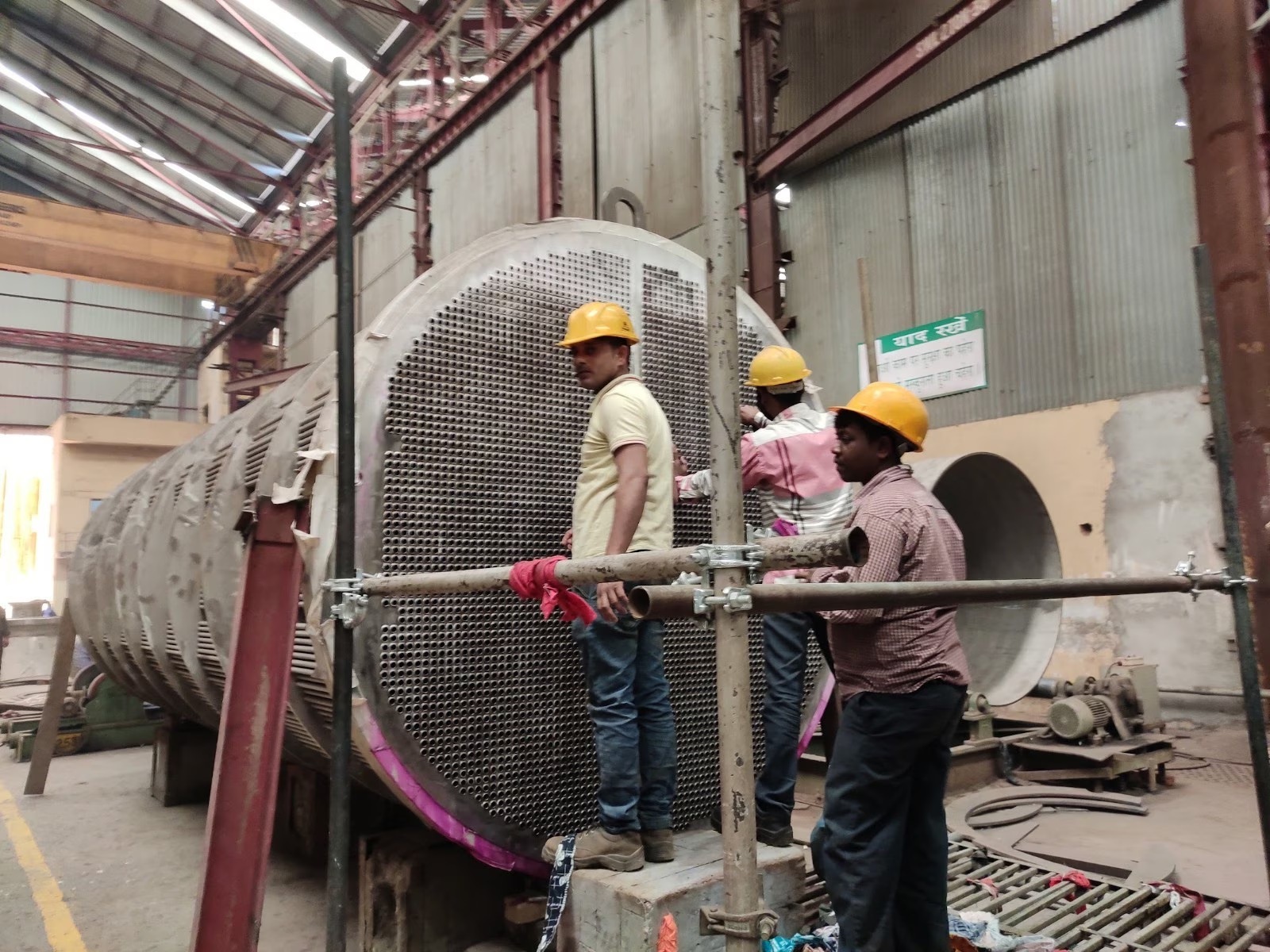
Anup makes very large metal containers that other people’s chemicals go inside. Each one is built to order, one at a time, to a drawing supplied by the customer.
The catalogue runs to heat exchangers, reactors and separators, pressure vessels and drums. It also covers columns and towers, industrial centrifuges, silos and piping spools, alongside custom fabrication. The equipment lands in refineries, petrochemical plants, LNG terminals and hydrogen projects. LNG is natural gas chilled to a liquid so it can be shipped. Fertiliser, chemical and pharmaceutical plants take it too, as do power stations. Water and wastewater works and nuclear projects complete the list.
Nothing here is a product in the shampoo sense. Per CARE, the credit-rating agency, these items are not standardised and are manufactured to specific customer requirement. CARE puts the lead time at roughly 19 to 20 weeks. The company procures raw material only after the equipment design has been finalised. Between roughly 50% and 60% of contract value is realised only on shipment. That payment follows inspection, testing and customer acceptance. Months of work go into a steel object, and most of the money arrives when the customer nods.
In the three months to June 2026, vessels brought ₹75.3 crore, or 60.1% of revenue. Heat exchangers brought ₹33.3 crore, which is 26.7% of the total. Towers and reactors accounted for ₹7.1 crore, or 5.7%. Centrifuges and other items came to ₹6.0 crore, or 4.8%. Tanks and silos brought ₹3.5 crore, or 2.8%. Domestic sales in the quarter were ₹61.3 crore, or 49% of revenue. Exports were ₹50.6 crore, or 40%. Deemed exports and sales into special economic zones