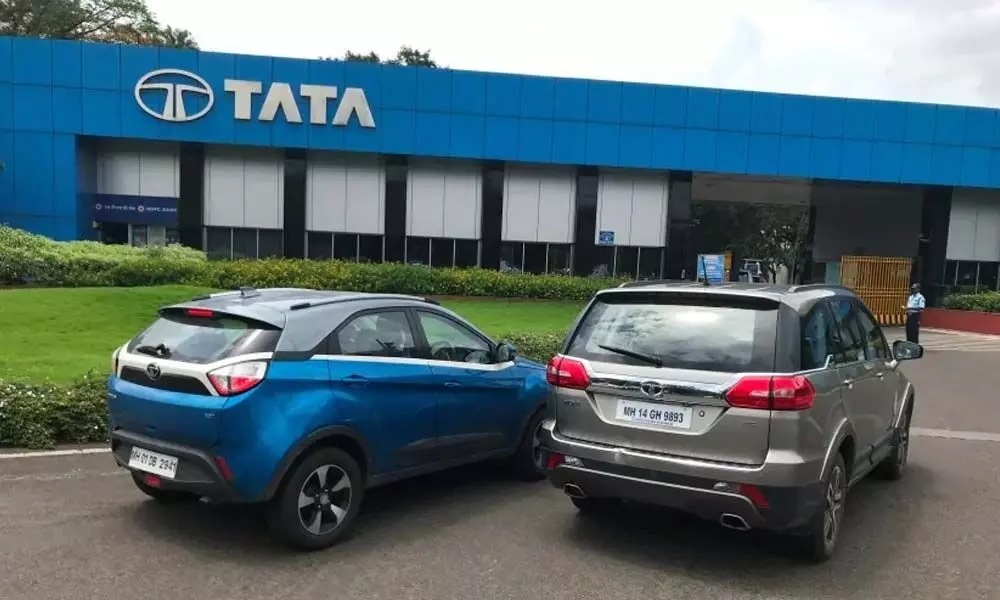
Tata Motors Passenger Vehicles:
₹70,108 Cr Revenue. -26% YoY. The Cyber Incident That Broke the Math.
A story of two companies held together by hope and balance sheets. JLR’s cyber meltdown cost ₹50,000 units of production. India PV is printing records. One is drowning. One is flying. And somehow, both are part of the same P&L.
The Company That Can’t Decide If It’s Growing or Shrinking
- 52-Week High / Low₹449 / ₹324
- Q3 FY26 Consolidated Revenue₹70,108 Cr
- Q3 FY26 Consolidated PAT-₹2,074 Cr (Loss)
- Q3 EPS (Annualised Q3×4)-₹37.88
- FY25 Full-Year EPS₹231
- Book Value₹301
- Price to Book1.17x
- Dividend Yield1.71%
- Debt / Equity0.61x
- Return (1 Year)-10.4%
Two Ships. Same Company. Different Destinations.
Tata Motors Passenger Vehicles Limited (formerly Tata Motors Ltd, post-demerger in October 2025) is exactly what you’d get if you woke up and decided to own both a profitable, high-growth Indian EV/passenger vehicle company AND a loss-making, cyber-attacked British luxury car maker in the same holding company.
Let me paint the picture: You have Jaguar Land Rover (JLR), the iconic UK-headquartered luxury auto maker that bought for $2.3 billion back in 2008, which generated 71% of your consolidated revenue in the last fiscal. Then you have India PV, which makes Tiago, Nexon, Harrier, and now the Sierra—a hot new mid-size SUV—and is chasing #1 position in the domestic EV market with 46% share and double-digit growth every quarter.
In Q3 FY26, one unit recorded a cyber incident that’ll eventually cost it ₹5,000+ crore in lost production, warranty provisions, and recovery costs. The other unit recorded the highest ever domestic quarter volumes and announced a ₹70,000 booking number for a brand-new product on day one. Both are real. Both are happening. Both are on the same balance sheet.
The demerger effective October 1, 2025, split the commercial vehicles business (which is now listed separately as Tata Motors Limited). What you’re looking at now is PV + JLR. A recovery story meets an existential crisis. Let’s untangle it.
How Do You Sell ₹1 Lakh Cars AND ₹30 Lakh SUVs From One Factory?
Here’s the split: 71% of revenue comes from JLR (Jaguar + Land Rover). Land Rover dominates with 93% of JLR’s sales—think Defender, Range Rover Sport, Discovery, Range Rover Evoque. Jaguar, the sedan/sports car marque, is bleeding red, which is why JLR is pivoting the entire Jaguar brand to all-electric by 2026 and retiring loss-making sedans. The bet: luxury EV buyers will pay the JLR premium.
That leaves 29% of revenue from India PV. But here’s what matters: India PV is growing at 20%+ post-GST cuts; JLR is shrinking at 40%+ due to macro, tariffs, cyber incidents, and China’s “structural” collapse. If you project five years forward, the mix will invert. India PV will be 60%+ of revenue. At that point, the balance sheet will reset, and suddenly this company will look like a 15% ROCE, 12% dividend-yielding, ₹1.5 lakh crore market cap business that people will actually want to own.
But you’re not there yet. You’re here. Today. With a cyber-crippled JLR, a cyber-insurance claim that’s still being fought, and a desperate need for FY26 to be “better than Q3,” which is a very low bar.
Q3 FY26: Numbers That Don’t Make Sense Until You Read the Fine Print
Result type: Quarterly Results (Consolidated) | Q3 FY26 Loss Per Share: -₹9.47 | FY25 Annual EPS: ₹231 | YTD (9M) Average PAT: Severely impacted by cyber incident
| Metric (₹ Cr) | Q3 FY26 Dec 2025 | Q3 FY25 Dec 2024 | Q2 FY26 Sep 2025 | YoY % | QoQ % |
|---|---|---|---|---|---|
| Consolidated Revenue | 70,108 | 94,472 | 72,349 | -25.8% | -3.1% |
| Operating Profit | 879 | 10,402 | -1,404 | -91.6% | Recover. QoQ |
| OPM % | 1.3% | 11.0% | -1.9% | -970 bps | +320 bps |
| PAT (Net Loss) | -2,074 | 5,484 | 76,248* | -138% | -103% |
| EPS (₹) | -9.47 | 14.69 | 206.85* | -165% | -105% |
When Your Factory Becomes a Hostage: The JLR Cyber Attack Explained
September 2025. JLR’s entire IT systems went down. Production across Solihull (England), Nitra (Slovakia), and Halewood (UK) ground to a halt. The incident: ransomware hit, systems encrypted, recovery took approximately one month of partial operations before full ramp-up by Q4.
Damage Tally: ~50,000 units of lost production. At an average selling price of ~GBP 76,000 per unit, that’s roughly GBP 3.8 billion (~₹38,000 Cr) in lost revenue. Gross margin impact? Approximately 40%, so ~₹15,000 Cr in lost contribution. But wait, fixed costs like salaries, depreciation, R&D still flowed. Net loss from forgone contribution: ~₹12,000–15,000 Cr on an annualized basis.
But that’s just half the story. Post-incident, JLR had to:
- • Settle supplier claims for overdue invoices (paid suppliers’ year-end arrears early)
- • Accrue warranty provisions (₹100 Cr+ for USA-specific buyback campaigns)
- • Increase vehicle marketing expenses (VME) to 7.7% of sales—double the historical 4.2%—to protect retail momentum in China and the US
- • Deal with inventory absorption timing effects (massive destocking in Q2 to shore up cash; restocking in Q3 ate into margins due to fixed manufacturing cost allocation)
Management guided that FY26 net loss will likely be in the -GBP 2.2 to -2.5 billion range for free cash flow. Why such a wide band? Q4 recovery timing is uncertain.
Record Volumes. Record Market Share. Record Everything Except Waiting Period.
While JLR was fighting hackers, India PV posted the following in Q3 FY26:
✅ Highest Ever Domestic Quarterly Volumes: 171,000 Units
Retail sales exceeded offtake. Inventory reduced across the industry by 10–15 days due to demand tailwinds post “GST 2.0” (September 2025 cut in GST rate on EVs from 5% to 0%). Market share reached 13.8% in January 2026, up 100 bps QoQ.
🚗 Sierra Launch: 70K Day 1 Bookings
- • Phenomenal response; “in six digits” by quarter-end
- • Production 7,000 units in January 2026; ramp constraints real
- • Harrier petrol (+30–35% of Harrier mix) shares 1.5L engine with Sierra
- • Waiting period 6–7 months expected to reduce as ramp continues
⚡ EV Growth Accelerating Fast
- • Q3 EV volumes ~24,000 per quarter (vs 16,000 historically)
- • Market share 46% in December (exiting quarter)
- • 2.5 lakh EVs on road milestone crossed
- • Concern: GST cut made EV TCO adverse vs petrol, but demand holding
Financial Bridge: India PV PAT for Q3 was ~₹200–300 Cr (management didn’t break out exact standalone figures, but from concall: revenue growth +24% YoY, EBITDA margin 7%, EBIT margin 1.2%, both improving QoQ). Add back PLI accruals of ₹361 Cr in Q3 (₹573 Cr YTD), and standalone profitability looks reasonable for a 13–14% CAGR growth company.
One Unit Has ₹3,200 Crore in Net Cash. The Other Has ₹39,000 Crore in Net Debt.
| Item (₹ Cr) | Sep 2025 (Latest) | Mar 2025 | Sep 2024 |
|---|---|---|---|
| Total Assets | 344,264 | 376,973 | 369,521 |
| Equity Capital + Reserves | 110,746 | 116,144 | 84,918 |
| Borrowings | 67,258 | 71,540 | 107,264 |
| Other Liabilities | 166,260 | 189,289 | 177,339 |
| Total Liabilities | 344,264 | 376,973 | 369,521 |
Available: ₹343 Billion (~₹34,300 Cr) + Undrawn RCF ₹195 Billion + Bridge facility ₹235 Billion (£2 Bn, £500 Mn drawn). Translation: No bankruptcy risk in the next 12 months. But if Q4 doesn’t deliver, covenant pressure could force asset sales.
Net cash ~₹5,000 Cr. Positive FCF in Q3. Capex well-managed. No leverage pressure. Can fund growth, shareholder returns, and weather downturns. Contrast: JLR’s ₹39,000 Cr net debt on ~₹2.5 Lakh Cr gross asset base = 15%+ leverage that needs urgent de-leveraging.
Consolidated D/E 0.61x masks the split: JLR 0.8–0.9x, India PV 0.15–0.2x. In isolation, India PV is fortress-like. Consolidated view? Vulnerable to JLR downside until demerger/sale happens or JLR stabilizes.
YTD FCF: -₹18,000 Crore. And It’s All JLR.
| Cash Flow (₹ Cr) | 9M FY26 | 9M FY25 | Q3 FY26 |
|---|---|---|---|
| Operating CF | Negative ~GBP 3 Bn | Positive | Severely Negative |
| Working Capital | Negative ~GBP 1.25 Bn | N/A | Inv. build + lower volumes |
| Free Cash Flow (Guidance) | -GBP 2.2-2.5 Bn FY26 | Positive | -₹17,900 Cr in Q3 alone |
Which Story Do You Want to Believe?
Interpretation Game: If you strip JLR out, India PV would show 35%+ ROE, 25%+ ROCE, single-digit P/E multiples, and negative net debt. The consolidated metrics look “OK” only because India PV’s 29% ROE + 20% ROCE is masking JLR’s collapsing returns. On a look-through basis, this is two companies with +/- 15% ROCE held in a single shell. Normally, that’s a takeover target or a demerger candidate. In this case, that’s exactly what’s happening—market is waiting for either JLR to be sold, stabilized, or written down.
Comparing a Luxury + EV Startup Hybrid to Pure-Play Competitors
| Company | CMP (₹) | P/E | MCap (₹ Cr) | Div Yield % | ROCE % | ROE % |
|---|---|---|---|---|---|---|
| Tata Motors PV | 351 | 21.5x | 1,29,159 | 1.71% | 20.0% | 28.1% |
| Maruti Suzuki | 14,159 | 29.8x | 4,45,163 | 0.95% | 21.7% | 15.9% |
| Mahindra & Mahindra | 3,332 | 25.9x | 4,14,406 | 0.76% | 13.9% | 18.1% |
| Hyundai Motor India | 2,094 | 29.9x | 1,70,162 | 1.00% | 54.2% | 42.2% |
| Force Motors | 21,345 | 29.3x | 28,125 | 0.19% | 29.9% | 20.8% |
The Trap: Tata Motors PV trades at 21.5x P/E, a discount to Maruti (29.8x) and M&M (25.9x). But here’s why: those peers don’t have a ₹39,000 Cr net-debt JLR subsidiary dragging returns. Hyundai Motor India has 54.2% ROCE vs TMPV’s 20%—Hyundai is pure-play high-margin PV. You’re getting a liquidity discount (P/B 1.17x vs 4.46x for Maruti, 5.0x for M&M) because the market doesn’t trust the consolidated earnings. Fair price for JLR uncertainty? Probably. But it also means: if JLR stabilizes, this stock re-rates 30–40% higher inside 12 months. If JLR blows up, it re-rates 30% lower. High-beta play.
Three Storylines Running in Parallel
🔴 JLR Cyber Incident + Recovery Arc
Incident: September 2025 ransomware attack. Lost production: ~50,000 units. Cost: ~₹15,000 Cr in forgone contribution. Recovery: Phased restart October 8, 2025. All plants operational by end-November 2025 at “full capacity.” Q4 FY26 expected to show operating profit recovery. FY26 guidance: FCF -GBP 2.2–2.5 Bn, but “ramp to be observed in Q4 and Q1 FY27.”
⚠️ Structural Headwinds at JLR
- • China’s premium market down 21% YoY—”structural, not cyclical”
- • 5,000 retailers in China pushed into insolvency last year
- • VME (sales support) at 7.7%—double the historical norm; expected to “cap and come down” by H2 FY26
- • Tariff drag: GBP 410 Mn adverse YTD; US price increases may lose stickiness to discounting
✅ New Product Launches (India PV)
- • Sierra: 70K day-1 bookings; 6–7 month waiting list
- • Punch Facelift launched; highest ever January volumes
- • Harrier/Safari 1.5L petrol launched; expected 30–35% of Harrier volumes
- • Punch EV and Sierra EV planned for “very soon”
The Tata Fortress and What It Means for Minority Shareholders
- Promoters (Tata Sons + Tata entities)42.56%
- Public24.14%
- DIIs (incl. LIC 4.65%)15.08%
- FIIs17.88%
Pledge: 0.00%. Promoter holding declined 3.83% over 3 years (due to demerger, not sales). Shareholder base: 66.7 lakh (up from 57.3 lakh in 9M FY25).
Tata Sons: The Deep-Pocket Backstop
43.69% owner via Tata Sons Private Limited. Will not let this company implode. Track record: rescued IndiGo crisis, supported Tata Steel, backed multiple turnarounds. The bet: Tata Sons has strategic intent to keep TMPV as the flagship automotive play in the domestic market. Minority shareholders benefit from this “too big to fail” safety net. The cost: dilution via capital calls (e.g., if JLR needs ₹10,000 Cr+ in bailout capital, Tata Sons will fund it, diluting your equity).
FIIs Hold 17.88%. Rekha Jhunjhunwala 1.33%.
Foreign institutional ownership is modest (typical for a company with execution/currency volatility concerns). Domestic retail has grown to 24.14% public float (Shareholder base 66.7 lakh from 38.1 lakh in Mar 2023—70% growth in retail interest over 2 years). Indian retail is betting on the India PV upside story. Institutional confidence: still cautious pending JLR stabilization.
Shake-Up Season: New MD, CFO, and a Whole Leadership Bench Overhaul
✅ Governance Strengths
- ✓ Independent board: 78% independent directors as of March 2025
- ✓ Gender diversity: 33% female board directors
- ✓ CRISIL reaffirmed ratings AA+/Stable in Oct 2025 (post-cyber incident)
- ✓ Clean audit history; no material qualifications
- ✓ Interest coverage ratio 3.37x (JLR’s debt is serviceable; no imminent stress)
⚠️ Governance Watch Points
- ⚠ Shailesh Chandra appointed MD & CEO Oct 1, 2025 (new appointment; previous leadership exited)
- ⚠ CFO Deepesh Baxi exited March 2025; Dhiman Gupta onboarded Nov 14, 2025 (6-month vacancy)
- ⚠ Full senior management reset: 10 KMP appointments on Nov 14, 2025 (CTO, CHRO, CDO, CPOs, CCOs)
- ⚠ Postal ballot Dec 2025: approved Shailesh Chandra’s 3-year contract at ₹4.00 Cr basic salary
- ⚠ Leadership in flux during the worst production crisis in company history (cyber incident Q3)
Translation: The board is cleaning house. New leadership = new strategy. Whether that’s “pivot JLR to profitability” or “prepare JLR for sale/merger” is unclear. Management messaging: “adjust our business model; environment has changed.” That’s code for “we’re rethinking everything.” Minority shareholders should watch Q4 guidance and any capital raise announcements very carefully. If Tata Sons needs to inject ₹15,000+ Cr into JLR, equity dilution will be substantial.
Why India is On Fire and Everything Else is Melting
🚀 India PV: Structural Upside, Cyclical Tailwinds
India’s domestic PV market in Q3 posted highest ever quarterly offtake at ~13 lakh units (industry). Tata PV’s share: 171,000 units (13.8% share). Growth drivers: GST cut on EVs (5% → 0%) in September 2025 created TCO parity vs petrol in compact/mid-SUV segments. Rural vehicle parc growing faster than urban. CV utilization near highs (good replacement cycle). EV penetration still <5% of new car sales, so 15+ year TAM ahead. Sierra launch proves product fit. Waiting lists prove pricing power. This is not hype; it's supply-constrained growth. Analysts project 12–18% CAGR on India PV revenue through FY28. Not controversial.
📉 JLR: Structural Decline, Cyclical Collapse
China’s premium car market down 21% YoY. Management called it “structural and permanent.” Translation: not a temporary macro dip; Chinese OEMs are eating JLR’s lunch in the affordable premium segment. JLR is niche (Defender, Range Rover, Range Rover Evoque—all >GBP 50,000). Cheaper Chinese EVs at GBP 20–30k are not direct competitors, but retail confidence in the segment is shaken. US luxury market: cyclical softness, tariff uncertainty. Europe: tariffs on Chinese imports creating unpredictability. JLR’s only structural lever is EVs (Jaguar all-electric by 2026) and Range Rover electric (launching FY26). But EV margins in luxury are still unproven. Best-case scenario: JLR stabilizes at 55–60% of historical volumes (i.e., ₹80,000–90,000 Cr revenue vs FY25’s ₹109,000 Cr); margins improve to 3–5% EBIT (vs current negative). That’s a ₹4,000–5,000 Cr EBIT business. Worst-case: continues to shrink; becomes ₹50,000 Cr revenue business with negative margins; requires Tata Sons bailout or asset sale.
🔄 The EV Transition: India PV Winning; JLR Wrestling
India PV’s EV market share at 46% (exiting Q3). Even post-GST cut (which killed EV TCO advantage), demand “remains stable,” per management. Why? Multi-price-point portfolio (Tiago EV at ₹8.5 lakh, Nexon EV at ₹12 lakh). Lifetime warranty. Value enhancements. Growing charging infra (18,100+ stations). For JLR, the play is different: Jaguar going all-electric by 2026, but brand perception is “old sedans.” Range Rover electric launching in FY26, but margins on luxury EVs are not yet proven (tooling costs, battery costs eating into the 40%+ gross margin luxury cars used to have). The risk: JLR’s EV ramp happens exactly when the demand environment is weakest (see: China). Timing is everything.
💰 Tariffs, Currency, Commodities: The Squeeze
JLR YTD tariff impact: GBP 410 Mn (~₹4,100 Cr). That’s the single biggest headwind. Management can pass some through, but retail competition limits pricing power. India side: commodity pressure ~1.7–2% of revenue historically, no precise Q4 guidance. INR weakness is a 2-way street: JLR’s GBP-denominated cash flow weakens against INR (macro hedge headwind), but India costs denominated in INR become relatively expensive vs global bench marks. For TMPV specifically, the company is geared towards these headwinds through pricing, hedging, and cost management. But JLR’s 40%+ EBIT margin assumption in FY25 is not defensible in the current tariff + margin compression environment.
Bottom Line on Macro: India PV is a 15%+ CAGR story for the next 5–7 years driven by EV penetration, geographic expansion, and vehicle parc growth. JLR is a 5–10% CAGR decline story for the next 2–3 years, followed by stabilization IF EV launches stick and China doesn’t get worse. The mix is inverting: by FY28, India PV will be 60%+ of revenue, and consolidated returns will look more like 15% ROCE, 18% ROE, 12% dividend yield—i.e., a 20% re-rating from here on the PV upside alone. But that’s a 2–3 year bet, and JLR could blow up the thesis in Q4 or FY27 H1.
The Verdict: A Bet on India PV Upside vs. JLR Downside Risk
Tata Motors Passenger Vehicles is a bifurcated bet held together by Tata Sons’ pledge not to let it implode. One unit is in high-growth, high-ROCE mode. The other is burning cash at a cyber-incident-accelerated rate. The market is pricing it as if both are equally likely to matter. You’re being asked to buy a ₹1,29,000 Cr company where ₹80,000 Cr of market cap belongs to India PV, and ₹50,000 Cr belongs to the hope that JLR stabilizes.
Q3 FY26 Execution: India PV delivered record 171K domestic volumes, 13.8% PV share, 46% EV share, and profitability guidance suggesting 15%+ FY26 CAGR. That part was near-perfect. JLR, on the other hand, suffered its worst quarter since the 2008 financial crisis due to cyber incident and macro headwinds. Consolidated loss of ₹2,074 Cr includes ₹800 Cr cyber-related impact, but underlying JLR EBIT margins have collapsed from 11%+ to negative single-digit. This is not a cyclical miss. This is a reset.
The Demerger Context: October 2025 demerger split CV business into Tata Motors Limited. What you have now is a “Pure PV+JLR” play. The expectation: over the next 2–3 years, either (a) JLR is sold to a strategic buyer or PE firm, (b) JLR is heavily written down and restructured, or (c) JLR stabilizes faster than consensus expects. Any of these three outcomes would be re-rating events. Doing nothing (JLR languishing for 5+ years) is the bear case already priced in.
Fair Value Estimate: If you value India PV at 18x forward earnings (reasonable for a 15% CAGR EV leader in a 13% market-share position) and JLR at a 0.8x revenue multiple (distressed auto luxury, similar to Ford or GM equity value post-restructuring), you’d get: India PV ₹65,000 Cr (assuming ₹3,600 Cr run-rate profit, 18x = ₹64,800 Cr) + JLR ₹35,000–40,000 Cr (on ₹109,000 Cr FY25 revenue × 0.35 multiple = ₹38,000 Cr, generous for a loss-making unit) = ₹100,000–105,000 Cr consolidated equity value. Current price is ₹1,29,000 Cr market cap. That implies ₹24,000–29,000 Cr of value destruction embedded in the current price—mostly JLR beta and de-rating for the cyber incident. If you believe JLR recovers to even a 1.0x revenue multiple or India PV grows faster than 15%, the risk-reward tilts positive. If you believe JLR is structurally broken and needs a 50%+ haircut, the downside is -20–25% from here.
✓ Strengths
- India PV growing 15%+ with 46% EV share; 13.8% domestic PV share and accelerating
- Sierra launch with 70K day-1 bookings; proven new product success
- EV market leadership and 2.5 lakh vehicles on road; structural advantage vs competitors
- India PV fortress balance sheet; net cash ~₹5,000 Cr, positive FCF, no leverage concerns
- Tata Sons backing; strategic importance to Tata Group; no bankruptcy risk
- ROCE of 20% is respectable for a conglomerate with JLR headwinds
✗ Weaknesses
- JLR cyber incident cost ₹5,000+ Cr; recovery trajectory uncertain
- JLR net debt ₹39,000 Cr; leverage will exceed 1.0x through FY27
- JLR EBIT margins collapsed; FY26 guidance -GBP 2.2-2.5 Bn FCF signal prolonged pain
- China’s “structural” premium market decline puts JLR’s largest growth region at risk
- Tariff headwinds (GBP 410 Mn YTD); JLR has limited pricing power to offset
- New management in crisis mode; visibility on JLR turnaround strategy low
→ Opportunities
- India PV domestic TAM runway: only ~5% EV penetration; 15+ year growth ahead
- Post-GST cuts TCO parity created new customer segments; market share capture ongoing
- Harrier/Safari petrol mix driving volumes; Sierra ramp creating 6–7 month waiting period
- JLR Range Rover electric and Jaguar all-EV brand launches in FY26; potential to arrest decline
- JLR sale / strategic partnership could unlock ₹30,000+ Cr of equity value
- Shareholder return optimization: higher payouts from India PV FCF if JLR separation happens
⚡ Threats
- JLR retail demand weakness continues; FY26 volumes could fall below 350K (vs 401K FY25)
- Further cyber attacks or supply chain disruption could delay recovery
- India PV competition intensifies; Maruti, Mahindra, Hyundai adding EV models aggressively
- Macro slowdown in India reduces demand; FY26 industry growth assumed 8–9%, could fall to 0–3%
- INR depreciation increases JLR debt servicing costs; GBP-denominated cash flows weaken
- Covenant breach risk if JLR debt metrics breach; credit rating downgrade likely (CRISIL on Negative Outlook)
This is not a “boring Indian auto company” story. This is a leveraged call option on India PV’s upside, hedged by JLR’s downside tail risk.
If you believe India PV can grow from ₹27,000 Cr revenue (FY26E) to ₹40,000+ Cr by FY28 at 18%+ ROCE margins, and simultaneously JLR either stabilizes at breakeven or gets sold for ₹30,000–35,000 Cr to a PE buyer, then the stock re-rates to ₹500–600 over 24 months. That’s 40–70% upside.
If you believe JLR is structurally broken (declining to ₹70,000 Cr revenue with negative EBIT), Tata Sons eventually writes down the equity by 30–40%, and India PV’s growth stalls due to competition, then the stock re-rates to ₹200–250. That’s -40–45% downside.
Risk/reward is asymmetric if you tilt positive on India PV’s TAM and JLR’s recovery probability. Asymmetric negative if you tilt bearish on JLR’s structural headwinds. The current price of ₹351 pricing in modest recovery for JLR (1.0x revenue multiple) and 12–13% growth for India PV. That’s a middle-ground assumption. Which side of the JLR trade are you on?