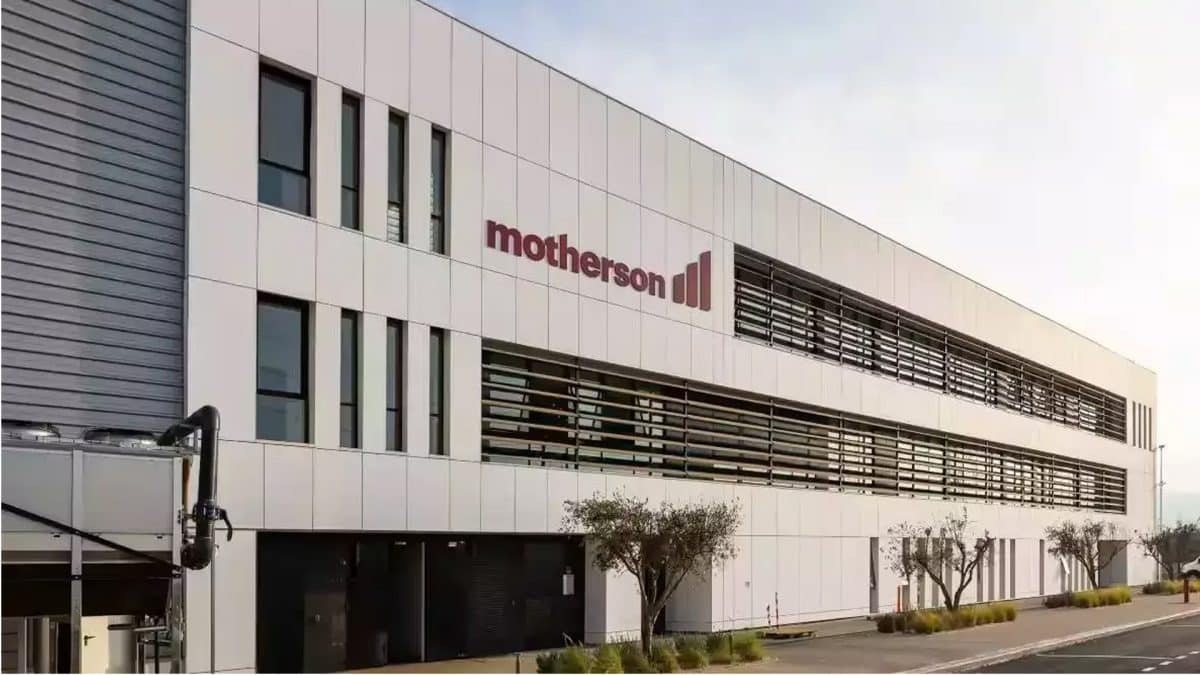
Motherson:
₹31,409 Cr Revenue. 36.8x P/E.
The Sprawling Beast That Just Keeps Growing
Record-breaking quarterly revenue, normalized PAT up 21% YoY, global auto supplier chaos = Motherson’s playground. Multi-billion acquisition spree. New greenfield plants. And the stock is up 44% in a year. Boring execution, spectacular results.
The Tier-1 Supplier That Became a Global Sprawl
- 52-Week High / Low₹136 / ₹71.5
- Q3 FY26 Revenue₹31,409 Cr
- Q3 FY26 PAT (Normalized)₹1,061 Cr
- Q3 FY26 EPS₹0.97
- Annualised EPS (Q3×4)₹3.88
- Book Value₹35.2
- Price to Book3.49x
- Dividend Yield0.46%
- Debt / Equity0.53x
- Net Leverage1.1x
The Motherson Multiverse: You Can’t Make This Stuff Up
Samvardhana Motherson International Ltd is India’s largest automotive ancillary company by revenue. But “ancillary” is doing heavy lifting here. The company doesn’t just make one thing—it makes everything: wiring harnesses, rear-view mirrors, interior modules, exterior polymers, integrated assemblies, aerospace components, and now consumer electronics with a 41% YoY growth rate. And then some.
The business portfolio is genuinely diversified. Wiring harness is 25% of revenue. Vision systems (mirrors) are 15%. Modules and polymers—the behemoth—are 46%. Integrated assemblies, 8%. Emerging businesses (aerospace, consumer electronics, and Atsumitec), 6% but scaling fast. The company operates across 270 facilities in 41 countries. Global OEM customers include VW Group, Mercedes, Hyundai, BMW, Ford, and increasingly, Japanese manufacturers like Honda and Toyota (via the Atsumitec acquisition). Revenue base: ₹1,21,111 crore (TTM basis). Operating margin: 8.88%. And the stock has delivered 44% returns in the last year.
But there’s friction underneath. The company is swinging for moon-shots via aggressive M&A: Atsumitec (95% stake), Nexans Autoelectric (EUR 207 million for wiring harness business), Yutaka Giken (Japan). It’s also building 12 greenfield plants across emerging markets. That’s ₹6,000+ crore capex guidance for FY26 alone. Meanwhile, global auto production remains uneven, EV adoption is ramping, and the company’s net leverage sits at 1.1x. Exciting? Absolutely. Safe? Let’s audit the books first.
They Make Parts. Lots of Parts. For Everyone. Globally.
Motherson’s business model is elegantly simple but geographically and product-wise complex. OEM customers design next-generation vehicles. They need wiring harnesses that carry power and signals through the car. They need mirrors (interior and exterior vision systems). They need plastic parts (bumpers, cockpit assemblies, door trims). They need thermal management. They need integrated door and roof systems. Motherson raises its hand for each and supplies. And now, they’re also supplying aerospace components and consumer electronics on the side.
Structurally, the company is vertically integrated—it does in-house design, development, manufacturing, and tooling. This moat is defensible because OEMs don’t want to manage multiple vendors for the same subsystem. Once a Motherson part is designed into a VW or Mercedes platform, switching costs are astronomical. Moreover, the company’s manufacturing is “local-for-local”: they source locally, produce locally, and supply locally from 270 facilities. This hedges FX risk, keeps logistics lean, and keeps customer satisfaction high.
Revenue concentration is high but improving. The top 8 customers account for 46% of revenue (vs 58% three years ago). The top single customer (Volkswagen Group) is 9%. The company explicitly reduced Mercedes-Benz exposure from 14% to 7% to diversify. India and USA represent 40% of revenue combined. But the growth engines are Asia (Japan, South Korea, Southeast Asia via recent acquisitions) and new verticals (aerospace, consumer electronics). The emerging businesses are scaling at >50% YoY.
Q3 FY26: Record Revenue, But Earnings Are Noisy
Result type: Quarterly Results | Q3 FY26 EPS: ₹0.97 | Annualised EPS (Q3×4): ₹3.88 | Full-year TTM EPS: ₹3.23
| Metric (₹ Cr) | Q3 FY26 Dec 2025 | Q3 FY25 Dec 2024 | Q2 FY26 Sep 2025 | YoY % | QoQ % |
|---|---|---|---|---|---|
| Revenue | 31,409 | 27,666 | 30,173 | +13.5% | +4.1% |
| Operating Profit | 3,043 | 2,686 | 2,611 | +13.3% | +16.6% |
| OPM % | 9.7% | 9.7% | 8.6% | Flat | +110 bps |
| Reported PAT | 1,072 | 984 | 846 | +8.9% | +26.7% |
| EPS (₹) | 0.97 | 0.83 | 0.78 | +16.9% | +24.4% |
Is 36.8x P/E Justified, or Just Hot Money?
Method 1: P/E Based
Full-year TTM EPS = ₹3.23 (actual). Industry median P/E = 26.7x. Motherson currently at 36.8x—a 38% premium. Justified by: global diversification, 13.7% ROCE, strong capex for future growth. Comparable range for a tier-1 global auto supplier with strong growth: 25x–32x.
Range: ₹81 – ₹103
Method 2: EV/EBITDA Based
TTM EBITDA (approx.) = ₹10,755 Cr. Current Enterprise Value = ₹1,42,668 Cr → EV/EBITDA = 13.3x. Quality auto supplier comps trade at 10x–14x EBITDA. Motherson sits at the high end thanks to growth expectations and capex.”
EV range (11x–13x): ₹1,18,305 Cr – ₹1,39,815 Cr → Per share:
Range: ₹89 – ₹113
Method 3: DCF Based
Base FCF (FY25): ~₹6,286 crore. Growth: 8–10% CAGR for 5 years (capex-backed, but subject to global auto cycle). Terminal growth: 2.5%. WACC: 9.5%.
→ Terminal Value (2.5% growth / 7% cap rate): ~₹112,500 Cr
→ Total EV: ~₹140,300 Cr (net debt ~₹10,942 Cr)
Range: ₹95 – ₹125
Motherson Is In Acquisition Overdrive. Here’s What’s Happening.
🔴 The M&A Shopping Spree
Motherson completed 5 acquisitions in FY25 and has announced 2+ more in FY26. The biggest: 95% stake in Atsumitec (Japanese manufacturer of precision-machined components like gear shifters, chassis parts). Also: Nexans Autoelectric wiring harness business for EUR 207 million (closing expected Q1 FY27). And: Yutaka Giken (81% stake, tender offer launched Feb 9, 2026). Strategic playbook is clear—leverage the Sehgal family’s relationships to buy into adjacent segments, consolidate, and integrate with group strengths. Management claims all acquisitions are “cash accretive” and “margin accretive.”
✅ Greenfield & New Initiatives
- • 12 greenfield plants (9 India, 1 China, 1 Poland, 1 Mexico, 2 UAE)
- • Majority to commission by H2 FY27
- • Vision Systems Greenfield in India (Q3 FY26)
- • Wiring Harness Greenfield in Morocco (Q3 FY26)
- • RoRo terminal at Dighi Port (Maharashtra) with APSEZ
⚠️ Capital Intensity & Execution Risk
- • FY26 capex guidance: ₹6,000 cr ±10%
- • FY27 capex guidance: Not yet disclosed
- • 12 greenfield plants is a massive logistics challenge
- • Global auto cycle remains uncertain
- • Integration of Atsumitec, Yutaka, Nexans is underway
Is the Fort Still Strong?
| Item (₹ Cr) | Mar 2023 | Mar 2024 | Mar 2025 | Sep 2025 (Latest) |
|---|---|---|---|---|
| Total Assets | 61,330 | 84,178 | 91,870 | 100,834 |
| Equity Capital + Reserves | 22,452 | 26,155 | 34,881 | 37,132 |
| Borrowings | 13,792 | 19,922 | 17,222 | 19,777 |
| Other Liabilities | 25,086 | 38,101 | 39,768 | 43,925 |
| Total Liabilities | 61,330 | 84,178 | 91,870 | 100,834 |
Debt stands at ₹19,777 Cr (Sep 2025) vs ₹17,222 Cr (Mar 2025). Debt/Equity: 0.53x. Net debt to EBITDA (LTM): 1.1x—well within stated comfort zone. But M&A + capex are pushing debt higher. Watch for leverage creep.
Interest coverage: 4.24x. Not stellar, but acceptable for a growth-focused auto supplier. With ₹1,578 Cr annual interest burden, the company can service debt comfortably, assuming EBITDA doesn’t contract.
Working capital days: -16 (as of Mar 2025). This means suppliers are financing Motherson. Strong bargaining power with vendors, but also suggests tight cash management.
Follow the Money
| Cash Flow (₹ Cr) | FY23 | FY24 | FY25 |
|---|---|---|---|
| Operating CF | +4,643 | +7,569 | +6,286 |
| Investing CF | -2,248 | -6,644 | -4,836 |
| Financing CF | -2,734 | +1,281 | -2,551 |
| Free Cash Flow | +2,395 | +925 | +1,450 |
Is This a Business, or a Spreadsheet?
Four-Year Revenue and Profit Trends
| Metric (₹ Cr) | FY22 | FY23 | FY24 | FY25 |
|---|---|---|---|---|
| Revenue | 63,536 | 78,788 | 98,692 | 113,663 |
| Operating Profit | 4,476 | 6,251 | 9,322 | 10,552 |
| OPM % | 7% | 8% | 9% | 9% |
| PAT | 1,182 | 1,670 | 3,020 | 4,146 |
| EPS (₹) | 0.86 | 1.47 | 2.67 | 3.60 |
This is a growth story. PAT CAGR of 45% is genuinely impressive and reflects M&A accretion, operational leverage, and margin expansion. But the law of large numbers applies—a ₹4,146 crore PAT base growing 45% is harder than a ₹1,182 crore base growing 45%. Expect moderation ahead.
Motherson vs The Global Brigade
| Company | Sales (₹ Cr) | PAT (₹ Cr) | P/E | ROCE % | Debt/Eq |
|---|---|---|---|---|---|
| Motherson | 121,111 | 3,525 | 36.8x | 13.7% | 0.53x |
| Bosch | 19,380 | 2,310 | 42.5x | 21.1% | 0.28x |
| Bharat Forge | 16,136 | 1,168 | 78.8x | 12.2% | 0.49x |
| Schaeffler India | 9,395 | 1,196 | 56.5x | 29.8% | 0.38x |
| Uno Minda | 18,850 | 1,158 | 55.9x | 18.8% | 0.28x |
The auto components space is richly valued across the board. Bharat Forge at 78.8x P/E is a cautionary tale. Motherson at 36.8x looks reasonable by peer comparison, but ROCE of 13.7% is the weakest in the group. Bosch and Schaeffler command higher ROCE multiples. The market is betting Motherson’s ROCE improves as greenfield plants contribute.
The Sehgal Empire Weakens Its Grip
- Promoters (Sehgal Family)48.60%
- Public17.89%
- DIIs20.98%
- FIIs11.99%
Promoter stake has fallen from 64.8% (Mar 2023) to 48.6% (Dec 2025). Sumitomo Wiring stake reduced from 14.15% to zero. QIP in Sep 2024 diluted promoter holding. Pledge: 2.90% (vs 0% historically)—a recent development worth monitoring.
Promoter: Sehgal Family
The Sehgal family, through various trusts and entities (Shri Sehgals Trustee Company, Renu Sehgal Trust), holds 48.6% of Motherson. Key individuals: Vivek Chaand Sehgal (12.49%, Group Chairman), Renu Alka Sehgal (11.96%, family trust), and various other family entities. The family controls operational and strategic decisions but with declining ownership. This is typical for Indian family businesses going public—founder retains control while shareholder base broadens.
QIP Impact & Pledge Watch
The Sep 2024 QIP (₹3,500+ crore raise) diluted promoter stake from ~60% to 48.6%. Recent pledges of 2.90% (up from 0%) suggest family may be using shares as collateral for M&A financing. This is a yellow flag—pledges can lead to forced selling in market downturns.
Boring But Important
✅ The Solid Bits
- ✓ Clean audit history—no material qualifications
- ✓ AAA (Stable) credit rating from ICRA (June 2025)
- ✓ Interest coverage 5.6x per FY25 ICRA report
- ✓ Global manufacturing footprint (270 facilities, 41 countries)
- ✓ Regular quarterly concalls maintained
- ✓ Investor meetings scheduled (Nuvama, JP Morgan, Mar 2026)
⚠️ The Watch List
- ⚠ Promoter pledge increased to 2.90% (leverage signal)
- ⚠ Capital-intensive model requires disciplined M&A integration
- ⚠ 12 greenfield plants at simultaneous execution risk
- ⚠ Exposure to global auto cycle downsides (EV, tariffs)
- ⚠ Minor regulatory fines (France, Germany, India) but within normal range
- ⚠ Customer concentration (VW Group 9%, still material)
The Sector Is In Flux. Motherson Is Trying To Catch Everything.
The auto components sector is undergoing existential pressure. ICE vehicles are being phased out in developed markets. EV adoption is ramping in China and, slowly, in India. Supply chain is decentralizing post-pandemic. And semiconductor and battery component demand is skyrocketing. Into this chaos, Motherson is buying businesses, building greenfields, and pivoting to aerospace and consumer electronics. Either genius or kamikaze. Let’s look at the math.
🔌 The EV Threat Is Real But Manageable
Wiring harness content per vehicle is lower in EVs vs ICE (fewer engine sensors, simpler thermal loops). Vision systems (mirrors) are not affected. Modules and polymers demand shifts but doesn’t disappear. Global PV production in FY26 is expected at ~91–93 million units. India’s EV share in new cars: ~5–6%. Commercial vehicle (CV) penetration: near-zero. The installed parc is still 95%+ ICE. So for the next 10+ years, Motherson will have customers. The threat is pricing pressure as OEMs consolidate suppliers.
🧲 The Hybrids & Emerging Markets Opportunity
Strong hybrids (used by Maruti, Toyota) still require full wiring harness and module content. The hybrid TAM in India is exploding—Maruti’s hybrid and segment strength is real. Motherson has tailored harness designs (HYSPEC range) for hybrids. Additionally, Southeast Asia, India, and Africa are growth markets for ICE vehicles for another 15–20 years. Motherson’s greenfield plants in these regions are bet-hedging, not empire-building.
🚀 Aerospace & Consumer Electronics: Real or Distraction?
Emerging businesses are growing at >50% YoY (though from a small base). Aerospace is “north of 40%” YoY growth (management’s words, Feb 2026). Consumer electronics (MECPL) is at 2 plants, targeting 16 million units annual capacity by end-FY26 with government ECMS incentives. These are real verticals but scaled-up slower than auto. The company’s playbook is customer-led adjacency: if a VW or BMW asks for aerospace components or EV cooling fluids, Motherson builds capability and acquires partners. This is defensive hedging, not aggressive new biz diversification.
⚠️ Competitive Intensity & Consolidation Risk
Bosch, Continental, Denso, and Lear Corporation are global tier-1 suppliers with deeper engineering R&D and software capabilities. Chinese suppliers (BYD, Aptiv, Yanfeng) are eating share in EV-centric components. Motherson’s moats (vertical integration, OEM relationships, local-for-local) are durable but not impenetrable. The company’s past 45% profit CAGR is unlikely to sustain—competition will normalize returns.
Macro Tailwinds: India’s vehicle parc growing 5–7% per year. Global auto production stabilizing at 85–95 million units annually post-COVID. India’s industrial capex cycle strong. Government push for data centres = immersion cooling fluid demand. Copper and aluminium prices moderately stable—no mega-cycles in near term.
Macro Headwinds: Geopolitical tensions (tariff uncertainty, sanctions). China’s auto OEMs gaining global market share. Developed-market auto production lumpy. EV supply chain shifting to battery makers and EV-native startups. Motherson is geographically and product-wise diversified against these, but not immune.
The Final Diagnosis
Motherson is a high-quality, globally diversified automotive components supplier executing an aggressive growth strategy at the exact moment the sector is fragmenting. Record quarterly revenue. 45% PAT CAGR. 12 greenfield plants. Billions in M&A. But also: 36.8x P/E (38% above sector median), moderate 13.7% ROCE, rising debt, and execution risk on 12 simultaneous greenfield projects.
The Bull Case: Motherson’s diversification (wiring, vision, modules, emerging businesses) insulates it from single-segment disruption. Acquisitions are bolt-ons that consolidate fragmented geographies and add complementary products. Greenfield plants in Asia-Pacific and Africa position the company for 2025–2030 emerging-market growth. The QIP raised ₹3,500+ crore without dilution concerns (still 48.6% promoter). Management has a 30-year track record of profitable execution. If greenfields ramp on schedule and M&A is integrated smoothly, ROCE can improve to 18–20% within 3 years, justifying current P/E.
The Bear Case: Global auto production is slowing. EV adoption will erode wiring harness content by ~15–20% over the next decade. The company is bidding blind on emerging-market demand (greenfields in 9 Indian states, Poland, Mexico, UAE—all execution-dependent). Capex of ₹6,000+ crore per year is capital-inefficient if ROCE doesn’t improve. Promoter pledge rising to 2.90% is a red flag. Net leverage will creep above 1.5x if M&A continues. At 36.8x P/E with modest 13.7% ROCE, the stock is priced for perfection.
Historical Context: Over 5 years, Motherson stock delivered 8.45% CAGR (vs 18.5% Nifty). Over 3 years, 30.1% CAGR (vs 15% Nifty). The recent 44% YoY return is well above historical average. This suggests current momentum may not persist. The stock is a compounder that over-delivers sporadically but underperforms in sideways years.
Q3 Execution: Highest-ever quarterly revenue of ₹31,409 crore is real. Normalized PAT of ₹1,061 crore (up 21% YoY) is real. OPM stability at 9.7% despite global PV production decline is real. But global automotive cycle is weakening heading into FY27. Management’s optimism on Q4 is encouraging, but earnings can reverse fast if OEM order books slow.
✓ Strengths
- Global tier-1 auto supplier with 270 facilities in 41 countries
- Diversified product portfolio: wiring, vision, modules, emerging biz
- 45% PAT CAGR over 4 years; revenue CAGR 15.4%
- Strong OEM relationships (VW, Mercedes, Hyundai, Toyota, Honda)
- Local-for-local manufacturing hedges FX and supply chain
- Acquisitions are bolt-on accretive plays, not transformational bets
✗ Weaknesses
- ROCE of 13.7% is moderate; cost of capital ~10%+ limits upside
- PAT margin only 3.56%—low for a global manufacturer
- Capex-heavy model requires sustained demand and operational discipline
- Promoter stake diluted to 48.6%; recent pledge hike to 2.90%
- Customer concentration (VW Group 9%) still material
- Debt rising; net leverage at 1.1x will trend higher with M&A
→ Opportunities
- Greenfield plants (12 total) targeting Asia-Pacific and emerging markets
- Emerging businesses (aerospace, consumer electronics) scaling at >50% YoY
- EV supply chain shift creating adjacent component demand
- Government incentives (ECMS, AACPT) supporting capex ROI
- M&A pipeline (Atsumitec, Yutaka, Nexans) adding product/geography
- Hybrid vehicle demand surge in India (Maruti, Toyota)
⚡ Threats
- EV adoption reducing wiring harness and module content per vehicle
- Chinese auto suppliers consolidating global market share
- Geopolitical tensions (tariffs, supply chain fragmentation)
- 12 greenfield plants execution risk; capex ROI uncertain
- Global auto cycle cyclicality; FY27 demand uncertain
- Competitive intensity from Bosch, Continental, Denso, Lear
Motherson is a credible execution machine betting billions that emerging markets + EV adjacencies + M&A = sustainable 15–18% ROCE within 3 years.
The Q3 results prove the company can deliver record revenue and growing profits in a softening global auto environment. But the market is pricing near-perfection at 36.8x P/E. Unless greenfield plants contribute faster or M&A synergies exceed 20%, the stock could face headwinds as capital intensity peaks before returns normalize. For growth-focused investors comfortable with execution risk, Motherson offers exposure to auto supply consolidation and emerging-market capex. For value-focused investors, the premium valuation and moderate ROCE suggest waiting for a pullback to ₹100–110 range.