At a Glance
Tata Consumer Products Limited (TCPL) has officially transitioned from being a “Tea and Salt” company into a multi-category FMCG powerhouse, crossing the ₹20,000 crore annual revenue mark in FY26. While the headline numbers look like a celebration, a deeper dive into the consolidated balance sheet and the segment-wise margins reveals a more complex narrative. The company is aggressively chasing growth through acquisitions—specifically Capital Foods and Organic India—but this expansion has come at a cost to the overall Return on Capital Employed (ROCE), which remains subdued due to high goodwill.
The India business is firing on all cylinders, with “Growth Businesses” like Tata Sampann and Ready-to-Drink (RTD) now contributing over 30% of domestic revenue. However, the international segment is grappling with a lag in margin normalization, primarily due to elevated green coffee prices in the US and geopolitical disruptions impacting exports. Investors are watching closely as the company executes a massive Go-To-Market (GTM) redesign, moving away from a unified distribution model to category-specific focus.
While the debt levels have been slashed following a major rights issue, the valuation remains at a premium, with a P/E ratio hovering around 74.7x. The auditor-style scrutiny points to a company that is technically robust but faces significant volatility in commodity prices (tea and coffee) and currency fluctuations. Can the “Growth Businesses” scale fast enough to offset the slowing growth in core tea volumes? The answer lies in their ability to premiumize a pantry that was once dominated by unbranded commodities.
Introduction
Tata Consumer Products is no longer just your grandmother’s tea company. Over the last few years, it has morphed into an integrated Food & Beverages (F&B) giant under the Tata Group umbrella. It holds the title of the 2nd largest tea company globally and maintains a dominant grip on the Indian salt market.
The company’s strategy is clear: strengthen the core (Tea & Salt) while aggressively scaling high-margin “Growth” categories. The acquisition of Capital Foods (Ching’s Secret) and Organic India is a bold bet on the “Mini-meals” and “Health & Wellness” platforms.
Operationally, TCPL is reinventing its reach. It currently touches 290 million households in India and distributes through 4.5 million retail outlets. The focus has shifted toward “Rurban” markets and digital-first channels, with E-commerce and Quick Commerce now making up a significant chunk of sales.
However, the path to becoming a top-tier FMCG player is riddled with commodity traps. Sudden spikes in North India tea prices or Arabica coffee costs can eat into margins before price hikes can be passed on. With a market cap of over ₹1.16 lakh crore, the stakes for management to “walk the talk” on execution have never been higher.
Business Model – WTF Do They Even Do?
At its heart, TCPL is a middleman that buys, brands, and sells what you eat and drink. They operate across three primary buckets:
- India Beverages: This is the kingdom of Tata Tea (2nd largest in India) and the premium Himalayan water. They also run a high-profile JV with Starbucks, which has now scaled to over 500 stores across 81 cities.
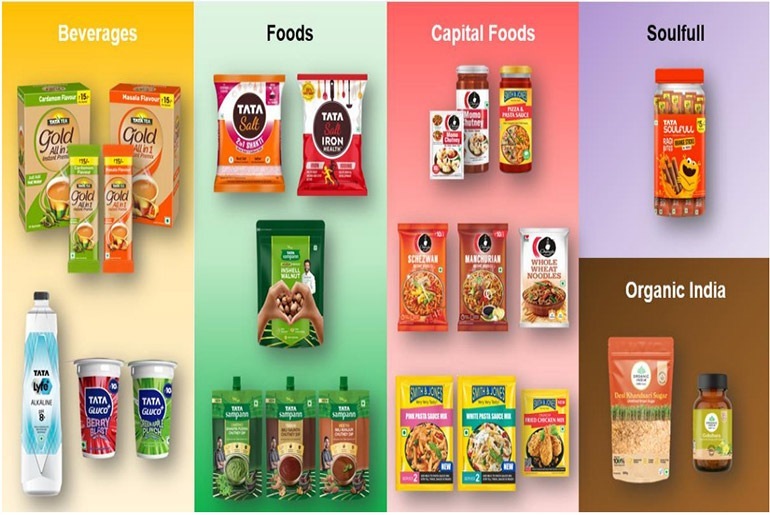
- India Foods: This segment is the current superstar. It houses Tata Salt (market leader), Tata Sampann (pulses, spices, staples), and the newly acquired Ching’s Secret and Organic India.
- International Branded: They own Tetley (Top 3 in UK/Canada) and Eight O’Clock Coffee (4th largest in the USA).
The model is shifting from