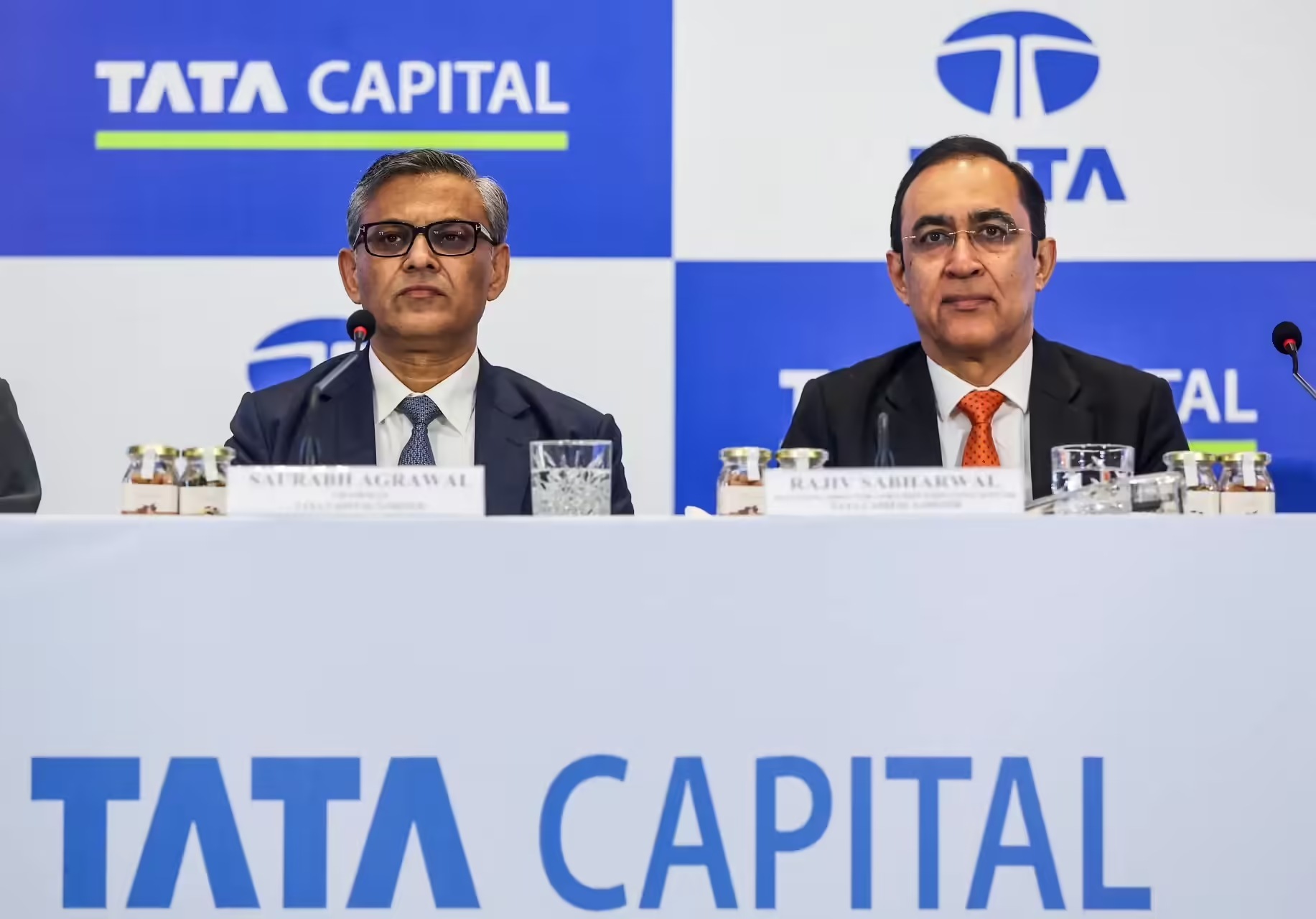
Tata Capital:
₹1,265 Cr PAT. 2.3% ROA.
The Most Boring Loan Book in India, But It’s Actually Working.
₹2.34 lakh crore loan book growing at 26% YoY. Record quarterly AUM addition. And a PE-like dividend yield of exactly zero percent. Welcome to the financial services equivalent of watching paint dry on a loan agreement.
The Tata Capital Story: Growing Like a Weed, Paying Like a Rock
- 52-Week High / Low₹368 / ₹315
- Q3 FY26 Revenue₹7,975 Cr
- Q3 FY26 PAT₹1,265 Cr
- Q3 FY26 EPS₹2.96
- TTM EPS (Annualised)₹10.93
- Book Value₹85.5
- Price to Book3.73x
- Dividend Yield0.00%
- Debt / Equity5.88x
- Listed SinceOct 14, 2025
Meet the Tata Group’s Loan Book Logistics Company
Tata Capital is the 3rd largest NBFC in India, trailing only Bajaj Finance and SBI Cards. Yes, you read that right. The flagship lending arm of a 157-year-old conglomerate. Serving 7.3 million customers. Operating 1,516 branches across 1,109 locations in 27 states. And generating ₹2.34 lakh crore in loan assets as of Q3 FY26.
The business is so granular, so diversified, and so boring that it actually works. Retail finance is 61.3% of the portfolio. SME is 26.2%. Corporate is 12.5%. Zero concentration risk. Zero celebrity founders. Zero “moonshot” pivots. Just steady, profitable, algorithmic lending across vehicles, homes, personal loans, business credit, and emerging micro-segments like housing finance for affordable properties in rural India.
Management frames Tata Capital as “a digital-first NBFC.” Translation: they’re hiring PhDs in machine learning, building underwriting scorecards that approve 97% of retail applications digitally, and collecting 99% of their dues through automated channels. The human touch is gone. The credit quality is… improving, apparently.
Q3 FY26 throws an interesting curveball. Highest-ever quarterly AUM addition. Unsecured retail rebounding after tightening cycles. Motor finance hitting operational breakeven after strategic repositioning. Credit costs declining. Operating leverage improving. And yet the stock trades at 30.5x trailing P/E, up from nothing in October 2025. Investor opinion on this NBFC is still being formed. Let’s dissect the facts before the narrative calcifies.
They Lend Money. To Everyone. All The Time.
Consumer Loans (43% of AUM): Personal loans, auto loans, home loans, loans against property, education loans. Your neighbor wants ₹5 lakh for a wedding? Tata Capital says yes at 7–9%. Your cousin wants to buy a second home? Tata Capital says yes, with a 62% average LTV. Your mechanic wants to start a workshop? They have an SBL product for that.
Commercial Finance (26% of AUM): Working capital loans, term loans, equipment financing, lease rental discounting. MSME owners who can’t access bank credit get a Tata Capital line at 10–12%. They scale distribution, Tata Capital scales lending. It’s a happy symbiosis.
Housing Finance (13% of AUM): Tata Capital Housing Finance (TCHFL), fully owned subsidiary, became a consolidated subsidiary in Q2 FY26. Already ₹81,585 crore AUM. Growing 30% YoY. Margins protected through affordable + micro-housing mix. Credit costs at 0.1% — best-in-class across Indian housing finance. ROA stable at 2.4% per quarter.
Motor Finance (9.5% of AUM): This is the repositioning story. Tata Capital absorbed TMFL (Tata Motors Finance) in April 2024, which immediately diluted returns (captive auto finance is commodity lending). Q3 saw a deliberate strategic re-pivot: de-growing near-term AUM (-6% QoQ), adding non-Tata OEM CV business (+19% share in new CV disbursements), increasing used vehicle sourcing, and tightening credit. Motor Finance hit operating breakeven in Q3. Management expects ROA improvement through FY27 and recovery by FY28.
Q3 FY26: The Numbers That Actually Matter
Result type: Quarterly Results | Q3 FY26 EPS: ₹2.96 | TTM EPS (Full Year Projection): ₹10.93
| Metric (₹ Cr) | Q3 FY26 Dec 2025 | Q3 FY25 Dec 2024 | Q2 FY26 Sep 2025 | YoY % | QoQ % |
|---|---|---|---|---|---|
| Revenue | 7,975 | 7,104 | 7,665 | +12.3% | +4.0% |
| PAT | 1,265 | 912 | 1,104 | +38.7% | +14.6% |
| NPM % | 15.9% | 12.8% | 14.4% | +310 bps | +150 bps |
| EPS (₹) | 2.96 | 2.15 | 2.61 | +37.7% | +13.4% |
| Cost-to-Income | 38.4% | 40.2% | 39.7% | -180 bps | -130 bps |
What’s This Growth Costing Us?
Method 1: P/E Based
TTM EPS = ₹10.93. NBFC sector median P/E = 17.7x. Tata Capital’s 26% AUM CAGR guidance and improving ROA justify 1.2x–1.5x sector. Fair P/E band: 21x–26.5x.
Range: ₹230 – ₹290
Method 2: Price-to-Book Based
Book Value = ₹85.5. Current P/B = 3.73x. NBFC peers (Bajaj Finance, Shriram Finance, Cholaman) trade at 3.1x–5.7x. Tata Capital’s mid-range justified P/B: 3.5x–4.5x given growth profile and IPO freshness.
Fair P/B: 3.5x–4.5x → Per share:
Range: ₹299 – ₹385
Method 3: DCF Based (Simplified)
Base PAT: ₹4,428 Cr (TTM). Growth: 20% for 2 years, then 12% for 3 years, then terminal 6%. WACC: 12% (cost of equity 14%, cost of debt 7.8%, D/E 5.88x).
→ Terminal Value (6% growth / 6% cap rate): ~₹73,000 Cr
→ Total Equity Value: ~₹92,000 Cr (estimated)
Range: ₹216 – ₹360
The Plot Thickens in Loan Land
🚀 The Big One: Unsecured Retail Inflection
After tightening cycles in 2024–early 2025 (when credit stress pockets emerged), Q3 FY26 marks an explicit pivot back to growth in unsecured retail. Unsecured disbursements hit a four-quarter high. Q3 disbursements were +30% YoY and +13% QoQ. Management flagged unsecured exposure currently at 10.4% of AUM, with a “runway to reach 15% over time.” Translation: management is confident in credit quality and is re-accelerating this higher-margin segment. Once disbursements scale, AUM growth will follow — a structural upside to guidance.
✅ Motor Finance Inflection
- • Breakeven achieved in Q3 (major milestone)
- • Deliberate de-growth phase ending; growth expected from H1 FY27
- • Non-Tata OEM share in new CV disbursements: 19% (multi-OEM transition working)
- • Used vehicle mix: ~30% of portfolio; incremental sourcing modulating based on GST dynamics
- • ROA improvement expected through FY27; target recovery by FY28
⚠️ Headwinds & Caution Flags
- • Labour Code rollout: one-time cost hit of ₹44 cr (Q3 normalised PAT: ₹1,290 cr ex-labour code)
- • Interest coverage: 1.38x (low; acceptable for NBFC but tight on an absolute basis)
- • Cost-to-income 38.4%: improving but target is 38–39%; margin for efficiency gains narrowing
- • Dividend yield: 0% (growth re-invested, not returned; suits growth investors, not income seekers)
The Fort Under Construction
| Item (₹ Cr) | Mar 2024 | Mar 2025 | Sep 2025 | Dec 2025 (Latest) |
|---|---|---|---|---|
| Total Assets | 176,694 | 248,465 | 256,228 | 271,936 |
| Net Worth (Equity + Reserves) | 23,417 | 33,191 | 36,284 | 43,153 |
| Borrowings | 148,512 | 208,851 | 213,294 | 213,294 |
| Other Liabilities | 4,765 | 6,422 | 6,649 | 6,649 |
| Total Liabilities | 176,694 | 248,465 | 256,228 | 271,936 |
Net worth grew from ₹33.2 Cr (Mar ’25) to ₹43.2 Cr (Dec ’25) — ₹10 Cr in 9 months. IPO infusion is showing. CAR at 20.3% is above regulatory minimum (CRR 11.5%) and above peers. Comfortable cushion for growth.
Borrowings at ₹2.13 lakh Cr. Debt-to-equity ratio 5.88x. Tight leverage. But cost of borrowing at 7.8% (average) is reasonable given AAA ratings. Debt maturity ladder is laddered; no refinancing cliff visible.
Total assets grew from ₹248 Cr (Mar) to ₹272 Cr (Dec) in 9 months. AUM (loans) is ₹234+ lakh Cr. Loan portfolio is 86% of total assets. This is a pure-play lending machine.
Where’s the Money Actually Going?
| Cash Flow (₹ Cr) | Mar 2024 | Mar 2025 |
|---|---|---|
| Operating CF | -37,999 | -29,872 |
| Investing CF | +5,758 | +3,167 |
| Financing CF | +35,952 | +29,412 |
| Net Cash Flow | +3,712 | +2,707 |
How Good Is This Lending Machine, Really?
The Profit Engine Accelerating
| Metric (₹ Cr) | Mar 2023 | Mar 2024 | Mar 2025 | TTM (9M+LTM) |
|---|---|---|---|---|
| Revenue | 13,631 | 18,178 | 28,324 | 30,856 |
| PAT | 2,946 | 3,327 | 3,655 | 4,428 |
| NPM % | 21.6% | 18.3% | 12.9% | 14.3% |
| EPS (₹) | 8.51 | 8.41 | 9.64 | 10.93 |
Revenue is growing 41% CAGR. Profit is growing 22% CAGR. The gap is leverage (debt is cheaper than equity, cost of borrowing diluting margins). But as the company matures and cost-to-income declines, the gap should narrow. This is not a margin-compression story; it’s a scale-and-efficiency story.
Tata Capital vs The Lending Aristocracy
| Company | Q3 Revenue (₹ Cr) | Q3 PAT (₹ Cr) | P/E | ROA % | D/E |
|---|---|---|---|---|---|
| Tata Capital | 7,975 | 1,265 | 30.5x | 2.3% | 5.88x |
| Bajaj Finance | 21,214 | 4,066 | 32.5x | 3.99% | 0.98x |
| Shriram Finance | 12,171 | 2,530 | 20.7x | 3.04% | 1.62x |
| Muthoot Finance | 8,188 | 2,823 | 14.9x | 4.67% | 1.58x |
| Cholaman.Inv.&Fn | 7,898 | 1,290 | 28.6x | 2.38% | 2.56x |
Tata Capital is neither the highest ROA nor the lowest P/E. It’s a middle child: fastest-growing AUM (26% CAGR), highest leverage (5.88x D/E), and priced at growth (30.5x P/E). Bajaj Finance (peer on valuation at 32.5x) has lower leverage and higher ROA. Muthoot Finance (lowest P/E at 14.9x) has best-in-class ROA at 4.67%. Tata Capital’s premium is justified only if AUM growth and operating leverage deliver the promised ROA expansion by FY28.
The Tata Stranglehold
- Tata Sons (80% of promoters)68.6%
- Other Tata Companies (19% of promoters)16.8%
- DIIs (incl. Institutions)16.7%
- FIIs / Public32.8%
Pledge: 0.00%. Shareholders: 14.04 lakh. IPO released ~5% public float into the market. But Tata Sons’ 68.6% is essentially a lock-in that ensures strategic continuity and mission alignment.
Promoter: Tata Sons & Ecosystem
Tata Capital is the flagship financial services company of the Tata Group. Tata Sons owns 80% of promoter stake. TMF Holdings (subsidiary structure), Tata Investment Corp, Tata Motors, Tata Chemicals, Tata Power — all minor stakeholders. The group benefits from internal supply (Tata Motors Finance merger, Tata Housing Finance consolidation). No conflict of interest; all in-group transactions are at arm’s length per Ind-As standards.
Change in Promoter Holding
Promoter holding declined from 95.6% (pre-IPO) to 85.4% (post-IPO). The dilution is by design — IPO was a capital raising exercise, not a promotional exit. Tata Sons’ commitment remains absolute. Their skin-in-the-game is deeper than any external investor’s.
Boring Governance Is the Best Governance
✅ The Clean Sheet
- ✓ AAA ratings from all major agencies (CRISIL, ICRA, CARE, India Ratings)
- ✓ IPO in Oct 2025 — fresh capital infusion and regulatory scrutiny passed
- ✓ SEBI settlement: Dec 23, 2025. One-time ₹32 lakh fine for NCD issuance violations (TMFL legacy, immaterial)
- ✓ NCLT-sanctioned demerger effective Oct 1, 2025 (TCHFL consolidated post-IPO)
- ✓ Quarterly concalls maintained; AI transparency in operations evident
- ✓ Promoter pledge: 0.00% (maximum alignment)
⚠️ Watch List
- ⚠ Debt-to-equity at 5.88x (leverage is high; sensitivity to rate cycles is high)
- ⚠ Interest coverage at 1.38x (tight; leaves little room for earnings surprises downside)
- ⚠ No dividend yet (0% yield; IPO proceeds are being re-deployed into growth, not returned)
- ⚠ Labour Code one-time cost: ₹44 cr absorbed in Q3 (normalising effect in Q4)
- ⚠ Motor Finance still in restructuring mode (8.5% of AUM, uncertain ROA recovery path)
The NBFC Game: Leverage, Rates, and Returns
India’s NBFC sector runs at roughly ₹25–27 lakh crore AUM collectively as of end-FY25. Growth is in the 18–22% range across the industry. But there are tiers. Bajaj Finance is the blue-blood wealth manager (stock price up 25x in a decade). SBI Cards is the rewards-focused credit card play (recession-resistant but commodity-like). Shriram Finance is the vehicle-finance specialist (asset-heavy, rate-sensitive). And then there’s Tata Capital — the diversified conglomerate NBFC trying to be all things to all people.
🔗 The Tata Group Synergy Play: Real or Overstated?
Tata Capital benefits from in-house customer sourcing (Tata Motors dealers are also auto-loan distributors), operational cost-sharing (IT infrastructure, branch networks, back-office), and cross-selling (Tata Power customers become personal loan customers). But synergies also create complexity. Motor Finance is a drag (post-TMFL merger). Housing Finance is diluting returns despite scaling fast. The “group synergy” framing is partially hype. In reality, Tata Capital is managing multiple business portfolios with divergent return profiles under one parent’s umbrella. Execution risk is real.
🚨 Interest Rate Sensitivity: The Structural Headwind
Tata Capital’s cost of borrowing is 7.8%. Its blended yield on the loan book is ~10–11% (estimated from NIM data). That 2–3% spread is declining as RBI cuts rates further (100 bps cuts in FY26 already). If rate cuts continue into FY27, net interest margins compress. Management is passing rate cuts to customers (NIMs stable per concall, not expanding). Leverage at 5.88x D/E means every 1% NIM compression flows directly to returns. This is why cost-to-income reduction is so critical — it’s the only lever to protect profitability if margins compress further.
💡 AI & Automation: Real Operating Leverage or Hype?
Management’s concall emphasis on “enterprise-wide AI deployment” is notable. 97% digital retail onboarding. 97% disbursements via scorecards. 99% collections via digital. Voice-based “Agentic AI” in sales, service, and collections. GenAI-driven credit memos. This is not pilot-stage talk; it’s scale-stage execution. If credit quality stays stable while cost-to-income declines from 38.4% toward 35–36%, then per-rupee profit increases materially. The thesis: AI is the structural cost-down lever that enables ROA expansion even if NIM compresses from rates. Credible, but unproven at scale.
🏠 Housing Finance: The Silent Winner
TCHFL’s 30% YoY AUM growth and 0.1% credit cost is exceptional. But it’s flying under the radar. ₹81,585 crore AUM, growing 30% YoY, with margins protected through affordable + micro-housing mix. ROA stable at 2.4% quarterly. If Tata Capital can scale TCHFL to ₹1.5 lakh crore AUM in 3 years while maintaining credit quality, that subsidiary alone could be worth ₹30,000+ crore market cap (at 4x P/E multiple on ROA expansion). This is a hidden asset within the consolidated financial services umbrella.
Competitive dynamics: Bajaj Finance is the quality leader (unmatched ROA and risk). Shriram Finance dominates vehicle finance (captive + industry leadership). Muthoot Finance owns the gold loan segment (lowest NPA, best ROIC). Tata Capital’s play is the “everything else” strategy — retail, SME, corporate, housing, motor, all under one roof. Diversification is strength. Complexity is risk.
Macro tailwinds: Vehicle parc growing. Rural consumption rising. MSME credit access expanding. Affordable housing policy tailwinds. GST credit benefits SME cash flows. RBI liquidity is orderly. The macro supports lending growth for the next 2–3 years.
Macro headwinds: Rate cycle is easing, not tightening (margin compression ahead). Deposit rates are competing with yields (cost of funds rising even as lending rates fall). EV adoption is beginning to compress vehicle finance demand (long-term threat, not immediate). Affordability indicators are tightening in segments like unsecured retail (deeper into the middle class, more stressed obligors).
The Tata Capital Equation
Tata Capital is not a mystery. It’s a straightforward financial leverage play on India’s lending boom, wrapped in Tata Group’s brand moat and powered by AI-driven operational efficiency. The equation is: 26% AUM growth × improving credit costs × declining operating leverage = ROA expansion from 2.3% toward 3.5%+ by FY28. The question is not whether the thesis is plausible. It’s whether the valuation (30.5x P/E, 3.73x P/B) prices in the success.
Q3 FY26 Execution: Highest-ever quarterly AUM addition of ₹16,800 crore. Unsecured retail disbursements at four-quarter high. Motor Finance breakeven achieved. Credit costs declining. NPM expanding from 12.8% (Q3 FY25) to 15.9% (Q3 FY26). Cost-to-income improving. Management confidence notably elevated. These are facts, not projections.
The Valuation Lens: At 30.5x TTM P/E, the market is pricing in significant ROA expansion (toward 3.5%+) and operating leverage realization by FY28. If that happens, the stock is reasonably valued. If AUM growth decelerates due to competitive pressure or macro deterioration, the stock re-rates downward sharply given the leverage (5.88x D/E makes every growth variance material). The margin of safety is thin.
Capital Deployment Path: IPO proceeds are not being returned to shareholders; they’re being deployed into the loan book. Dividend yield is 0%. For growth investors seeking 15%+ annualised returns from capital appreciation, Tata Capital’s 26% AUM CAGR × ROA expansion thesis is compelling. For income investors, this is the wrong counter.
Historical Context: Tata Capital was not a standalone entity until the IPO. It was buried inside Tata Sons’ holding company structure. The IPO separated it, allowing the market to value it on standalone fundamentals. The first 6 months of public life show disciplined execution. But the real test comes in FY27–28, when macro headwinds (rate cuts, deposit competition) intensify and management must prove that AI and unsecured retail momentum can sustain growth without NIM compression dragging returns.
✓ Strengths
- 26% AUM CAGR; highest-ever quarterly addition of ₹16,800 crore
- Diversified portfolio: retail 61%, SME 26%, corporate 13% (zero concentration)
- TCHFL subsidiary: 30% YoY growth, 0.1% credit cost (housing finance jewel)
- AI-driven underwriting: 97% digital onboarding, 99% digital collections
- AAA ratings across all agencies (top-tier credit profile)
- Tata Group backing (brand, synergy, integrity)
✗ Weaknesses
- Leverage at 5.88x D/E (highest among tier-1 NBFCs)
- Interest coverage 1.38x (tight; leaves little margin for error)
- ROA at 2.3% (lower than Bajaj 3.99%, Muthoot 4.67%)
- Motor Finance still in restructuring mode (portfolio drag)
- Zero dividend yield (capital not returned, reinvested entirely)
- Cost-to-income already declining; limited headroom for further improvement
→ Opportunities
- Unsecured retail re-acceleration (10.4% → 15% over time, higher margins)
- Motor Finance multi-OEM transition (breakeven achieved; growth expected H1 FY27)
- AI operating leverage (cost-to-income 38% → 35% potential by FY28)
- TCHFL scale (₹81k Cr → ₹1.5 lakh Cr AUM by FY28 possible)
- Rural lending expansion (undeserved customer base, captive through Tata channels)
- Fintech partnerships (using Tata Neu ecosystem for customer acquisition)
⚡ Threats
- RBI rate cuts compressing NIMs (cost of funds not declining as fast as yield)
- Competitive intensity in unsecured retail (Bajaj, BajajFinserv also scaling)
- EV adoption in auto lending (structural headwind 3–5 years out)
- Affordability stress in rural/semi-urban segments (late-cycle credit stress)
- Leverage sensitivity (5.88x D/E means 1% growth miss → 5–6% ROA miss)
- Macro deterioration (recession scenario would compress AUM growth and spike NPAs)
Tata Capital is not a “buy-and-hold forever” stock. It’s a “watch the thesis play out” stock.
The company has three years to prove that 26% AUM growth, declining credit costs, and AI-driven operating leverage can expand ROA from 2.3% toward 3.5%+ while managing the leverage (5.88x D/E) and macro headwinds (rate cuts, deposit competition). If they succeed, the stock at 30.5x P/E is reasonably priced. If they stumble — if AUM growth decelerates due to macro or competition, or if NPAs spike in unsecured retail — the stock re-rates downward with conviction given the leverage embedded in the capital structure.
The IPO in October 2025 was a capital-raising event, not a promotional exit. Tata Sons’ 68.6% stake is a vote of confidence. Q3 execution is credible. But credibility is not valuation. The market is already pricing in success. The burden of proof is now on management to execute FY27–28 guidance without stumbles.