Super Sales India Ltd Mar 2026 : A Massive 69.2x Valuation for a 0.70% Return on Equity
Section 1 — At a Glance
Super Sales India Ltd presents a stark contrast between market valuation and financial reality. The company commands a market capitalization of ₹256.03 crore at a current market price of ₹834, yet it generated a net profit of just ₹3.57 crore for the full fiscal year ending March 31, 2026. This thin profitability places the stock at a trailing P/E ratio of 69.2x, even though its Return on Equity (ROE) stands at a muted 0.70% and Return on Capital Employed (ROCE) is at 2.71%.
While top-line revenue has shown minor stability, closing FY26 at ₹410.54 crore compared to ₹403.77 crore in FY25, profitability remains highly volatile. Profit before tax staged a recovery to ₹7.96 crore from a loss of ₹1.72 crore in the previous fiscal year, but net margins remain razor-thin.
Investors are closely tracking the company’s strong asset backing, as the stock trades at 0.52 times its book value of ₹1,585, offering a deep statistical discount on a balance sheet level. However, substantial structural issues continue to weigh on performance. The company has delivered a poor sales growth of 8.99% over the past five years. Operating cash flows must now support an elevated debt profile, as borrowings have expanded to ₹110.33 crore. High raw material consumption costs, which stood at ₹249.16 crore in FY26, alongside climbing power and fuel expenses, leave operating profitability vulnerable to commodity cycles.
When valuation detaches from underlying capital efficiency, asset discounts can transform into value traps. The core challenge ahead is whether this extensive capital base can ever be optimized to generate meaningful corporate earnings.
Section 2 — Introduction
Super Sales India Ltd, established in 1981, operates as a small-cap player in the industrial manufacturing and textile ecosystem. Historically anchored as a reliable manufacturer of yarn, the company has diversified into manufacturing high-precision engineering gears and acting as a specialized marketing agency for textile machinery giants.
The small-cap space frequently features legacy businesses stuffed with real estate, investments, or unutilized capacities that trade at deep discounts to book value. This article exists to dissect the recent March 2026 financial disclosure, evaluating whether the company is on the verge of an operational turnaround or if it remains constrained by capital inefficiency and escalating leverage.
Section 3 — Business Model: WTF Do They Even Do?
Super Sales India Ltd runs a three-headed business model that splits its attention across very different industrial cycles:
Textile Division: This is the legacy engine, operating 105,000 spindles that churn out 25 tons of yarn daily. It accounted for 64.35% of total revenue in FY24, leaving the company heavily exposed to the volatile margins of the cotton spinning sector.
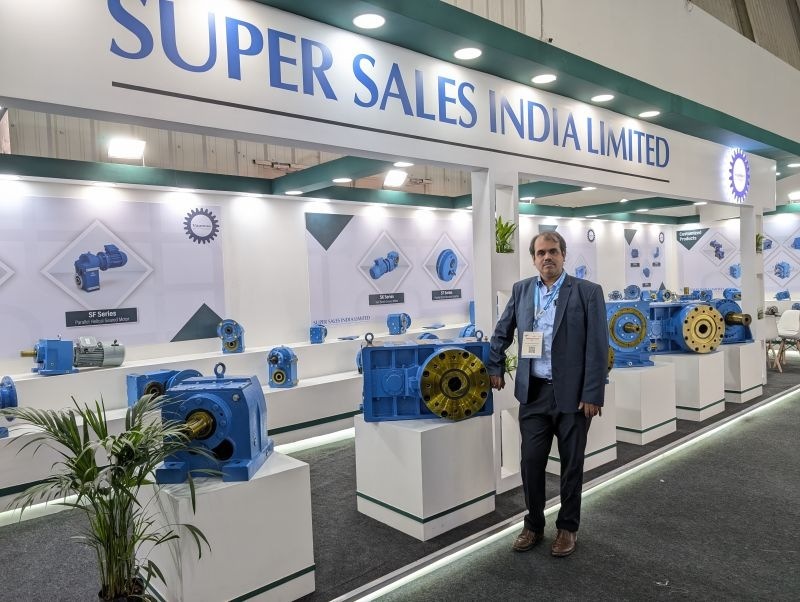
Engineering Division: Manufacturing high-precision industrial gears and gearboxes. This segment caters to heavy sectors like mining, construction, and material handling, making up 19.88% of sales.
Marketing Division: Acting as an agency for Lakshmi Machine Works (LMW) Textile Machinery, generating commission receipts, erection fees, and service charges, contributing 9.09% of revenues.
The operation relies heavily on traditional infrastructure. To hedge its heavy energy needs, the company has historically utilized wind energy with an installed capacity of 26.43 MW.
Section 4 — Financials Overview
Figures are consolidated, in ₹ crore.
The quarterly sequence reveals how hard it is for this cost structure to consistently pass through raw material variations to final buyers.
Comparison Table
Metric
Latest Quarter (Mar 2026)
YoY (%)
QoQ (%)
Revenue
102.92
2.21%
-0.91%
EBITDA / Operating Profit
6.78
61.81%
24.18%
PAT
-1.39
28.72%
-59.77%
EPS (₹)
-4.53
28.66%
-60.07%
Data Source: Excel Quarters Block & Screener Table
The top-line has stalled in a tight band around ₹100 crore per quarter. While operating profits managed a mild sequence expansion to ₹6.78 crore, net profitability dived back into negative territory at -₹1.39 crore due to rigid financing costs and localized tax provisions. Quarterly earnings volatility is a clear indicator of low pricing power, where minor cost variations completely alter net profit