General information and education, not investment advice. The author is not a SEBI-registered adviser or research analyst. No recommendation, no promised returns. Markets carry risk including loss of capital. Figures may not be current. Always consult a SEBI-registered adviser.
1. At a Glance
Sumeet Industries makes polyester yarn at Surat, and it sold more of it than a year ago. Revenue for the three months to June 2026 was ₹272.36 crore. That is 9.6% more than the same quarter a year earlier. Rather less of it stayed in the company.
Operating profit was ₹8.47 crore, against ₹13.60 crore in the same quarter last year. Net profit was ₹1.14 crore, against ₹7.98 crore. Operating margin, the share of sales left after running costs, came to 3.11%.
Management attributes the thinner margin to raw-material and freight cost inflation, after a surge in crude-linked feedstock prices. It points to costs rather than to demand, and the investor presentation calls the disruption exceptional and short-term. On the earnings call, the company said production volume fell about 17% from the previous quarter. It named raw-material scarcity and a 15-day maintenance shutdown as the causes. Sales held up, per the same call, because existing stock was sold down.
The balance sheet was rearranged over the same months. The company completed a ₹199.75 crore rights issue in July 2026, allotting 16.84 crore shares. Of that sum, ₹100 crore is earmarked for working capital. Another ₹49.90 crore goes to integrating a bought-out chips plant, and ₹23 crore to repaying debt. The remaining ₹22 crore funds a captive solar plant of 6.5 megawatts.
That bought-out plant was sitting in a liquidation process, and Sumeet agreed to pay ₹23.47 crore for it. The company’s market capitalisation is ₹987 crore.
2. Introduction
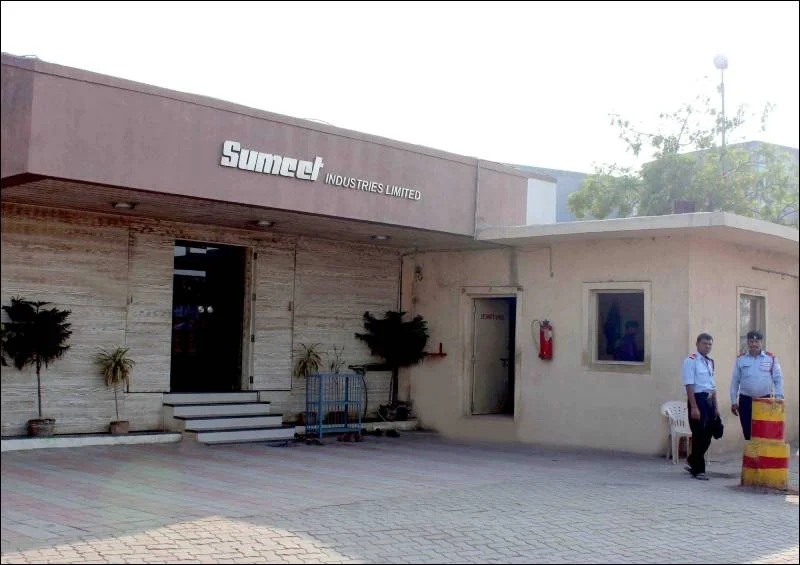
Sumeet Industries Limited was incorporated in 1988 as Sumeet Synthetics Private Limited. It became a public limited company in 1992 and took its present name four years later. It has been making polyester at Surat for more than three decades. The plant sits at Karanj, in Mandvi taluka of Surat district.
The corporate history has a break in the middle of it. In July 2024 the Eagle Group acquired the company from the earlier promoters, Sumeet Shankarlal Somani and family. The purchase ran through a resolution plan approved by the National Company Law Tribunal on 16 July 2024. That tribunal hears insolvency cases, in which a failed company is handed to a new owner. The acquisition itself was completed in December 2024.
Crisil, a credit-rating agency, wrote in August 2025 that the plan involved a significant haircut to creditors and a fresh equity infusion. A haircut means the lenders accept less money than they were owed. Crisil also revoked a ratings suspension that had stood since July 2012. It assigned Crisil BB+/Stable and Crisil A4+ to ₹292 crore of the company’s bank facilities.
The Eagle Group is a Surat textile group with nearly four decades in polyester filament yarn. Its other trades are texturising, sizing, weaving and related lines of business. Its promoters, Radheshyam Bhawarlal Jaju, Pratik Rajesh Jaju and Rohan Dipakbhai Modh, are the promoters of Sumeet.
The announcement calendar has been busy since the takeover went through. In March 2026 the company won Nakoda Limited’s Phase-III chips plant for ₹23.47 crore under a liquidation process. In June 2026 the board approved a ₹199.75 crore rights issue, in the ratio of eight shares for every twenty-five held, with a record date of 12 June. A rights issue offers new shares to existing shareholders in proportion to what they already own. In July 2026 the company allotted 16.84 crore rights shares, taking paid-up capital to ₹138.95 crore.
Three decades of yarn, and then two years of paperwork. The same month, the board approved a preferential issue of 84,31,195 shares arising from the resolution plan. An extraordinary general meeting was called for 24 August 2026, to approve the conversion of optionally convertible redeemable preference shares into them.
US
Now live
US Stocks terminal is live
13,000+ US tickers · EDGAR fundamentals · screener and filings feed — the same terminal, for American markets.
Explore →
3. Business Model: WTF Do They Even Do?
The company melts chemicals and pulls them into thread. The chemicals are purified terephthalic acid and monoethylene glycol, and both are priced off crude oil. The thread goes to weavers in Surat, who turn it into fabric. That fabric becomes roughly everything in an Indian wardrobe that is not cotton.
There are four products. PET chips, in textile grade, come out of the continuous polycondensation plant. Partially oriented yarn is sold in semi-dull, bright and dope-dyed variants. Fully drawn yarn is sold in those three and in super-bright as well. Polyester texturised yarn comes intermingled and non-intermingled. The end markets are apparel, home textiles and industrial applications.
The investor presentation states installed capacity at 1,00,000 tonnes a year for the chips plant. Partially oriented yarn runs to 52,500 tonnes and fully drawn yarn to 45,500 tonnes. Texturising yarn is 5,400 tonnes and recycled chips 2,700 tonnes. Capacity utilisation is stated at 98-100%.
Sales volumes for the year to March 2026 were 37,593 tonnes of fully drawn yarn and 36,153 tonnes of texturised yarn. Chips came to 28,836 tonnes, and other products to 1,525 tonnes.
The revenue mix has shifted between the year to March 2024 and the year to March 2026. Fully drawn yarn went from 38% of revenue to 44%. Polyester texturised yarn went the other way, from 37% to 33%. Chips moved from 23% to 21%, and others held at about 2%.
Selling is done through agents. Per the earnings call, the company sells to agents, who in turn sell to the weavers, with thousands of final users