General information and education, not investment advice. The author is not a SEBI-registered adviser or research analyst. No recommendation, no promised returns. Markets carry risk including loss of capital. Figures may not be current. Always consult a SEBI-registered adviser.
1. At a Glance
Sky Gold makes gold jewellery for other companies to sell under their own names. Consolidated revenue for the three months to June 2026 was ₹2,012.8 crore, up 77.9% from ₹1,131.2 crore a year earlier. EBITDA — earnings before interest, tax and depreciation — was ₹156.7 crore, a margin of 7.8%. Reported net profit was ₹104.9 crore against ₹43.6 crore in the same quarter a year before. It is the first time quarterly profit has passed ₹100 crore. The whole of the year to March 2024 produced ₹40.5 crore.
The quarter also brought news that carries no figures at all. Akash Talesara was appointed chief executive with effect from 9 June 2026. It is the first time the top operating job has sat outside the three founding Chauhans. The statutory audit moved to M S K A & Associates LLP, a member firm of BDO India, which reviewed this quarter’s numbers. Promoters have announced that they will draw no salary from the year to March 2027. They will take payouts only through dividends declared out of operating cash flow, which is the cash the business itself generates. It is a pay structure that stays at zero until the cash statement cooperates.
Management reported roughly ₹30 crore of operating cash flow in the June quarter. The year to March 2026 recorded an outflow of ₹44.9 crore. The year before that, the outflow was ₹273.2 crore. A subsidiary lost ₹10.7 crore to a cyber fraud in July, disclosed on 16 July 2026.
2. Introduction
Sky Gold began in 2005 as a partnership firm in Mumbai and became a private limited company in 2008. Managing Director Mangesh Chauhan started out in Zaveri Bazar, Mumbai’s gold market. Mahendra Chauhan runs production, design and research; Darshan Chauhan handles design innovation, exports and brand partnerships. The company states total promoter experience at over 50 years, which in Zaveri Bazar terms is one apprenticeship and change.
The shares listed on the BSE SME platform, a board for smaller companies, in October 2018. Turnover crossed ₹500 crore that same year. The company moved to the NSE main board in January 2023. Revenue for the year to March 2023 was ₹1,153.8 crore, with EBITDA of about ₹36.3 crore.
What followed was mostly acquisitions and fundraising. The year to March 2024 brought a new 81,000 square foot factory, and a ₹128 crore raise from very wealthy individuals and promoter warrants. The next year added Star Mangalsutra and Sparkling Chains, a ₹270 crore share sale to institutions, and a bonus issue of nine free shares for every one held. The year to March 2026 brought Speed Bangle, which makes lightweight Italian bangles. Through Starmangalsutra it also brought 51% of Shri Rishab Gold, a manufacturer that turned over ₹49 crore the previous year. A Dubai office opened along the way. The group now runs to five subsidiaries, which the auditors list by name.
Revenue was ₹785.6 crore in the year to March 2022. The following year it was ₹1,153.8 crore, then ₹1,745.4 crore. The year to March 2025 brought ₹3,548.0 crore. The year to March 2026 brought ₹6,294.9 crore. Guidance given in 2023 put the year to March 2027 at about ₹5,000 crore, on a net margin of 3.5%. The year to March 2026 came in above that revenue figure on its own.
India Ratings, a credit-rating agency, upgraded the bank facilities to IND A/Stable and IND A1 in February 2026. The company was added to the MSCI India Domestic Small Cap Index in August 2026.
US
Now live
US Stocks terminal is live
13,000+ US tickers · EDGAR fundamentals · screener and filings feed — the same terminal, for American markets.
Explore →
3. Business Model: WTF Do They Even Do?
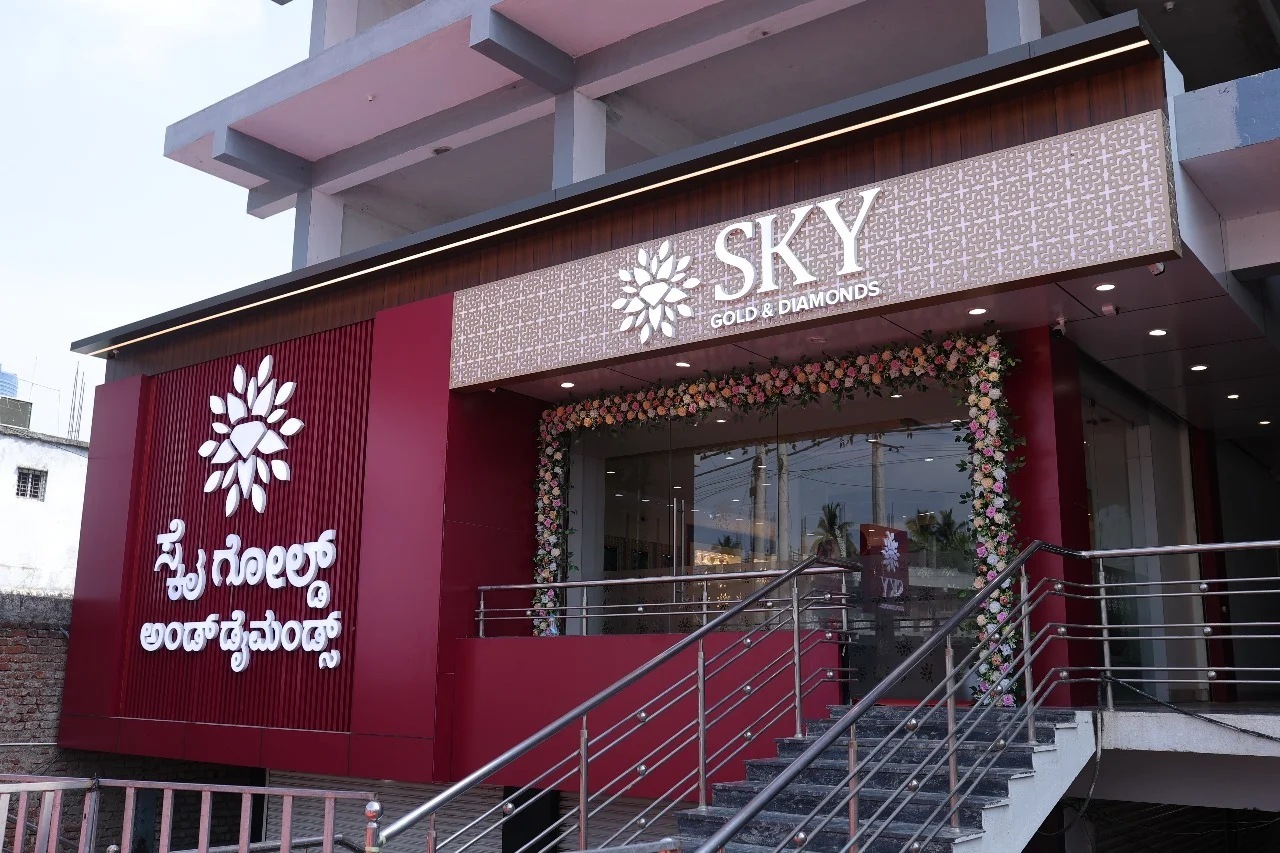
Sky Gold makes gold jewellery for other companies to sell. The business is wholesale, or B2B, and it runs no shops of its own. Its output sits in roughly 2,000 retail outlets in India and more than 500 abroad, under other names.
The specialty is lightweight cast jewellery: low-grammage designs that turn over quickly, rather than heavy wedding and temple pieces. Machinery does the work the gold does not, with 3D printing machines from Germany, Italy and the United States. The rest is casting, electro-forming, stamping and laser cutting. The company states that its pieces are 10 to 20% lighter than comparable ones, with a better finish. That is a physics problem sold as a fashion problem.
The catalogue runs to 18 sub-brands, among them Rangi, Marisa, Saathiya and Sovana. The design library holds over 9 lakh unique designs. The design team has doubled to about 180 people in three years, out of some 1,500 employees. Lead time from design to finished product is 7 to 20 days. Management’s line is that the constraint is design rather than machinery: “our key competitive advantage is design.”
The core product is 22 carat gold. Pieces in 18 carat gold and diamond-studded work are the fast-growing focus, alongside Italian bangles made by Speed Bangle. The range also covers mangalsutra, chains,