Simmonds Marshall Ltd Q4 FY26: Operating Profits Jump 107% to ₹9.48 Crore as Margin Reaches 14.36%, but Working Capital Remains Tight at 131 Days
1. At a Glance
Simmonds Marshall Ltd has suddenly moved into the bright spotlight of the automotive component arena. The company has posted an operational turnaround that is drawing significant attention from market observers. When a micro-cap structural auto-component business reports a 107.8% surge in quarterly operating profit—climbing from ₹4.56 crore in March 2025 to ₹9.48 crore in March 2026—the headline numbers look highly impressive. Annual sales have broken past the psychological barrier to reach ₹238 crore, while trailing 12-month net profits have expanded by 71.4% to reach ₹14.8 crore. On paper, it looks like a high-growth industrial engine firing on all cylinders.
However, a deeper look into the operational machinery reveals several financial challenges beneath the surface. The entire business model remains heavily locked into the cyclical movements of the Indian domestic two-wheeler and commercial vehicle segments. A single industry segment represents over half of the top-line demand. While operating profit margins expanded smoothly to 14.36% in the latest quarter, the structural cash generation tells an entirely different story.
The balance sheet shows that a massive chunk of capital remains trapped in internal working capital loops. The company requires 212 days to rotate its raw material and finished inventory, creating a prolonged cash conversion cycle of 131 days. This operational setup forces the business to continuously depend on short-term bank borrowings and credit lines just to keep the production floors running.
Furthermore, the tax provisions for the full fiscal year look unusually low relative to historical corporate averages, which artificially props up the reported net profit figures. The ultimate test for this automotive supplier lies in whether it can successfully convert these accounting profits into tangible, free cash flows, or if the incoming cash will simply get trapped in piles of specialized metal fasteners stored across the warehouse floors.
2. Introduction
Simmonds Marshall Ltd is an established industrial manufacturer that was set up back in 1960. It has spent more than six decades refining its niche in the specialized automotive and industrial fastener space. Operating out of its manufacturing facility in Chakan, Pune, the company focuses entirely on the production of high-precision self-locking nuts, specialized bolts, studs, and cold-forged sleeves. These are not ordinary generic hardware items; they are safety-critical components designed to withstand extreme vibration and stress in high-performance automotive engines and moving chassis assemblies.
The business operates primarily as a Tier-1 and Tier-2 supplier to the domestic automotive sector. It maintains long-term supply arrangements with major Indian automotive brands, including Bajaj Auto, Hero MotoCorp, TVS Motor, and Ashok Leyland. Because components like self-locking nuts have long engineering qualification cycles, the company enjoys relatively high entry barriers once embedded into a vehicle’s official platform.
The corporate structure includes a consolidated framework encompassing its primary manufacturing operations alongside its subsidiary, Stud India. Together, they manage an installed production capacity of nearly 500 million nuts per year. This scale allows them to service a domestic market that accounts for 86% of total revenue, supplemented by a 14% export footprint channeled through global joint ventures.
Despite this long-standing industrial presence, the company operates in a fragmented sector where global tier-1 giants and unorganized local workshops battle continuously for volume. This competitive setup limits the company’s independent pricing leverage against powerful automotive original equipment manufacturers (OEMs).
3. Business Model – WTF Do They Even Do?
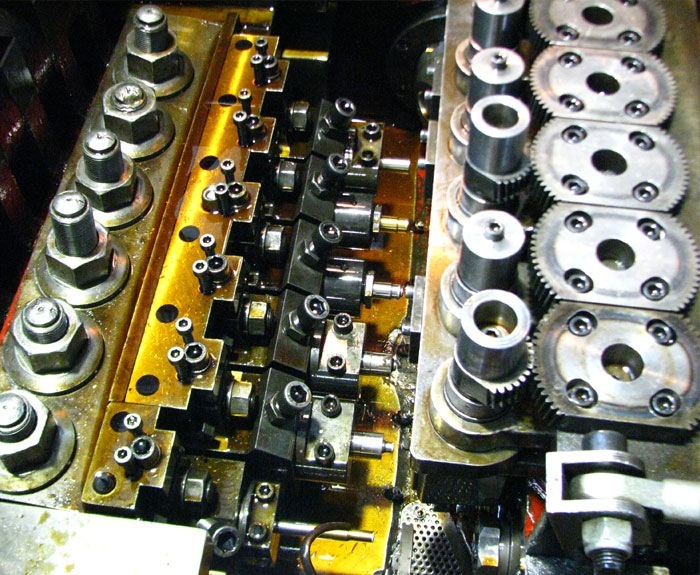
To put it in the simplest terms possible, Simmonds Marshall spends its days taking large coils of specialized steel wire, cutting them down, cold-forging them under immense pressure, and threading them to create millions of specialized nuts and bolts that keep vehicles from falling apart on the highway. If a wheel nut on a commercial truck or a critical engine bolt in a two-wheeler fails, the consequences are disastrous. That is why the company focuses on highly specialized self-locking nuts, such as Cleveloc, nylon-insert variants, and Phillidas products, which are engineered to stay locked in place under continuous industrial vibration.
The revenue model is overwhelmingly focused on product sales, with specialized fasteners, bolts, and studs generating 98% of the top line, while minor engineering services fill the remaining 2%. The operational layout is highly concentrated, with the two-wheeler segment historically consuming over half of total production volumes, followed by commercial vehicles and industrial equipment.
[Specialized Steel Input]
│
▼
[Cold-Forming & Threading] ──► [Specialized Self-Locking Fasteners] ──► [Automotive OEMs]
│
▼
[Trapped Working Capital (212 Days Inventory)]
While this specialized portfolio protects them from basic commodity competition, the commercial reality is tough. The company sits right in the middle of a tight supply chain squeeze. On one side, they buy steel from massive steel producers who demand quick payment. On the other side, they sell finished components to giant automotive companies that expect long credit terms and routine price discounts.
To make matters more complex, keeping these high-volume production lines efficient requires running advanced automated headers and threaders at optimal capacity. This setup leaves the company highly exposed to any sudden drops in consumer demand for two-wheelers.
Have you ever wondered why small manufacturing companies struggle to scale even when their factories are completely full? Let us know your thoughts in the comments section below.
4. Financials Overview
The financial performance for the quarter ended March 31, 2026, shows a strong expansion in operating profits, alongside a clear increase in operational expenses.
All figures below are stated in ₹ million, precisely matching the official financial disclosures (1 Crore = 10 Million).
Consolidated Quarterly Performance
Parameter
Q4 FY26 (Ended Mar-26)
Q4 FY25 (Ended Mar-25)
YoY Change (%)
Q3 FY26 (Ended Dec-25)
QoQ Change (%)
Revenue from Operations
660.30
539.20
22.46%
599.01
10.23%
EBITDA (Operating Profit)
94.80
45.60
107.89%
78.80
20.30%
PAT (Profit After Tax)
44.30
29.20
51.71%
43.40
2.07%
Reported EPS (₹)
3.96
2.60
52.31%
3.88
2.06%
The business recorded a revenue expansion of 22.46% year-on-year, driven by stable off-take from its primary domestic automotive buyers. The standout metric is the EBITDA performance, which surged to ₹94.80 million from ₹45.60 million in the previous year’s matching quarter. This expansion caused the operating profit margin to improve to 14.36%.
However, looking at the quarter-on-quarter trend, the Net Profit growth slowed significantly to just 2.07%. This slowdown happened because the company had to record a major current and deferred tax charge of ₹162.23 million in Q4 FY26, after paying almost zero corporate taxes in the preceding quarters of the year.
5. Valuation Discussion – Fair Value Range only
To assess the current valuation of Simmonds Marshall Ltd without bias, we analyze its audited full-year financial numbers using three distinct valuation approaches.
The company reported a consolidated full-year FY26 Net Profit of ₹147.91 million on a total equity base of 112 million outstanding shares (Face Value of ₹2 each). This gives a full-year trailing EPS of ₹13.21. The current market price stands at ₹180, which translates into a trailing price-to-earnings (P/E) multiple of 13.62x.