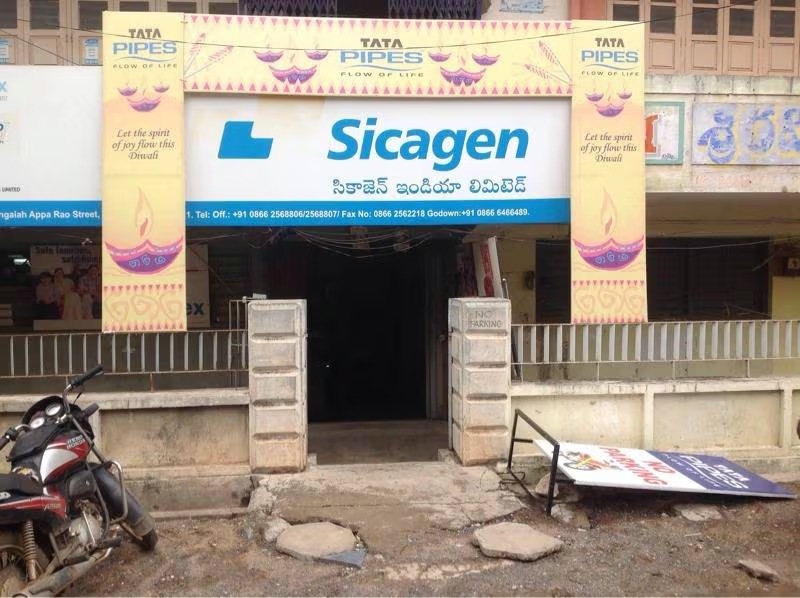
The market often overlooks the “boring” businesses until the numbers scream for attention. Sicagen India Ltd just reported its audited FY26 results, and for a company with a Market Cap of ₹210 Cr, it is sitting on a massive Revenue base of ₹973 Cr.
The contrast is stark: a company generating nearly ₹1,000 Cr in annual sales is being valued at just 0.22 times its sales. With the Board recommending a 10% dividend and a leadership transition in play, the narrative is shifting from a quiet trading house to a diversified value play. However, the thin margins and a heavily “moderately intensive” working capital cycle remain the dragons that the new management must slay.
1. At a Glance
Sicagen India is a classic example of a “sum-of-the-parts” story that the market is currently pricing at a deep discount. Operating as an integral part of the $2+ Billion AM International Group, Sicagen is not just a trader; it is a multi-limbed industrial entity.
The Scale vs. Value Paradox
The company reported a Revenue of ₹277.91 Cr for the latest quarter (Mar 2026), marking a 10.5% YoY growth. Despite this massive top-line movement, the market capitalization stays tethered at approximately ₹210 Cr. When a company’s annual sales are nearly 5x its market cap, you are either looking at a massive bargain or a business with deep-rooted efficiency issues.
The Red Flags to Watch
- Thin Margins: The Operating Profit Margin (OPM) is hovering around 4.04%. In the trading world, there is zero room for error. A slight spike in logistics or raw material costs can wipe out the bottom line.
- Asset Quality: There is a significant risk regarding recovery from advances and aged debtors. Specifically, ₹18 Cr has been outstanding for more than 365 days. In a small-cap setup, ₹18 Cr is not just a number; it’s a potential hit to the equity.
- Low Return Ratios: An ROE of 3.74% is lower than a standard savings account return. This suggests the company is struggling to sweat its assets effectively.
The Silver Lining
The company is trading at 0.43 times its Book Value (₹125). In a bull market where “everything is expensive,” finding a debt-light entity (Debt to Equity of 0.32) trading at less than half its intrinsic accounting value is rare. The board’s decision to maintain a 10% dividend payout reflects management’s confidence in liquidity, despite the operational hurdles.
2. Introduction
Sicagen India Ltd, incorporated in 2004, has evolved into a diversified industrial powerhouse. While its roots are in trading building materials—partnering with titans like Tata Steel and Jindal Pipes—it has branched into manufacturing MS barrels, water treatment chemicals, and even boat building.
The company is headquartered in Chennai and serves as a vital cog in the AM International Group’s supply chain. With 15 sales offices and warehouses across India, it has built a distribution moat that is hard to replicate.
However, the latest audited results for FY26 bring a mix of stability and transition. The resignation of Nandakumar Varma and the appointment of Prasanna Joshi as the new Whole-Time Director marks a pivotal moment. Joshi, a Mechanical Engineer and IIM-A alumnus with 13 years of history within the company, is now tasked with converting Sicagen’s massive volume into meaningful shareholder returns.
Is the market ignoring a giant, or is the giant simply too slow to move? We dig into the data to find out.
3. Business Model – WTF Do They Even Do?
To the uninitiated, Sicagen looks like a messy garage. To a seasoned industrialist, it’s an integrated supply chain.
The Five Pillars of Sicagen:
- Building Materials (The Volume Engine): This is the core. They trade everything from EWR pipes and construction steel to cables and wires. They are authorized distributors for the “Who’s Who” of Indian steel.
- Industrial Packaging (The Cash Cow): They manufacture MS Drums and Cable Reel Drums. This isn’t just trading; it’s high-volume manufacturing with units in Chennai.
- Power & Control Systems: They provide mechanical governor services and servicing of actuators. Think of this as the “high-margin service” niche.
- Specialty Chemicals: Operating out of Tuticorin, they manufacture high-end chemicals for industrial water treatment.
- Subsidiaries (The Tech Edge): Through Wilson Cables (Singapore) and Danish Steel, they play in the premium cable and precision engineering space.
The Roast: Sicagen basically acts as the middleman for India’s infrastructure. They buy steel from Jindal, sell it to contractors, and then sell the contractor a boat and some water treatment chemicals for their next project. It’s a “jack of all trades” model that provides stability but suffers from an identity crisis in the eyes of the stock market.
4. Financials Overview
The latest quarter shows a resilient top line but highlights the struggle to expand the bottom line.
Quarterly & Yearly Performance Comparison
| Metric | Mar 2026 (Latest) | Mar 2025 (YoY) | Dec 2025 (QoQ) |
| Revenue | ₹277.91 Cr | ₹251.52 Cr | ₹264.27 Cr |
| EBITDA | ₹11.23 Cr | ₹10.61 Cr | ₹9.27 Cr |
| PAT | ₹4.46 Cr | ₹3.97 Cr | ₹4.93 Cr |
| EPS (Quarterly) | ₹1.13 | ₹1.00 | ₹1.25 |
| Annualized EPS | ₹4.52 | – | – |
Analysis:
The YoY Sales growth of 10.5% is healthy. However, the Net Profit Margin remains squeezed. Management “walked the talk” by maintaining a consistent OPM of ~4.04%, which is slightly better than the previous year’s 3.79% (Mar 2024).
The P/E ratio currently sits at 11.5, which looks attractive against an industry average of 26.1. But remember, a low P/E is only a “deal” if growth follows.
5. Valuation Discussion – Fair Value Range
Calculating the value of a company trading at 0.4x book value requires a reality check.
Method 1: P/E Based Valuation
- Annualized EPS: ₹4.52 (based on Q4 FY26 results).
- Target Multiple: 12x to 15x (Conservative for a trading/mfg hybrid).
- Value: $4.52 \times 12 = 54.24$ to $4.52 \times 15 = 67.80$.
Method 2: EV/EBITDA
- FY26 EBITDA: ₹38.8 Cr (Annualized/Summed).
- Enterprise Value (EV): ₹284 Cr.
- Current EV/EBITDA: ~5.8x.
- A re-rating to 7x EV/EBITDA would imply a fair value closer to ₹65-70.
Method 3: Adjusted Book Value (DCF Alternative)
Since it’s a trading-heavy business, Book Value is king.
- Current BV: ₹125.
- Applying a 40% “liquidity and bad debt” haircut: ₹75.
Fair Value Range
Based on these metrics, the estimated fair value range for Sicagen India lies between ₹62 and ₹78.
Disclaimer: This fair value range is for educational purposes only and is not investment advice.
6. What’s Cooking – News, Triggers, Drama
The boardroom at Sicagen has been more active than the stock price lately.
- The Guard Change: Nandakumar Varma has stepped down. In comes Prasanna Joshi. Usually, when a 20-year veteran takes the helm, we see a “house cleaning” phase. Will he write off the ₹18 Cr bad debt or recover it? That is the 18-crore-rupee question.
- The Merger: The NCLT has approved the merger of Danish Steel Cluster with Sicagen. This is a strategic move to “rationalize and streamline” management. Translation: Expect some cost-cutting and better operational synergy in the coming quarters.
- Dividend Bait: By recommending a 10% dividend (₹1 per share), the board is effectively paying you to wait. At a stock price of ₹53, that’s a decent yield for a micro-cap.
Do you think a change in leadership will finally push the OPM past the 5% mark?
7. Balance Sheet
The balance sheet is where the “Value” is hidden, but it’s also where the “Stress” lives.
| Row | Mar 2026 (Consolidated) | Mar 2025 | Mar 2024 |
| Total Assets | ₹740 Cr | ₹722 Cr | ₹723 Cr |
| Net Worth | ₹495 Cr | ₹460 Cr | ₹440 Cr |
| Borrowings | ₹159 Cr | ₹148 Cr | ₹121 Cr |
| Other Liabilities | ₹86 Cr | ₹114 Cr | ₹162 Cr |
| Total Liabilities | ₹740 Cr | ₹722 Cr | ₹723 Cr |
Audit Commentary:
- Borrowings have crept up from ₹121 Cr to ₹159 Cr. Debt is like salt; a little is fine, but this is starting to taste salty.
- The Net Worth is nearly 2.3x the current Market Cap. You are buying ₹1 of assets for 43 paise.
- “Other Assets” stand at a whopping ₹533 Cr. This includes that “aged debtor” risk we mentioned.
8. Cash Flow – Sab Number Game Hai
Cash is a fact; profit is an opinion. Sicagen’s cash flow shows a company working hard just to stay in the same place.
| Cash Flow Type (₹ Cr) | Mar 2026 | Mar 2025 | Mar 2024 |
| Operating (CFO) | 44 | 33 | 25 |
| Investing (CFI) | -7 | -14 | -3 |
| Financing (CFF) | -19 | -17 | -20 |
Analysis:
The company is generating healthy cash from operations (₹44 Cr in FY26). Where does it go?
- ₹7 Cr into buying assets (maintenance Capex).
- ₹10.45 Cr into paying interest (the cost of that ₹159 Cr debt).
- ₹3.96 Cr back to you as dividends.
The “Free Cash Flow” of ₹38 Cr is impressive for a company of this size. It suggests the business is throwing off cash, even if the P&L looks modest.
9. Ratios – Sexy or Stressy?
Ratios tell the story that the management won’t.
| Ratio | Value | Verdict |
| ROE | 3.74% | Stressy. Barely beating inflation. |
| ROCE | 5.95% | Stressy. Improving, but needs to be double digits. |
| Debt to Equity | 0.32 | Sexy. Very comfortable leverage levels. |
| PAT Margin | 2.56% | Stressy. One bad quarter away from a loss. |
| Current Ratio | 2.36 | Sexy. No liquidity crisis here. |
Commentary: Sicagen is like a massive truck with a small engine. It carries a lot of weight (Assets/Sales) but moves very slowly (ROE).
10. P&L Breakdown – Show Me the Money
Let’s look at the three-year journey of the top and bottom lines.
| Year | Revenue (₹ Cr) | EBITDA (₹ Cr) | PAT (₹ Cr) |
| Mar 2026 | 973 | 39 | 18 |
| Mar 2025 | 929 | 36 | 17 |
| Mar 2024 | 892 | 32 | 11 |
Analysis:
Revenue has grown steadily. EBITDA is up. PAT has climbed from ₹11 Cr to ₹18 Cr in two years. That is a 63% jump in profit while the stock price has actually fallen 20% in the last year. This is the definition of “divergence.”
Are investors penalizing the company for its low ROE, or are they just blind to the profit growth?
11. Peer Comparison
How does Sicagen stack up against the big boys and the niche players?
| Company | Revenue (Qtr) | PAT (Qtr) | P/E |
| Redington | ₹28,758 Cr | ₹561 Cr | 10.8 |
| Creative Newtech | ₹740 Cr | ₹17.7 Cr | 13.4 |
| Sicagen India | ₹278 Cr | ₹4.46 Cr | 11.5 |
| MMTC | ₹0.34 Cr | ₹46 Cr | 83.1 |
Sarcastic Note: MMTC is making ₹46 Cr profit on zero sales (don’t ask), while Redington is playing a different sport entirely. Sicagen sits in the middle—cheaper than Creative Newtech but lacking the explosive growth narrative.
12. Miscellaneous – Shareholding and Promoters
The promoters seem to like the stock more than the public does.
| Category | Shareholding % (Mar 2026) |
| Promoters | 61.13% |
| FIIs | 2.47% |
| DIIs | 0.58% |
| Public | 35.82% |
Promoter Roast: The AM International Group, led by Ashwin Muthiah, has been slowly creeping up their stake (from 55.4% to 61.1%). When the owners are buying more of their own “undervalued” paper, it usually means they know something the market doesn’t. Or they just have a lot of spare change from their $2 billion Singapore empire.
13. Corporate Governance – Angels or Devils?
Sicagen operates with a “big group” mentality. The presence of auditors like Venkatesh & Co. and regular board updates provides a level of comfort.
However, the “Risk of Recovery” mentioned in the rating rationale is a governance yellow flag. Why are ₹18 Cr worth of debtors sitting on the books for over a year? In a high-quality governance setup, these would be provisioned or recovered aggressively.
The recent leadership transition was handled professionally, with clear disclosure of “personal reasons” for the outgoing director and a well-vetted successor. No drama, just business.
14. Industry Roast and Macro Context
Trading building materials in India is like being a waiter at a busy wedding. You see a lot of food (money) passing through your hands, but you only get to keep a tiny tip (margin).
The Macro View:
With India’s infra push (Gati Shakti, Housing for All), the demand for steel pipes and cables is sky-high. But the industry is plagued by volatile commodity prices. If steel prices drop, Sicagen’s inventory loses value. If they rise, their working capital requirement explodes.
The sector is currently being roasted by high interest rates. Sicagen’s ₹159 Cr debt isn’t free. They paid over ₹10 Cr in interest this year. That is money that could have been profit.
15. EduInvesting Verdict
Sicagen India is a classic “Cigar Butt” investment (to borrow from Ben Graham). It’s not a glamorous growth stock, but there’s a lot of value left in the puff.
SWOT Analysis
- Strengths: Part of a $2B global group, massive revenue base, trading at 0.43x Book Value.
- Weaknesses: Thin margins (4%), low ROE (3.7%), and aged debtors.
- Opportunities: Merger with Danish Steel to drive efficiency, leadership change under Prasanna Joshi.
- Threats: Volatility in steel prices, rising interest costs on borrowings.
The company is financially stable (Acuite BBB Stable), pays a regular dividend, and is growing its profits faster than its revenue. The challenge remains the efficiency of capital. If the new WTD can improve the working capital cycle and bump the ROE into the double digits, the market might finally stop treating this ₹1,000 Cr revenue giant like a penny stock.
Until then, it remains a story of “Deep Value” competing against “Low Efficiency.” Which side are you betting on?