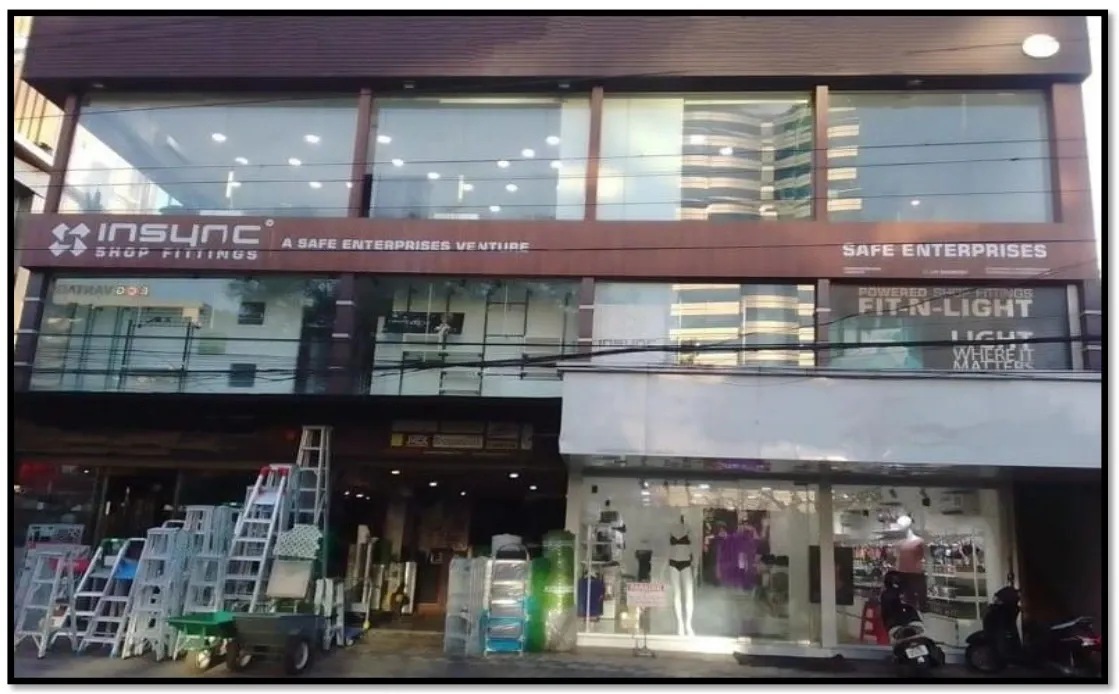
Safe Enterprises Retail Fixtures Ltd Half Yearly Results: The 24.8% Refurbishment Engine Driving a 19x Valuation Zone
Section 1 — At a Glance
Safe Enterprises Retail Fixtures Limited posted revenue from operations of ₹218.42 crore for the fiscal year ended March 31, 2026, representing a growth of 57.9% compared to ₹138.31 crore in the previous fiscal year. Operating EBITDA reached ₹79.09 crore, up 60.0% from ₹49.42 crore, while the consolidated net profit scaled to ₹63.86 crore, registering a 63.0% growth year-on-year. Consequently, reported basic and diluted earnings per share (EPS) for the full fiscal year stood at ₹13.70, or ₹14.62 depending on adjustments for extraordinary items, compared to ₹11.42 in the prior period. Investors are increasingly paying attention to the structural shifts in retail footprint monetization, particularly a substantial 65% surge in revenue intensity per store to approximately ₹51.4 lakhs. This improvement highlights a capital-efficient expansion model driven by larger store formats and an enriched scope per setup.
However, operational challenges have surfaced in tandem with this rapid top-line acceleration. The company’s working capital cycle extended notably, with working capital days rising from 32 days to 62 days, primarily on account of debtor days climbing back to 76 days from 63 days. Furthermore, high customer concentration continues to frame the business, with the top 10 buyers contributing 95.91% of fiscal year 2025 revenue, and the single largest retailer accounting for 84.53%. High customer concentration means operational stability depends heavily on the execution timelines and financial health of a handful of anchors. The company remains virtually debt-free following its listing in June 2025, positioning its cash balances effectively for upcoming structural transitions. The upcoming consolidation of multi-site facilities into a single hub forms the core of near-term execution tracking.
Section 2 — Introduction
Safe Enterprises Retail Fixtures Limited has transitioned from a localized interior engineering partnership founded in 1976 into an institutional proxy for India’s organized retail rollout. The company handles the structural backbone of physical retail execution, designing, manufacturing, and installing standardized and modular shop fittings across domestic markets.
The relevance of the company has intensified following its ₹161 crore initial public offering on the NSE SME platform. This capital injection is being deployed to break localized capacity constraints through a greenfield engineering project. As organized retail chains accelerate expansion into Tier 2 and Tier 3 cities, physical infrastructure demand has pivoted away from traditional on-site carpentry toward precise, modular, and tech-integrated shop layouts. This article evaluates the financial realities, cash conversion dynamics, and manufacturing scaling paths behind the company’s headline numbers.
Section 3 — Business Model: WTF Do They Even Do?
The business operates essentially as an assembly-line engineering provider for physical brand real estate. Instead of executing slow, customized store build-outs, the company produces standardized metal and woodwork components, display racks, partition systems, and electrified tracks that allow a retail brand to establish an operational storefront quickly. Its revenue is split into two primary buckets: greenfield storefront execution for new store openings (68.9% of the mix) and brownfield additions or refurbishments for existing locations (24.8% of the mix).
Revenue Segment
Contribution (%)
Greenfield New Store Layouts
68.9%
Refurbishments / Upgrades
24.8%
The manufacturing base consists of three units in Thane and Navi Mumbai, complemented by a specialized metal subsidiary in Pune, altogether processing thousands of tons of metal and millions of square feet of woodwork annually. The customer base is concentrated, serving large institutional retail chains across electronics, fashion, and departmental formats. To optimize its economic share within each location, the business is increasingly building out advanced options like digital display systems, wireless electrified shelving, and automated self-checkout infrastructure.
Section 4 — Financials Overview
Figures are consolidated, in ₹ crore.
The company reports financial performance on a half-yearly frequency, aligning with regional regulatory frameworks for its listing segment.
Half-Yearly Financial Progress
Metric
Latest Half (H2 FY26)
YoY (H2 FY25)
Previous Half (H1 FY26)
Revenue
106.04
80.55
112.38
EBITDA / Operating Profit
36.77
27.64
42.32
PAT
30.61
22.23
33.25
EPS (₹)
6.57
6.48
7.13
Note: Component line items extracted from historical disclosures. EPS reflects period-specific