General information and education, not investment advice. The author is not a SEBI-registered adviser or research analyst. No recommendation, no promised returns. Markets carry risk including loss of capital. Figures may not be current. Always consult a SEBI-registered adviser.
1 — At a Glance
Somewhere in Bengaluru sits a company whose whole commercial purpose is making other people’s products look better. Badges, decals, and the little chrome piece on a scooter that nobody consciously registers. SJS Enterprises has been doing this since 1987, and in the three months to June 2026 it did ₹261 crore of it.
Revenue rose 24.5% from a year earlier. Operating profit rose 33.5% to ₹74.67 crore. Net profit rose to ₹74.18 crore from ₹34.57 crore. A note in the accounts explains most of that jump. The company sold land and a building it owned outright on 15 June 2026. The price was ₹58.5 crore against a book value of ₹29.85 crore. ₹27.95 crore went in as an exceptional item, a one-off gain outside normal trading. The building had not been in use since 2019. It sat idle for seven years and then out-earned a month of the business.
Management put profit with the one-off stripped out at ₹50.25 crore, up 45.2%. Management called that the highest profitability since the company listed. The same quarter carried a Pune plant commissioning and board approval for a wholly owned display subsidiary. The board also approved buying the last 9.9% of Walter Pack India. A postal ballot, which is a vote shareholders cast by post, will decide on moving the registered office from Karnataka to Maharashtra. Four corporate actions came out of one board meeting.
2 — Introduction
SJS was set up in 1987 as a partnership firm by Mr V. Srinivasan, Mr K.A. Joseph and Mr Sivakumar. It became a private limited company in June 2005. In September 2015 Evergraph Holdings Pte Ltd, a subsidiary of Everstone Capital, acquired a majority stake. That purchase took out the 26% held by Serigraph Inc, an American specialty printer, and part of the promoters’ holding. The company listed on the NSE and BSE in November 2021, raising ₹800 crore. All of it was an offer for sale, meaning existing owners sold shares and the company itself received nothing. Promoter holding went from 99% to 50%. Evergraph then diluted its stake between 2021 and 2024 as part of its exit. After a board approval in December 2023 it was reclassified from promoter to public, which is how the exchanges label a shareholder. Mr K.A. Joseph is Managing Director.
The company grew by acquisition. Exotech Plastics, now SJS Decoplast, was bought outright in April 2021 for around ₹64 crore, adding chrome plating and painting. Walter Pack India followed in July 2023, 90.1% of it for roughly ₹238.6 crore. That brought in-mould decoration, where the pattern goes on inside the mould as the part is formed, plus labelling, forming and electronics. On 6 August 2026 the board approved acquiring the remaining 34,661 shares from Mr Roy Mathew for about ₹19.9 crore. Walter Pack India will then be wholly owned. The disclosure records this as a related party transaction, since Mr Mathew is a Whole-Time Director of Walter Pack India. It states that the purchase follows the terms of the 2023 share purchase agreement, on an arm’s length basis, meaning priced as it would be between strangers.
In December 2025 SJS signed an exclusive five-year technology licence and supply agreement with BOE Varitronix. It covers optical bonding and assembly of automotive display systems in India. Optical bonding fixes a screen to its cover glass without an air gap between them. BOE Varitronix supplies the components and transfers the technology. In August 2026 the board approved incorporating a wholly owned subsidiary for that display business, with investment of up to ₹10 crore. ICRA, a credit-rating agency, reaffirmed the long-term rating at AA- in February 2026 and revised the outlook to Positive.
US
Now live
US Stocks terminal is live
13,000+ US tickers · EDGAR fundamentals · screener and filings feed — the same terminal, for American markets.
Explore →
3 — Business Model: WTF Do They Even Do?
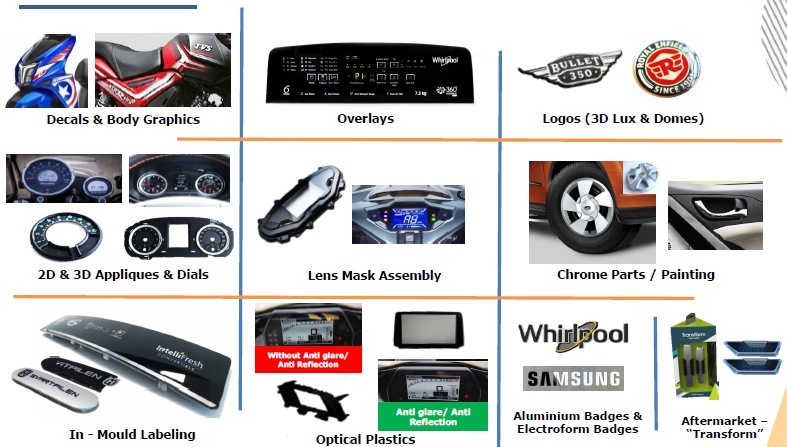
SJS calls itself a design-to-delivery aesthetics solutions provider, a phrase engineered to survive contact with a slide deck. In practice it sells 17,500 separate items, or SKUs, across 11 categories. None of them make the vehicle go.
The catalogue starts with decals, body graphics, appliques and dials. Then come overlays, aluminium badges, domes and 3D lux badges. Then chrome-plated parts, optical plastics and lens mask assemblies. Between them they cover the whole visible surface of a motorcycle that is not paint. Kit value is what the parts on one vehicle are worth to the supplier. The company describes a legacy kit value of ₹1,200 to 1,500 per vehicle. It puts the current figure after the Walter Pack India acquisition at ₹3,500 to 5,000, and targets five to eight times growth from there. The business model, in plain terms, is persuading a carmaker that the dashboard should have more stuff on it.
In the year to March 2026, passenger vehicles were 41.7% of revenue and two-wheelers 38.3%. Consumer products were 15.5% and other segments 4.5%. In the three months to June 2026,