ALL SECTIONS
Russia’s other AI war
In the global race for AI dominance, Russia continues to lag behind the leading powers. Instead, it is waging a different war – less about chips and models, and more about narratives, algorithms and the slow poisoning of the information environment
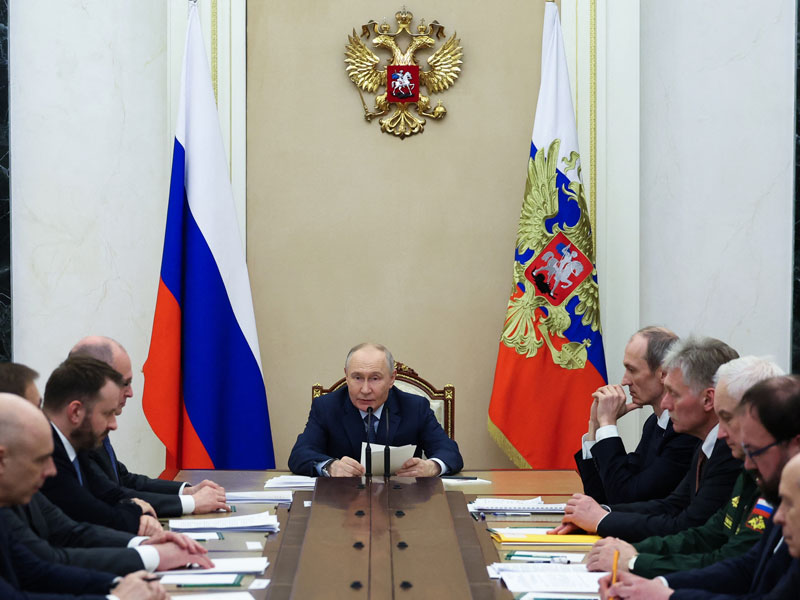 Russia’s President Vladimir Putin chairs a meeting on the development of artificial intelligence technologies 
Featured | Markets | Science and Technology
Author: Khatia Shamanauri, Features Writer
Top 5
- Top 5 female-fronted fintech firms
- Top 5 Latin American tech hubs
- Top 5 sustainability pioneers in Europe
- Top 5 keys to global economic recovery
- Top 5 WFH habits, according to the world’s most successful business leaders
- Top 5 pandemic-proof industries
- Top 5 countries to be world’s next manufacturing hubs
- Top 5 most influential and inspirational US economists
- Top 5 ways to boost employee engagement and commitment
- Top 5 financial services that are ripe for automation
- Top 5 ways that GDPR has impacted digital banking
- Top 5 emerging fintech hubs across the globe right now
- Top 5 ways that the finance industry can prepare for AI
- Top 5 economic risk factors that must be considered
- Top 5 tips for retailers looking to sell into Chinese market
On June 6, 1972, just over a week after Richard Nixon’s visit to Moscow ended, the film Residence Permit premiered in the Soviet Union. On its surface, it was an ordinary drama. In reality, it was a finely engineered piece of state propaganda – a story about a doctor from Leningrad who chooses to remain in Western Europe in pursuit of freedom and professional success, only to discover that stories about Western prosperity are a myth. His decision to leave the Soviet Union, the film concludes, was the greatest mistake of his life.
To spread that message, Moscow needed an entire machinery: studios, censors, distribution networks, cultural institutions. The infrastructure for propaganda was vast, expensive, and slow. More than 50 years later, Russia’s goals remain largely unchanged. It still seeks to project similar messages both domestically and abroad. What has shifted, however, is the cost, speed and scale of pursuing those ambitions.
Today, the Kremlin can do in minutes what once took months, and it can do it across dozens of languages, on hundreds of platforms, at a scale no Soviet propagandist could have imagined. The reason is artificial intelligence. But not in the way the term is usually understood. When analysts speak of an AI race, they typically mean a contest over who builds the most powerful models, the fastest chips and the most capable systems. By that measure, Russia occupies a complicated position. It faces a significant structural constraint: hardware.
Samuel Bendett, an adviser to the Russia Studies Programme at CNA, a Washington, DC–area think tank, says that Russia has a strong pool of talent – STEM-educated specialists and mathematicians capable of developing advanced software. “But hardware has always been the weakness, and this goes back to the early days of the Cold War,” he adds.
That weakness matters enormously in the modern AI landscape. Cutting-edge machine learning systems depend on specialised chips – graphics processing units (GPUs) and AI accelerators – capable of performing vast numbers of mathematical operations simultaneously.
Currently, Russia cannot produce the advanced chips needed for frontier AI. Western sanctions following the invasion of Ukraine have created even more problems. As a result, Moscow relies on smuggled or Chinese-sourced components for more sophisticated systems. “Russia loves NVIDIA microchips and depends on them for military-related AI