Rico Auto Industries FY26: Highest Revenue Ever, But the Math Stays Stiff
General information and entertainment, not investment advice. The author is not a SEBI-registered adviser or research analyst. No recommendation, no promised returns. Markets carry risk including loss of capital. Figures may not be current. Consult a registered adviser before acting.
Prices referenced are not live; data as of 10 June 2026.
1 — At a Glance
Rico Auto (RAIL) logged its record annual revenue—₹2,478 crore in FY26, a 12% lift on FY25’s ₹2,212 crore. Net profit, however, limped to ₹51 crore versus ₹21 crore a year earlier: the margin stayed thin despite the topline gain.
The P/E trades at 32.2x off an EPS of ₹3.73 (annualised from FY26 full-year PAT). Peer median sits at 27.1x. Net borrowings of ₹712 crore sit against a ₹1,824 crore market cap—a leverage position that CRISIL’s December 2025 rating frames as “moderate” on a D/E of 0.93x.
Management flagged two “one-off” cost hits in FY26: ₹11 crore labour-law impact, ₹19 crore raw-material settlement lag. Strip those, and adjusted EBITDA margin climbs to 10.25% from the reported 9%.
The growth story hinges on ₹2,500 crore of new orders (5-year life), 40 product launches, and a Hosur plant (Tamil Nadu) due operational September 2026. Exports are 16% of sales; management projects 32% export growth in FY27.
The tension: record revenue, margin pressure, and a valuation that leaves little room for execution slip.
2 — Introduction
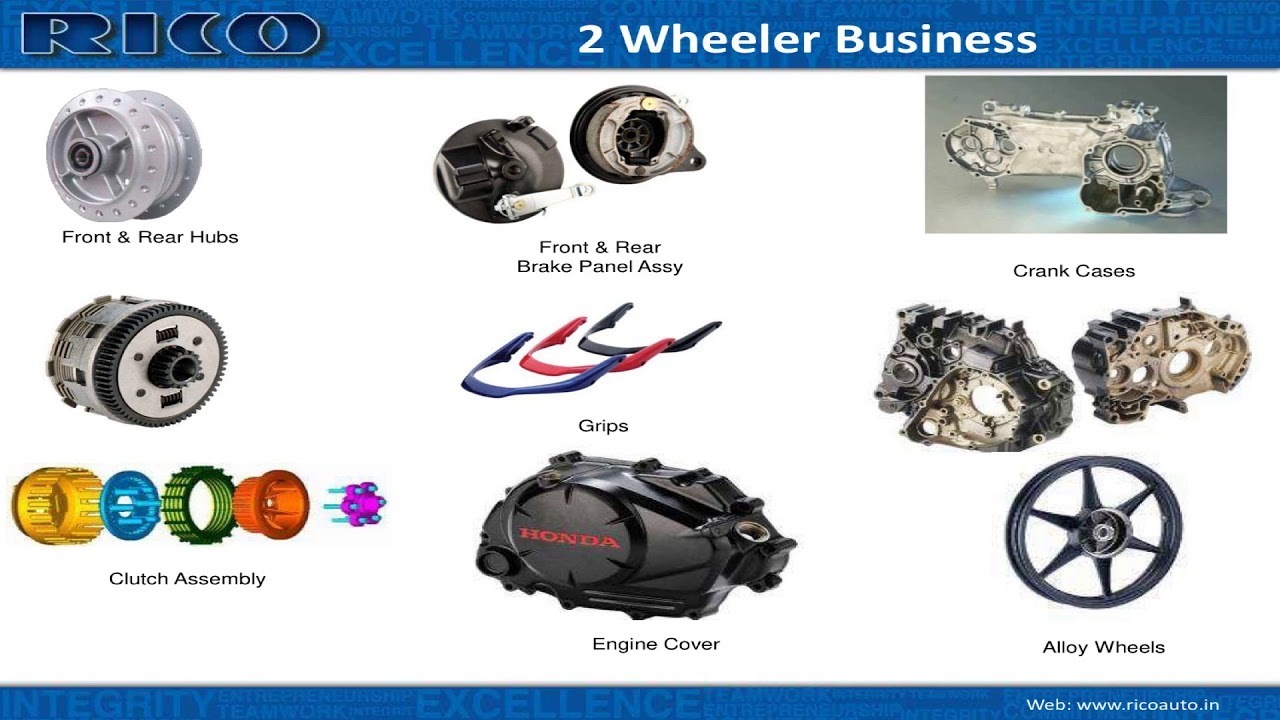
RAIL sits within the Ludhiana-based Rico Group, incorporated in 1983. The company manufactures precision-cast aluminium and ferrous auto components—engine parts, clutch assemblies, transmission gears, braking systems—for two-wheelers, four-wheelers, commercial vehicles, and hybrid/EV applications.
The customer roster spans BMW (sole-supplier status for certain lines), Toyota (EV components), Maruti Suzuki, Tata Motors, Hero MotoCorp, and Bosch. In February 2024, RAIL earned “Three-Star Export House” status from the Directorate General of Foreign Trade; the AEO-T2 (Authorised Economic Operator) certificate preceded it.
The group operates 16 manufacturing plants across Haryana, Uttarakhand, Tamil Nadu, Rajasthan, and Gujarat. Two wholly owned subsidiaries—Rico Auto Industries (USA) and Rico Auto Industries (UK)—handle trading and logistics in North America and Brazil.
FY26 saw the launch of a ₹220 crore capex project in Hosur to service Toyota and other southern OEMs. The Tamil Nadu government approved ~₹39 crore in subsidy for this facility.
3 — Business Model: WTF Do They Even Do?
Two buckets: aluminium casting (~88% of FY26 sales at ₹2,155 crore) and ferrous casting (~12% at ₹322 crore). The aluminium play dominates—engine blocks, transmission housings, suspension parts. Ferrous handles heavier duty: gears, brake drums, structural brackets.
The sales model is B2B, tier-1 OEM direct: a customer (say, Maruti) calls for a component, RAIL quotes, tools up, and supplies in volume. Exports run 16% of the top line (₹395 crore in FY26); domestic grabs 84% (₹2,083 crore).
The pitch is precision and scale: RAIL can machine an aluminium block to micron tolerances, assemble sub-systems, and ship in quantities that a small job shop cannot match. The business requires heavy capex upfront (tooling, casting lines, CNC machines), so the margin game is volume and utilization. Higher volume spreads fixed cost; lower volume leaves it stranded.
A secondary thread: RAIL has quietly built internal CNC machine manufacturing to feed its own plants. Recently, management disclosed external sales of these machines have begun—”just done our first sale.” This is early-stage, unquantified, but suggests a potential margin escape hatch if the auto components margin stays compressed.
Defense and railways are the new frontier. AAN Engineering (100% subsidiary) builds mechanical fuses and metal parts for aerospace. FY26 defence revenue was ₹20–30 crore; management targets >₹50 crore in FY27. Railways just got RDSO (Rail India Technical Standards Organization) clearance; FY26 was minimal (₹3–4 crore); FY27 target is “crossing ₹100 crores,” anchored on modernization spend.
The model, in short: capital-intensive, volume-dependent, customer-diversified, margin-thin, with a slow-burning pivot toward non-auto.
4 — Financials Overview
Figures are consolidated, in ₹ crore. Latest result type: Annual (Yearly), March 2026.
Metric
FY26
FY25
YoY Change
Revenue
2,477.73
2,212.4
+12.0%
EBITDA
223.18
195.15
+14.4%
PAT
50.51
21.4
+136.0%
EPS (annualised)
3.73
1.58
+136.0%
The topline grew 12%—a respectable clip for auto components, where industry volume growth is single-digit. Management attributed the beat to three factors: (1) ramp-up of programs launched in prior years, (2) new customer wins (Knorr-Bremse, Cummins, Piaggio, Case New Holland), and (3) export recovery post-COVID supply-chain cleanup.
EBITDA rose 14.4% despite a reported margin of 9.0% (vs. 8.8% in FY25). The culprit was ₹19 crore in raw-material settlement lag—a quarterly/monthly timing mismatch between aluminium/ferrous price moves and customer reimbursement. Management is renegotiating settlement frequency to monthly; 75% of customers by value have agreed.
PAT more than doubled, but the growth is inflated by two one-offs in FY25: a ₹14 crore loss capitalization of interest, and higher tax payouts. Strip FY25’s one-offs, and FY26 PAT growth lands at a more mundane 15–20%.
Concall colour: Management framed FY26 as “highest ever annual revenue” and guided FY27 to “cross ₹3,000 crores”—a 21% jump, anchored on the 40-product launch pipeline and ₹2,500 crore order book. EBITDA margin is expected to recover “going beyond 10.25%” (the adjusted FY26 figure) from Q1 FY27 onward, conditional on stable raw-material costs and the monthly settlement rollout.
5 — Market Expectations & Historical Multiples
This section describes how the market is currently pricing the company and how that compares with its own history and peer group. It is descriptive, not predictive.