General information and education, not investment advice. The author is not a SEBI-registered adviser or research analyst. No recommendation, no promised returns. Markets carry risk including loss of capital. Figures may not be current. Always consult a SEBI-registered adviser.
1. At a Glance
Pyramid Technoplast makes the containers that other companies fill with chemicals. Quarterly revenue reached ₹222.49 crore, against ₹163.81 crore in the same quarter a year earlier. Measured against that base, the increase works out at 35.8%. Operating profit was ₹20.26 crore, up from ₹13.34 crore in the same three months. Net profit came to ₹10.45 crore, against ₹7.91 crore a year earlier. Earnings per share, the profit attached to each share, was ₹2.84 against ₹2.15.
The plants shipped 87,954 intermediate bulk containers, the 1,000-litre cubes that sit inside steel cages. Polymer drum output reached 5,226 tonnes, and mild steel drums added 2,928 tonnes. Capacity utilisation ran at 62.05% against quarterly installed capacity of 20,936 tonnes. Roughly a third of the machinery spent the quarter in a state best described as available.
Management attributes the revenue growth mainly to price, saying sharp raw material cost increases were passed on to customers. Volumes were softer, according to the same source, with export-linked demand for the containers affected by the war. Finance cost rose 179% over the year, and depreciation rose 61%. Management links both to the enlarged asset base and to borrowings.
Total assets closed the financial year at ₹527.22 crore, up from ₹368.65 crore. Borrowings closed at ₹183.97 crore, against ₹55.14 crore a year earlier. The company had built nine plants, a solar farm and a recycling unit in quick succession.
The board also approved a change of statutory auditor. It set a record date for a final dividend of ₹0.50 a share.
2. Introduction
Pyramid Technoplast was incorporated in 1997 and began producing polymer drums at Silvassa the following year. The company’s own journey slide reads like a list written on a napkin and then ticked off. Turnover milestones of ₹100 crore and ₹200 crore are marked, with ₹400 crore after them. Each one is dated, and each was apparently celebrated by immediately building another plant.
The Bharuch cluster arrived through the 2010s. Polymer drums came first, then production of intermediate bulk containers, then mild steel drums from 2016. A design registration for the container came along the way. The company converted from private limited to public limited in 2022, and listed the following year. The listing raised ₹153 crore, of which ₹62 crore was an offer for sale. The fresh issue of ₹91 crore went to repayment of borrowings, working capital and general corporate purposes.
The year to March 2026 was when the pipeline emptied out all at once. Production started at Wada in Maharashtra. The recycling plant, Unit 9, was commissioned on 3 October 2025. A 6 MW solar plant followed on 30 October 2025. A further 5 MW began at Bharuch in February, with 2.25 MW in Maharashtra. Total solar investment is stated at over ₹60 crore, against estimated annual savings of ₹15 crore. That is a four-year payback on a machine whose only job is to stop the electricity bill arriving.
An extraordinary general meeting on 23 May 2026 approved borrowing and disposal limits up to ₹500 crore. On 11 August 2026 the company announced a new Kutch facility. It is to add 10,000 containers a month by March 2027, alongside ₹35.4 crore of approved subsidies. Two company secretaries resigned in the interim. Ms Puja Sharma left effective 11 November 2025, and Mr Pramod Yadav effective 25 March 2026.
Revenue compounded at 17% a year over the stretch from March 2021 to March 2026. The top line moved from ₹313.5 crore to ₹680.91 crore.
US
Now live
US Stocks terminal is live
13,000+ US tickers · EDGAR fundamentals · screener and filings feed — the same terminal, for American markets.
Explore →
3. Business Model: WTF Do They Even Do?
Pyramid Technoplast makes the thing a chemical arrives in. That is the whole of the business, and it carries more detail than the sentence suggests.
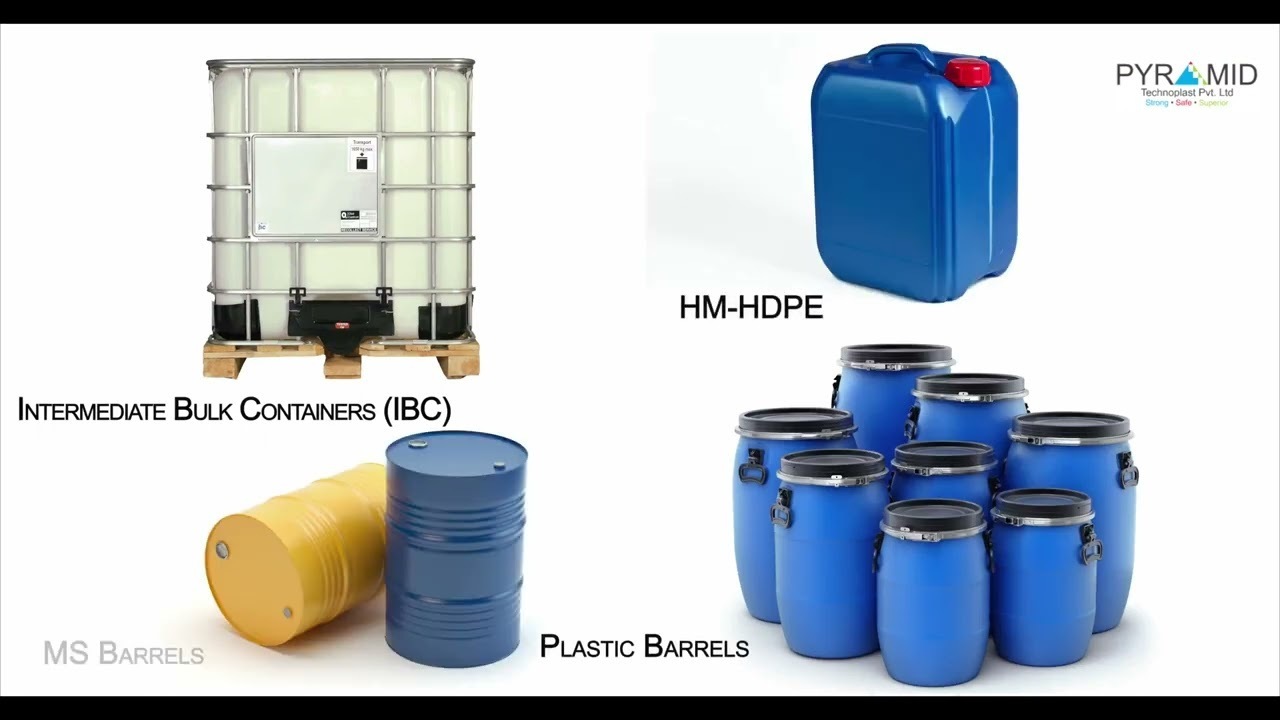
Three product families carry the revenue. Polymer drums run from 20 litres to 250 litres, moulded from HDPE, a tough plastic. They sell as Narrow Mouth, Wide Mouth, Full Open Top and Jerry Cans. Intermediate bulk containers are the 1,000-litre cube held inside a steel cage. Pallets underneath come in steel, plastic, composite or wood, every one 1,200mm long and 1,000mm wide. They differ chiefly in pallet height, a choice a buyer either needs desperately or does not need at all. Mild steel drums hold 200 to 210 litres. Variants include General Purpose, Epoxy Coated, Composite and Galvanized, and an Open Top version is made as well. The steel drums carry UN certification and conform to the Indian standard IS 1783:2014.
Backward integration covers the fittings. Caps, lids and handles are made in-house, along with bungs and lugs. Those come off injection moulding machines, while the drums themselves come off blow moulding lines. The recycling plant closes the other end