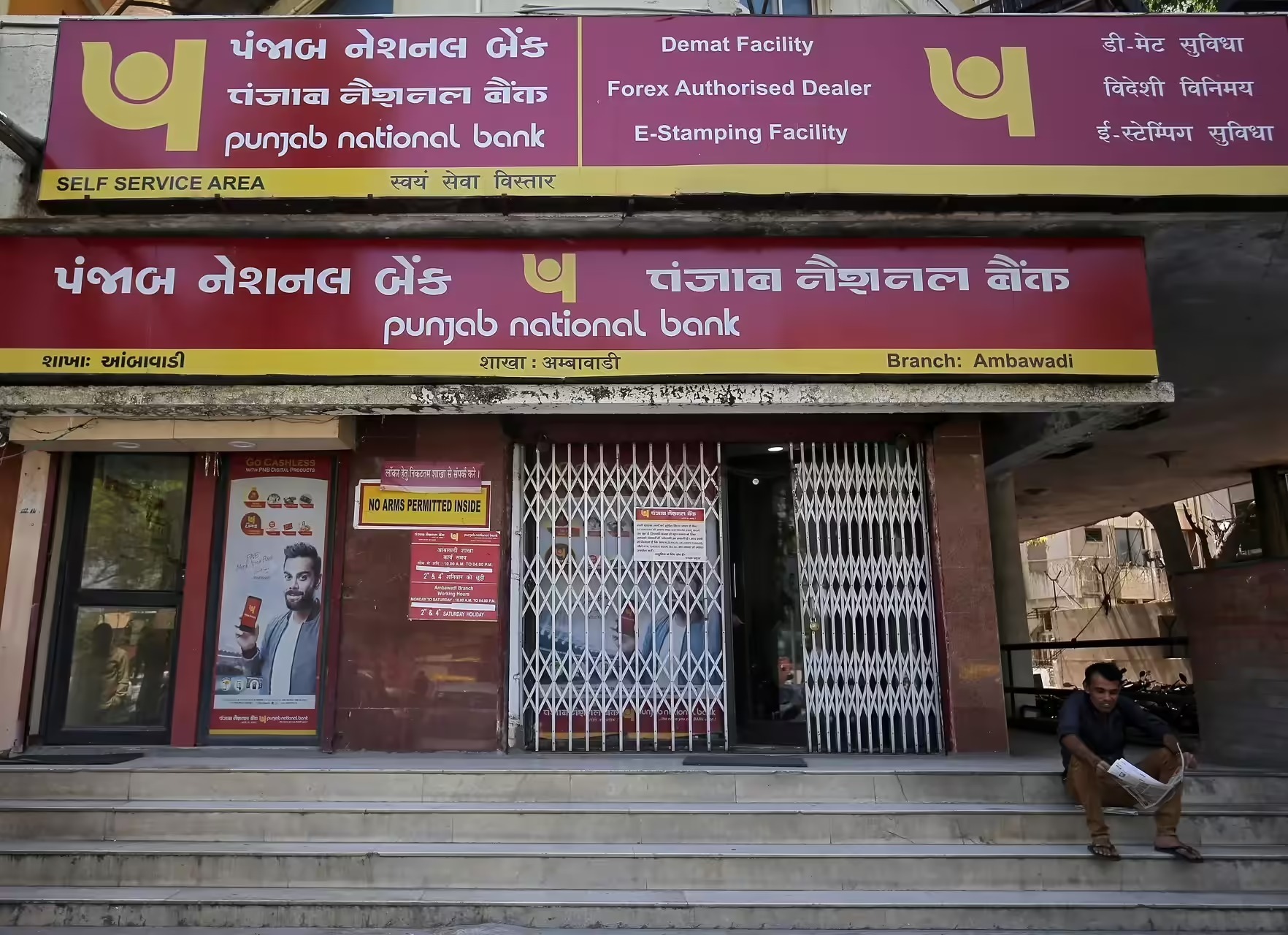
Punjab National Bank FY26: The Mix Shift That Didn’t Show Up in the Margin
General information and entertainment, not investment advice. The author is not a SEBI-registered adviser or research analyst. No recommendation, no promised returns. Markets carry risk including loss of capital. Figures may not be current. Consult a registered adviser before acting.
1. At a Glance
PNB reported ₹18,393 Cr net profit in FY26, up 0.5% from FY25’s ₹18,480 Cr—a full stop on a three-year 76% CAGR.
Earnings were hijacked by a one-time tax shift (₹3,324 Cr charge in Q1) that, even excluding it, leaves annualized ROA at 1.06% versus the prior year’s 0.97%—respectable for a PSU bank, fragile by profit growth standards.
The real tension: management is engineering a deliberate portfolio tilt toward Retail/Agriculture/MSME (RAM) to escape corporate lending’s thinner spreads, but six months of visible data show no margin relief yet. NIM contracted 42 bps YoY, deposit costs stayed sticky, and the CD ratio edged up to 73.6%.
Asset quality continued its recovery arc—GNPA fell to 2.95%, NNPA to 0.29%—but with ₹41,534 Cr in SMA bucket (3.3% of advances), the buffer is high but the tail is watching.
The teaser: a bank in the middle of a customer mix reengineering, showing the cost-to-income improvement (51.79% vs 54.59%) but not yet the yield lift that’s supposed to come next.
2. Introduction
Punjab National Bank, India’s first Swadeshi bank, started life in 1895 in Lahore. The 2020 government-mandated merger of PNB, Oriental Bank of Commerce, and United Bank of India created a three-in-one behemoth: it’s now the third-largest PSU bank after SBI and Bank of Baroda by business size.
The post-merger years (2020–23) were spent cleaning—NPAs touched 14%, then fell. By FY25, GNPA had compressed to 3.95%, PCR to 96.8%. The 2026 audit handed management the runway they’d asked for: a clean asset book and ₹1.49 Lakh Cr in advances.
FY26 announced a conscious strategy pivot. Rather than play corporate lending—where spreads compress and PSU benchmark rates hurt—PNB is steering toward RAM: higher yields, higher customer frequency, lower systemic risk. It’s a shift that shows up in the concall transcript but not yet in the headline numbers.
A new MD (Ashok Chandra, appointed Jan 2025) inherited a 10,228-branch empire with 1+ lakh employees and distribution reach across rural (38%), semi-urban (25%), urban (20%), and metro (17%) zones.
3. Business Model: What Even Is PNB?
PNB is a universal bank that earns money by turning deposits into advances and charging a spread between the two rates, plus fee income, plus treasury gains.
Advances mix (as of Q3 FY26): Retail 24%, Agriculture 16%, MSME 16%, Corporate & Others 43%. Translation: the bank still leans corporate, but less than it did a year ago (was ~49% a year back). Management target for FY27 is 58% RAM and 42% corporate—an aggressive rebalance in 12 months.
Deposits mix (Q3 FY26): Term deposits 63% (the expensive sticky kind), Savings 32%, Current 5%. The CASA ratio (Current + Savings as % of domestic deposits) was 37.29% as of Q3 FY26, down from 39.31% a year prior—a slip that fed margin compression.
Geography: Domestic dominates (96% of business), but the bank operates branches in Dubai and GIFT City; has subsidiaries in the UK and Bhutan; and a JV in Nepal. International business is <5% of total operations.
Distribution: 10,261 branches, 11,109 ATMs, 32,809 Business Correspondents (BCs). The network is ancient and sprawling—useful for deposit gathering in semi-urban and rural India, expensive to maintain in a digital era.
Digital: By Q3 FY26, 95% of all transactions were digital; every third loan is now sanctioned in digital mode. Digi MSME Prime (launched Q4) targets 100% end-to-end digital MSME loans up to ₹10 Cr. WhatsApp banking users jumped 77% YoY to 1.09 Cr. Digital lending sanctioned ₹20,873 Cr in Q4 across 4.8 lakh customers.
The model is a PSU universal bank caught between deposit-driven fund-cost inflation and yield pressure—solving it via scale, digital, and customer mix engineering.
4. Financials Overview
Figures are consolidated, in ₹ crore.
Metric
Q4 FY26
Q4 FY25
YoY %
Q3 FY26
QoQ %
Revenue
32,798
27,852
+17.8%
32,513
+0.9%
Operating Profit
25,280
18,852
+34.2%
24,214
+4.4%
Net Profit
5,592
3,442
+62.4%
5,125
+9.1%
EPS (Annualized)
4.87
3.04
+60.2%
4.46
+9.2%
Full year (FY26 vs FY25):
Metric
FY26
FY25
YoY %
Revenue
130,772
124,010
+5.5%
Net Profit
18,393
18,480
-0.5%
EPS
16.00
16.08
-0.5%
Quarterly beat, annual flatline. Q4 delivered—operating profit up 34%, net profit up 62% YoY. But FY26 full-year net profit of ₹18,393 Cr is a statistical draw with FY25’s ₹18,480 Cr.
The blame: Q1 FY26 carried a ₹3,324 Cr one-time tax hit from management’s switch to the new corporate tax regime (Section 115BAA). Backing it out, run-rate operating profit improved, but headline PAT did not.
Concall colour: Management celebrated “broad-based sustainable performance” on growth, asset quality, profitability, and operating efficiency. Most guidance was met or exceeded. The two misses were CASA ratio and margins—attributed to “liquidity and interest rate dynamics.”
5. Market Expectations & Historical Multiples
This section describes how the market is currently pricing the company and how that compares with its own history and peer group. It is descriptive, not predictive.
Metric
Current
5-Yr Avg
Peer Median
P/E
6.59x
11.6x
8.28x
EV/EBITDA
16.1x
—
—
P/B
0.80x
0.97x
0.97x
ROE
13.0%
9.4%
13.93%
ROCE
6.13%
—
6.0%
The market currently pays 6.59x earnings here, versus a five-year average of 11.6x. PNB trades below its peer median of 8.28x,