Prime Fresh Q4 FY26: A ₹274 Crore Green Grocer with Mainboard Dreams and Cash Flow Drama
Section 1 — At a Glance
The financial ledger of an agricultural supply-chain business often resembles the volatile climate it relies upon. For Prime Fresh Limited, the conclusion of the fiscal year ended March 31, 2026, presents a sharp dichotomy between headline scale and structural capital efficiency. The company achieved a record top-line performance, logging annual revenue of ₹273.98 crore, which represents a robust multi-year scaling trajectory from ₹149.21 crore in FY24 and ₹206.77 crore in FY25. This rapid volume expansion has successfully caught the eye of institutional participants and prompted a full migration from the BSE SME platform to the main board of the BSE.
However, behind the impressive growth numbers lies a structural capital strain that requires careful scrutiny. While net profit for FY26 rose to ₹13.21 crore, the cash engine of the business tells an entirely different story. Cash flow from operating activities sank to a negative ₹11.91 crore in FY26, marking a consecutive multi-year streak of cash destruction. The gap between accounting profits and real cash is driven by a working capital cycle that has ballooned to 115 days, heavily anchored by trade receivables that jumped to ₹88.91 crore.
True corporate health is never measured by the speed of the delivery truck, but by the velocity at which invoices convert back into cold cash.
With a massive planned capital expenditure of ₹150 crore hanging over a modest net worth, Prime Fresh is racing against its own balance sheet to transition from a localized middleman to an integrated agricultural infrastructure champion.
Section 2 — Introduction
Established in 2007 and based out of Ahmedabad, Prime Fresh Limited operates an integrated post-harvest management and distribution network for fresh fruits and vegetables. The corporate journey began with a single warehouse and modified delivery vans; today, the enterprise coordinates logistics across 18 states, connecting over 110,000 farmers to organized retail, e-commerce platforms, and wholesale channels.
The company’s primary corporate agenda centers on shifting its operational identity away from standard volume trading toward high-margin services, including third-party logistics (3PL), specialized warehousing, and ripening solutions. The recent listing migration to the BSE Mainboard signifies management’s desire to play in the big leagues, but it also exposes their volatile metrics to far more rigorous institutional oversight.
Section 3 — Business Model: WTF Do They Even Do?
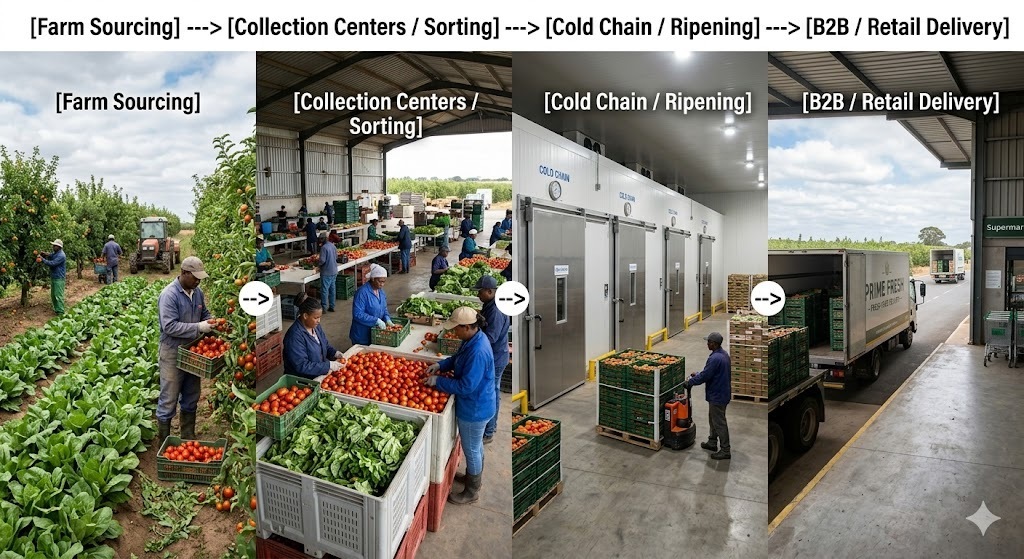
Prime Fresh acts as the corporate middleman between regional growers and commercial buyers, trying to add a layer of organization to India’s notoriously chaotic agricultural supply chain. They handle everything from sorting onions to managing cold storage networks across Gujarat, Maharashtra, and Rajasthan.
The revenue mix is split between selling actual farm produce—which accounts for 87% of their top line—and collecting fees for handling and warehousing services, which brings in around 9%. They boast a high-profile client roster that reads like a who’s who of grocery delivery and retail tech, including Reliance Fresh, Swiggy, Zepto, and Zomato. Additionally, they have signed strategic agreements with ITC Limited to cross-sell distribution capabilities. The core objective is to buy low from the farm gate, limit spoilage to under 5%, and sell quickly to supermarkets before the tomatoes turn to paste.
Section 4 — Financials Overview
Figures are consolidated, in ₹ crore.
Headline Results Performance
Metric
Latest Quarter (Q4 FY26)
YoY
QoQ
Revenue
₹79.91
49.98%
7.51%
EBITDA / Operating Profit
₹5.13
66.02%
-18.57%
PAT
₹2.85
47.67%
-36.95%
Reported EPS (₹)
₹2.05
45.39%
-38.07%
The sequential plunge in operating performance during Q4 highlights the inherent seasonality of managing perishable produce. While the yearly comparison looks healthy due to a lower base in the previous fiscal period, the sequential numbers reveal immediate pressure. EBITDA margins fell from 8.48% in Q3 to 6.42% in Q4, confirming that when raw material costs spike, the business struggles to pass those costs downstream in real time.
What is Management Promising in the Coming Quarters?
During recent interactions, management noted that operational efforts in traditional channels and bulk business orders are paying off, helping them achieve record sales volumes of 21,454 MT in Q3. Looking ahead, the focus remains locked on expanding the high-margin fruits and vegetables services