Capacit’e Infraprojects FY26: A ₹2,623 Crore Tower of Receivables and Hard Hats
Section 1 — At a Glance
A contract win is an entry in an order book, but survival in the engineering, procurement, and construction (EPC) landscape depends entirely on the cash cycle. For Capacit’e Infraprojects Limited, FY26 emerged as a multi-layered narrative of record topline milestones running parallel to structural margin stress. The company printed a record consolidated revenue from operations of ₹2,623 crore for the full year, translating to a stable 12% year-on-year growth trajectory. Yet, the bottom line told a far more conservative story, with consolidated profit after tax contracting by 5% to ₹193 crore. This divergence highlights a systemic risk: in the construction sector, revenue is merely an opinion until it successfully clears the gauntlet of raw material inflation and working capital friction.
Investor scrutiny remains intensely focused on the company’s asset efficiency and liquidity indicators. While management successfully achieved an inflection in net cash generated from operating activities—surging to ₹223 crore from a modest ₹52 crore in the prior fiscal year—the balance sheet remains heavily constrained by an elongated collection cycle. Trade receivables and contract assets together form a massive mountain of uncollected economic value.
High-velocity order inflows provide operational visibility, but capital efficiency is won or lost in the structural clauses of the billing cycle.
With an unexecuted order book sitting at a multi-year high, the operational runway is secure, but conversion efficiency will dictate whether this backlog transforms into shareholder value or structural balance sheet stress.
Section 2 — Introduction
Capacit’e Infraprojects entered FY26 carrying the distinct operational profile of a highly specialized, urban-focused EPC player. From its corporate base in Mumbai, the firm has carved out an institutional niche in executing technically demanding high-rise, super high-rise, and specialized gated townships.
The corporate architecture is explicitly designed to handle structural complexity, servicing both premium private real estate developers and large-scale public infrastructure bodies across India’s principal metropolitan growth corridors. Over its twelve-year operating history, the company has transitioned from a localized contractor into an organized institutional counterparty capable of managing multiple high-value construction sites simultaneously.
The strategic focus for the fiscal year centered heavily on rebalancing its client portfolio, upgrading its structural credit profile, and aggressively pursuing non-core asset monetisation to buffer the cash requirements of its active project sites.
Section 3 — Business Model: WTF Do They Even Do?
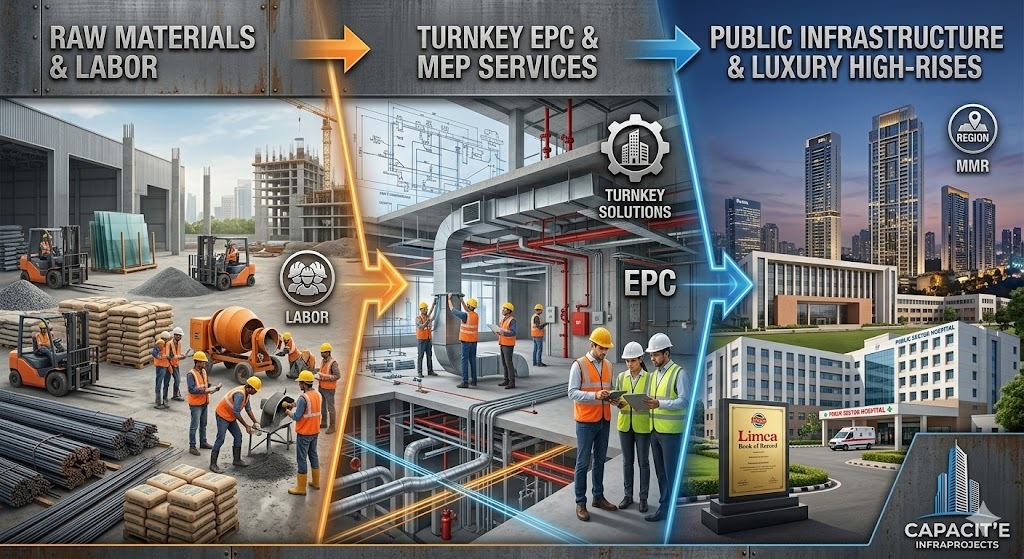
Capacit’e operates a business model that can be effectively summarized as translating massive piles of cement, steel, and migrant labor into premium vertical real estate. They are the structural engineers behind high-profile urban profiles, constructing everything from 80-story luxury residential towers in Worli to multi-specialty municipal hospitals and corporate office complexes.
The revenue mix exhibits a deliberate split: the public sector accounts for 57% of the order backlog, leaving the remaining 43% tied to private sector developers.
Order Book Mix (Sector-Wise): Public Sector: 57% Private Sector: 43%
The product mix is heavily tilted toward Residential projects at 62%, followed by Mixed-Use developments at 29% and Institutional buildings at 9%. The core structural dilemma is that high-rise construction requires intensive upfront capital deployment for specialized machinery, aluminum formwork, and jump-form engineering systems.
While their resume includes prestigious real estate developments like Lodha’s The Park and Piramal Mahalaxmi, the business model forces them to behave as a structural bank for their clients—funding construction expenses long before the final invoice is certified and cleared.
Section 4 — Financials Overview
Figures are consolidated, in ₹ crore.
Metric
Latest Quarter (Q4 FY26)
YoY (%)
QoQ (%)
Revenue from Operations
₹711.8
6%
5%
EBITDA / Operating Profit
₹109.1
27%
1%
PAT
₹44.6
-16%
-12%
Reported EPS (₹)
₹5.26
-16%
-11%
The full-year performance highlights stable operational scaling, but reveals an immediate under-the-hood problem regarding earnings quality. While operating profit (EBITDA) grew 13% to ₹427 crore, matching topline growth, net profit slipped from ₹204 crore to ₹193 crore.
The culprit? Other income plummeted from ₹58 crore to ₹21 crore. FY25 was artificially padded by non-operational write-backs, and as those one-offs vanished, the core