Popular Vehicles & Services Mar 2026: ₹1,405 Cr of Debt for a -0.6% Return on Equity
Date of Publishing -
Spotted a factual error — a wrong number, date, or fact? Tell us and we will check the source.
Section 1 — At a Glance
Popular Vehicles & Services Ltd closed FY26 with a consolidated top line of ₹6,381.10 Cr, yet the bottom line bled a ₹12.47 Cr loss. The fourth quarter offered a mixed reality: Q4 sales hit ₹1,754.45 Cr, reflecting a solid 27.8% YoY jump, but it wasn’t enough to prevent a quarterly net loss of ₹4.96 Cr. The market is viewing this growth with deep skepticism, valuing the entire enterprise at a mere ₹708.93 Cr market capitalization.
Adding to the tension, management had to acknowledge a material process issue in their April business update, forcing a restatement of Q4 revenue growth down from an initial 69% to 28% due to an “erroneous calculation.” When internal data gathering requires public apologies, the market naturally demands a wider margin of safety. Revenue growth without operational discipline is just expensive motion. The focus now shifts entirely to their ability to integrate FY26’s aggressive dealership acquisitions and cap their inventory funding, which drove overall borrowings up 52% YoY to a towering ₹1,405.51 Cr.
Section 2 — Introduction
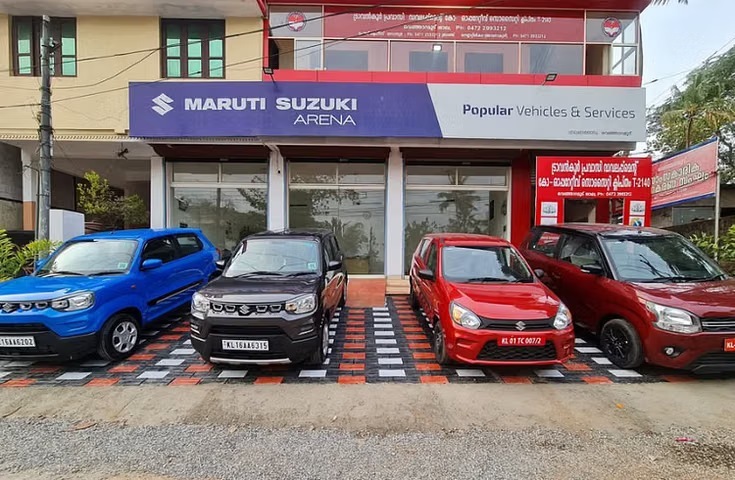
Popular Vehicles, part of the Kuttukaran Group, is one of India’s oldest Maruti Suzuki dealers, navigating the trade since 1983. They deal in new and pre-owned vehicle sales, spare parts, servicing, and financial facilitation. Recently, the company made some decisive strategic shifts, divesting from Honda and Piaggio to funnel capital toward what they perceive as stronger long-term bets like Audi, BharatBenz, and deeper Maruti networks. Pivoting away from struggling brands to double down on premium and commercial vehicles is theoretically sound, provided management can successfully operate the new showrooms without sinking the ship.
Section 3 — Business Model: WTF Do They Even Do?
In simplest terms, they buy cars from OEMs and sell them to you. They operate roughly 500 touchpoints across seven states, primarily anchored in Kerala, which still generates 53.4% of their revenue. In FY26, they pushed out over 53,000 new vehicles and serviced nearly a million more.
The business model is essentially a volume game wrapped in a real estate puzzle. New vehicles bring in 75% of the revenue but a measly 37% of the EBITDA. Meanwhile, services and spare parts contribute just 19% of the topline but a massive 62% of the EBITDA. They are fundamentally a massive, multi-state repair shop that sells cars on the side to guarantee a steady supply of future breakdowns. And just to ensure they hit all the corporate buzzwords, they recently launched an e-commerce platform for spare parts, because every physical dealership eventually decides it needs to be an omnichannel tech ecosystem.
Section 4 — Financials Overview
Figures are consolidated, in ₹ crore.
Metric
Latest Quarter (Mar 2026)
YoY (Mar 2025)
QoQ (Dec 2025)
Revenue
1,754.45
1,372.36
1,785.36
Operating Profit
53.13
25.82
51.80
PAT
-4.96
-13.72
0.67
EPS
-0.70
-1.93
0.09
The Q4 numbers are technically improving, in the sense that they have stopped getting worse as aggressively as they did last year. An operating profit of ₹53.13 Cr is visually respectable, but it gets entirely swallowed below the line by ₹27.22 Cr of interest and ₹37.73 Cr of depreciation.
Management framed FY26 as “a year of recovery, execution and strategic repositioning.” They also had to awkwardly admit on the concall that Q4 revenue growth numbers in an earlier update were “inadvertently misstated.” When management blames “system updates and consolidation exercises” for botching the top-line math, you nod politely and scrutinize the filings twice. Meanwhile, CEO Raj Narayan put in his papers to “pursue an opportunity outside the industry,” leaving MD Naveen Philip to steer the integration of their newly acquired operations.
Section 5 — Valuation Discussion: Fair Value Range Only
Valuing a loss-making auto dealership requires patience and a solid imagination for normalized earnings.
P/E Method: With a trailing full-year EPS of -₹1.75, the traditional P/E multiple is mathematically broken. If we entertain management’s guidance of returning to FY24 PAT levels (~₹76 Cr, or ~₹10.6 EPS) in FY27,