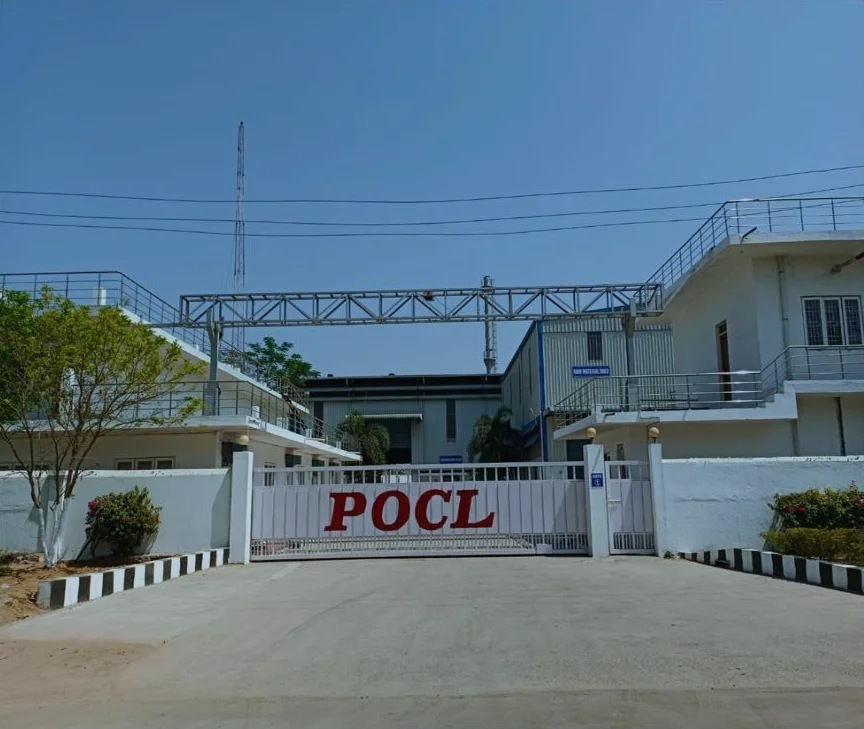
POCL Enterprises FY26: The 50% Topline Mirage and the Curious Case of the Turning Planet
Date of Publishing -
Spotted a factual error — a wrong number, date, or fact? Tell us and we will check the source.
Section 1 — At a Glance
Corporate turnarounds are often hidden behind flat headlines. For the full year ended March 31, 2026, consolidated revenue for POCL Enterprises Limited dipped slightly to ₹1,431.68 crore from ₹1,450.10 crore in the previous fiscal year. However, investor attention is firmly anchored to the bottom line, where consolidated net profit advanced to ₹41.48 crore. This divergent earnings quality signals a structural shift from raw volume brokerage toward high-margin value-added processing.
The immediate headwind for the company stems from its latest quarter performance. In Q4 FY26, operational volumes were temporarily throttled by a planned 25-day infrastructure upgrade and modernization shutdown at its flagship Maraimalai Nagar lead alloying plant. While this execution pause muted near-term revenues, it highlights a deliberate management choice to trade short-term throughput for long-term process efficiency and environmental compliance.
The primary worry for stakeholders remains the inherently lean operating margins typical of the secondary metal recycling segment, which leaves the business exposed to swings in global commodity benchmarks. Yet, a capital infusion of ₹69.67 crore raised via preferential allotments has shored up the capital layout, paving the way for the impending amalgamation of its associate entity, Planetfirst Green Private Limited.
True corporate transformation is rarely a straight line; it frequently requires a temporary step back in volume to build the infrastructure required for sustainable margin expansion.
As this processing layout reconfigures, the financial plumbing reveals whether this smallcap metals player is genuinely upgrading its earnings engine or simply reshuffling its balance sheet assets.
Section 2 — Introduction
POCL Enterprises has spent over three decades operating in the unglamorous, grit-heavy corridors of non-ferrous metal recycling and chemical manufacturing. Established in 1988, the company manufactures lead alloys, zinc metals, metallic oxides, and plastic additives across five manufacturing units located in Tamil Nadu and Puducherry.
While the broader equity market chases software algorithms and consumer tech multiples, this business functions as a critical supply-chain node for industrial titans. Its lead and zinc derivatives find their way into everything from Exide car batteries to MRF tyres and heavy-duty cable sheaths. It is a working-class enterprise operating in a globalized ecosystem, sourcing scrap metal from international yards and linking its realizations directly to global trade indices.
Section 3 — Business Model: WTF Do They Even Do?
The business model is essentially industrial alchemy: taking what society discards—primarily spent lead-acid batteries and scrap metal pieces—and refining them back into manufacturing-grade elements. The revenue engine is divided into three distinct segments.
The undisputed heavyweight is the Metals division, which commands roughly 65% of the top line, focusing on lead smelting, refining, and alloying. Metallic Oxides (Zinc and Lead oxides) bring in around 29%, catering heavily to the tyre and rubber industries. The remaining 6% belongs to Plastic Additives, which creates PVC stabilizers.
Step 1: Scrap Sourcing – Gathering international scrap and spent lead-acid batteries from global yards.
Step 2: Smelting & Refining – Transforming raw inputs through high-temperature industrial processing.
Step 3: Metals & Metallic Oxides – Extracting pure lead alloys, value-added zinc, and chemical oxides.
Step 4: Battery & Tyre OEMs – Shipping the finished elements directly to tier-1 manufacturing clients.
The underlying risk profile is concentrated. The company’s largest single customer historically contributes nearly 29% of total revenue. If that client relationship catches a cold, the company’s manufacturing throughput risks immediate hypothermia. To hedge this vulnerability, management is diversifying into value-added zinc metal sales and copper scrap processing, looking to squeeze extra margin out of the same old factory gates.
Section 4 — Financials Overview
Figures are consolidated, in ₹ crore.
Metric
Latest Quarter (Mar 2026)
YoY (%)
QoQ (%)
Revenue
332.29
-10.76%
-8.82%
EBITDA / Operating Profit
17.32
-6.12%
+6.85%
PAT
12.80
+21.67%
+40.81%
EPS (₹)
4.16
+10.34%
+41.02%
The financial sheets present a fascinating divergence. While quarterly revenue contracted by 10.76% year-on-year due to the planned facility downtime, quarterly net profit actually surged by 21.67%.
This statistical anomaly stems from a classic consolidation bridge. While management’s standalone internal presentation highlights a quarterly standalone PAT of ₹9.70 crore, the final consolidated ledger reads ₹12.80 crore. The mystery is solved by looking at their 40% owned associate, Planetfirst Green Private Limited, which turned sharply profitable during the second half of the year and began feeding the consolidated bottom line.
Earnings quality isn’t just about the absolute bottom-line number; it’s about knowing precisely whose balance sheet baked the cake.
During recent communications, management noted that the 25-day planned upgrade at Maraimalai Nagar “temporarily impacted sales during the quarter but left the facility with improved