Pine Labs FY26: The 143x P/E Fintech That Finally Found a Bottom Line
Spotted a factual error — a wrong number, date, or fact? Tell us and we will check the source.
Section 1 — At a Glance
Pine Labs turned structurally profitable in FY26, posting a Consolidated Net Profit of ₹112.51 crore against a severe net loss of ₹145.49 crore in the preceding fiscal year. This financial turnaround comes on the back of full-year revenue from operations climbing to ₹2,710.59 crore, up 19.18% year-on-year. However, public market investors face an eye-watering valuation hurdle, with the stock trading at a recalculated price-to-earnings (P/E) multiple of approximately 145.8x based on full-year earnings.
While the broader expansion trajectory remains intact, a clear deceleration was visible in the final stretch of the year. Revenue growth moderated to 17.02% year-on-year in Q4 FY26, down sequentially from the festive highs recorded in Q3 FY26. Operating cash flows delivered a massive optical surge to ₹395.39 crore for the full year, heavily driven by an aggressive Q4 performance of ₹676 crore that was significantly aided by early settlement actions.
The core challenge for the company lies in optimizing capital efficiency, as the business continues to carry a heavy asset base alongside substantial depreciation charges and expanding employee stock option allocations.
Sustained profitability in transaction-heavy platforms is rarely a function of sudden top-line bursts; it is the mathematical consequence of fixed digital infrastructure costs finally getting covered by incremental ecosystem volumes.
The market must now evaluate whether this structural turnaround can support the premium valuation multiple or if operational headwinds will trigger a near-term reset.
Section 2 — Introduction
Pine Labs has spent over two decades transitioning from a legacy offline point-of-sale terminal provider into an integrated merchant commerce ecosystem. Fresh from its public listing in November 2025, where it raised ₹2,080 crore in fresh capital to extinguish debt and fuel technology assets, the enterprise finds itself under intense public market scrutiny.
The corporate strategy emphasizes a deliberate shift away from pure hardware-linked subscription fees toward higher-margin software services, consumer affordability networks, and cross-border issuance platforms. This evolution takes place against a complex domestic macro background, where base payment processing fees face structural compression, forcing merchant platforms to build deeper, value-added software layers to ensure long-term ecosystem retention.
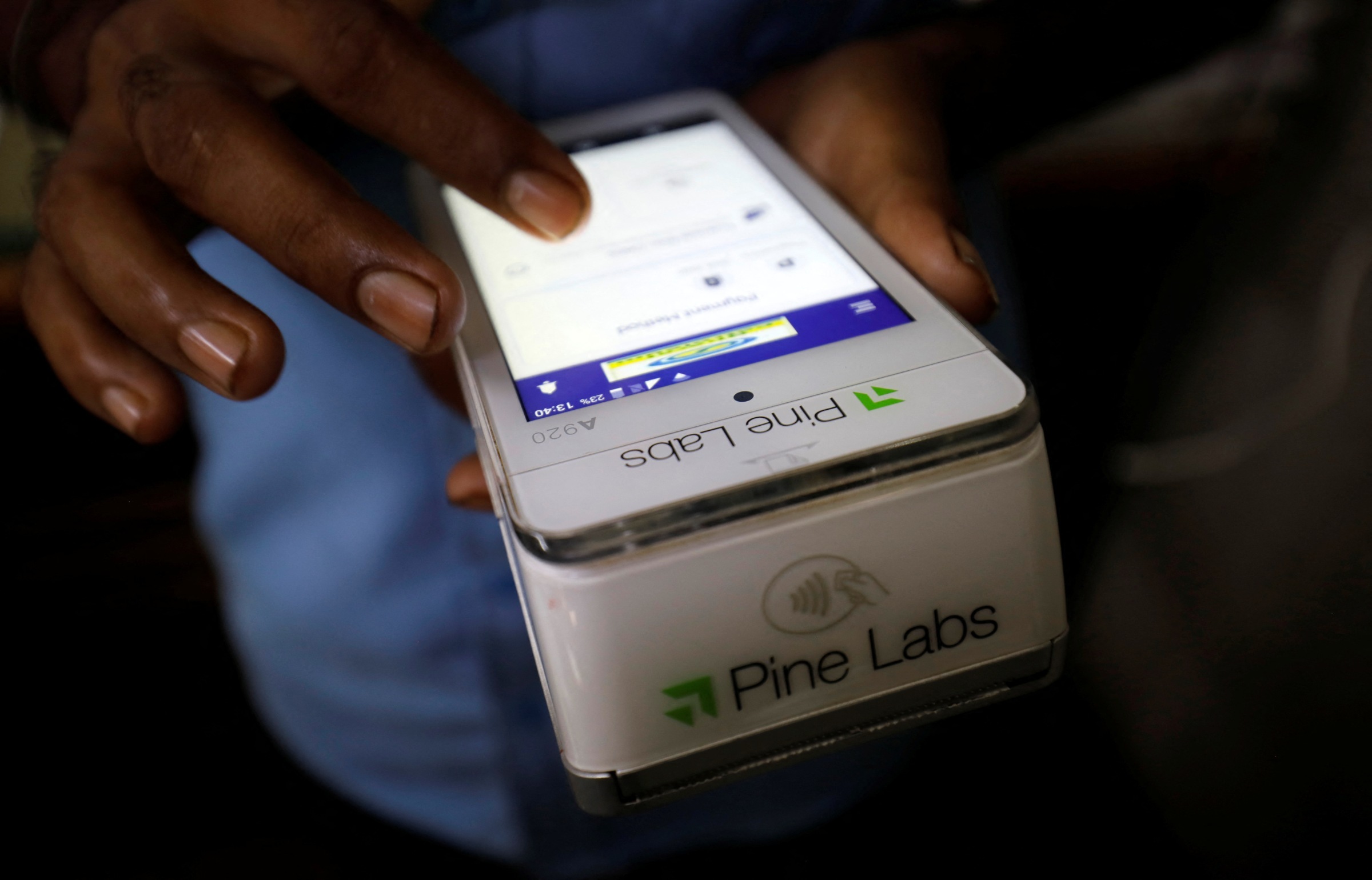
If you believe Pine Labs simply distributes those grey credit card terminals resting on retail checkout counters, management would strongly disagree. The enterprise views itself as an expansive omnichannel merchant operating system.
The operational architecture is split into two primary engines:
Digital Infrastructure & Transactions: This encompasses offline and online payment gateways, soundboxes, and the high-margin affordability network that runs instant point-of-sale EMIs and brand subventions.
Issuing & Acquiring Platform: This segment manages corporate gift card catalogs, loyalty programs, and prepaid solutions under the Woohoo framework.
The transaction flow moves through a sequence of monetization touchpoints:
The Merchant Transaction A consumer initiates a purchase at the retail counter or online checkout.
The Pine Labs Terminal or Gateway The transaction hits the company’s proprietary hardware or digital gateway infrastructure.
The Core Split The system instantly bifurcates the incoming flow into a standard base payment and a specialized EMI subvention layer.
The Revenue Capture Pine Labs skims its share from both sides, collecting an upfront processing fee from the brand alongside a recurring subscription fee from the merchant.
When a consumer utilizes a no-cost EMI offer at a retail touchpoint, Pine Labs sits squarely in the middle of the flow. It extracts subscription fees from the merchant for the digital checkout point, a transaction take-rate from the acquiring bank, and a processing fee from the consumer brand sponsoring the affordability campaign. It is an integrated toll-booth model designed to monetize merchant transaction flows, consumer credit access, and corporate distribution rails simultaneously.