Pace Digitek Mar 2026: A ₹11,338 Crore Order Book Trapped in a 286-Day Delivery Hell
Date of Publishing -
Spotted a factual error — a wrong number, date, or fact? Tell us and we will check the source.
Section 1 — At a Glance
Pace Digitek Limited presents a classic masterclass in the perils of aggressive structural scale. On the surface, the headline numbers scream exponential growth: full-year FY26 revenue reached ₹2,641 crore, and the executable order book has swollen to a historic ₹11,338 crore, driven by a massive structural pivot into Battery Energy Storage Systems (BESS). However, beneath this visible momentum lies an increasingly severe working capital crisis. The company’s cash flow from operations plunged to a negative ₹917 crore for FY26, heavily weighed down by trade receivables that have escalated to ₹2,067 crore, representing an alarming debtor cycle of 286 days.
While public sector orders account for 97.8% of the pipeline, the operational reality is defined by intense milestone-based billing backlogs and execution delays. The company successfully raised ₹819 crore through its October 2025 IPO to fund capital expenditure, yet its total borrowings simultaneously climbed from ₹161 crore to ₹981 crore within twelve months. Investors are left balancing an undeniable multi-year revenue visibility against a cash-burning execution engine that remains highly concentrated around a few sovereign counterparties.
A booming order book is merely a corporate vanity metric until it successfully mutates into hard, unencumbered cash on the balance sheet.
The central puzzle for the market now is whether the high-margin energy transition can unlock this liquidity trap before the weight of the leverage catches up.
Section 2 — Introduction
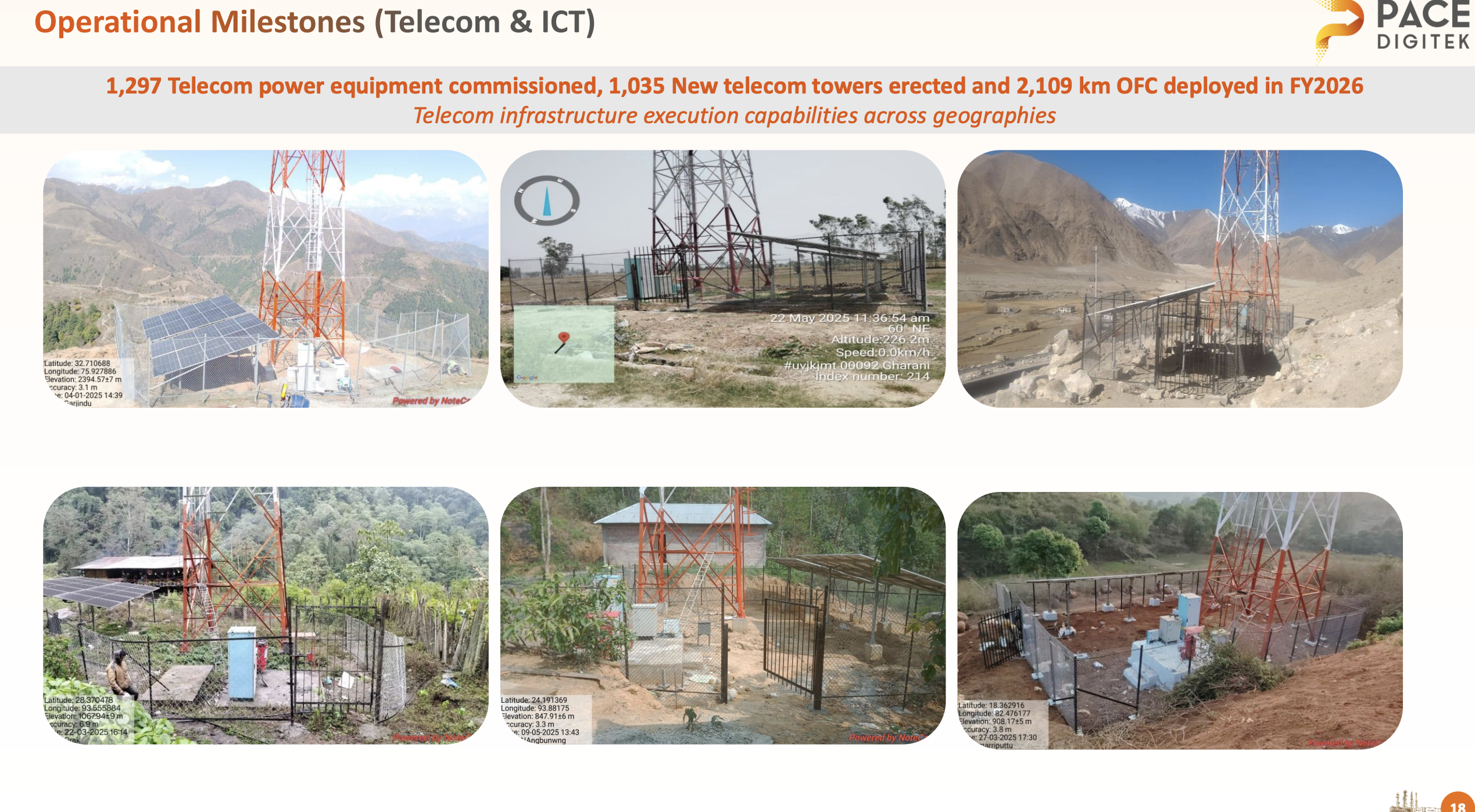
Pace Digitek Limited, originally incorporated in 2007 as Pace Power Systems, has historically operated quietly in the background of India’s digital rollout, manufacturing power management systems and installing passive telecom infrastructure. Its fortunes shifted dramatically with the execution of BSNL’s massive 4G saturation project, catapulting the company from a small-scale manufacturer into a large-scale turnkey infrastructure contractor.
Recently, management orchestrated an ambitious corporate makeover, positioning the company as an integrated energy and digital infrastructure platform. Backed by its fresh public listing on October 6, 2025, the company is aggressively scaling up production facilities in Karnataka to transition from basic telecom tower assembly into complex utility-scale BESS deployment and Commercial & Industrial energy storage products.
Section 3 — Business Model: WTF Do They Even Do?
Pace Digitek essentially functions as a hyper-scaled project executor disguised as a high-tech clean-energy pioneer. The business model is heavily bifurcated: they manufacture power components (SMPS, lithium-ion battery modules, and containerized storage systems) and then bundle them into massive engineering, procurement, and construction (EPC) contracts for telecom networks and power grids.
Despite the marketing narrative highlighting a sophisticated clean-energy transformation, the historical revenue architecture remains incredibly primitive. Telecom projects brought in 94% of top-line revenues, with basic project execution making up 92.2% of that vertical. Furthermore, the company suffers from extreme monopsony risk: the public sector accounts for 96% of its customer base, and the top three clients command a staggering 89% of total revenues. They are also struggling with massive capacity mismatches; while the newly commissioned BESS lines ran at 80% capacity, Facility 2 managed a dismal 15% utilization for its battery systems in the past fiscal year.
Section 4 — Financials Overview
Figures are consolidated, in ₹ crore.
Metric
Latest Quarter (Mar 2026)
YoY (Mar 2025)
QoQ (Dec 2025)
Revenue
1,097.00
833.00
441.00
EBITDA / Operating Profit
163.00
94.00
118.00
PAT
106.00
27.00
79.00
EPS
4.59
3.21
3.51
The quarterly trajectory illustrates an extreme year-end revenue skewing, with ₹1,097 crore—nearly 42% of full-year sales—booked entirely in the final quarter. While quarterly revenues expanded by 60.5% YoY, operating profit margins compressed sequentially from 18% in December 2025 to 15% in March 2026, directly reflecting the lower-margin profile of the growing energy EPC mix.
What is Management Promising in the Coming Quarters?
During the June 2026 earnings call, management aggressively defended the margin dilution, noting that the structural transition into heavy energy execution naturally commands lower initial margins than legacy telecom. Management said, “By October, we would be operating with 10 GWh operational capacity… ahead of our earlier plans.”
They have guided for an ambitious revenue target of ₹3,200 to ₹3,400 crore for FY27, moving up to ₹4,000+ crore by FY28. However, they acknowledged near-term margin friction, lowering PAT margin guidance to a modest 10% to 11% range for the upcoming fiscal year due to volatile raw material costs.
Rapid structural transitions often look like a triumph on the income statement and a crime scene on the cash flow statement.
Would you comfortably back an infrastructure player whose top-line growth depends