Federal-Mogul Goetze India Mar 2026: The ₹829 Cr Cash Vault Holding a 13x P/E Hostage
Date of Publishing -
Spotted a factual error — a wrong number, date, or fact? Tell us and we will check the source.
Section 1 — At a Glance
A multi-decade automotive components franchise presents a fundamental paradox: expanding absolute profitability metrics alongside an aggressively expanding capital isolation strategy. Federal-Mogul Goetze (India) Ltd completed March 2026 by reporting an annual revenue peak of ₹1,958.40 crore, representing an 8.79% year-on-year growth trajectory from the ₹1,800.19 crore posted in March 2025. Net profit margins structuralized efficiently, driving absolute PAT to ₹170.66 crore against ₹162.03 crore in the prior fiscal period.
Yet, the core narrative of this enterprise does not reside within the operational output of its internal combustion engine components. It lives on the asset side of the balance sheet. The company’s cash and bank balances scaled to an unprecedented ₹829.26 crore by March 31, 2026, up from ₹610.17 crore in the previous year. This liquid reserves pile now commands over 35% of the total market capitalization of ₹2,347.86 crore.
When cash components accumulate at this velocity without corresponding capital redistribution, underlying returns face natural architectural resistance. The market continues to apply a severe capital allocation discount, pricing the enterprise at a price-to-earnings multiple of 13.75 times, vastly detached from broader automotive ancillary sector aggregates. Capital efficiency remains structurally bound: incremental operational gains are consistently diluted by a low-yielding treasury architecture. The critical variable for public market participants shifts entirely away from factory utilization metrics toward the resolution of a multi-year corporate restructuring deadlock.
Section 2 — Introduction
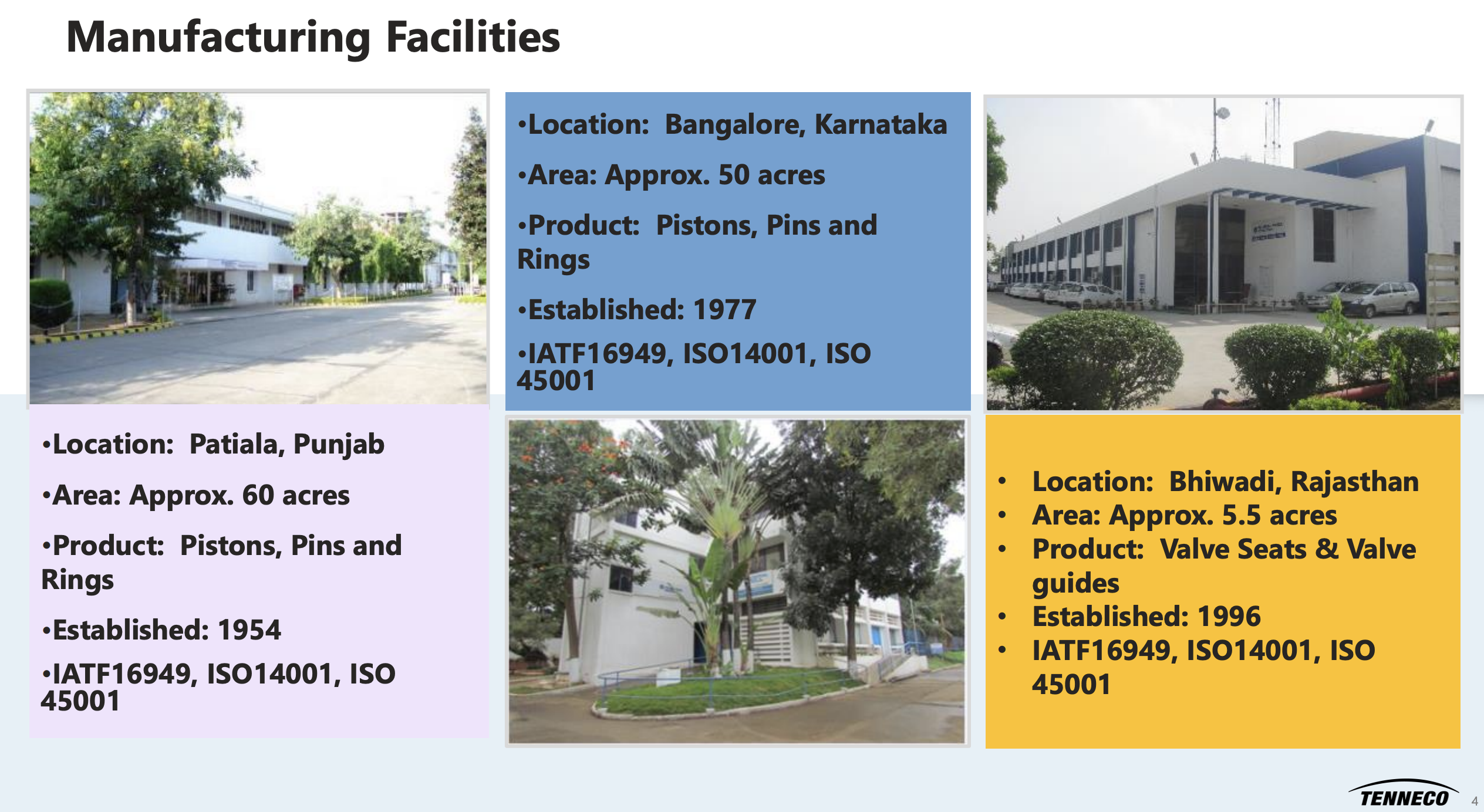
Federal-Mogul Goetze (India) Ltd occupies an entrenched, highly mature position within the domestic automotive supply chain. Established over seven decades ago in 1954 as a strategic joint venture with Germany’s Goetze-Werke, the enterprise has weathered structural macroeconomic cycles, regulatory transitions, and ownership shifts. Today, it operates as an indirect subsidiary of global automotive tier-1 supplier Tenneco Inc., following Tenneco’s global acquisition of the Federal-Mogul group.
The corporate structure underwent further architectural changes when funds managed by private equity giant Apollo Global Management completed the global buyout of Tenneco. Consequently, control of this domestic entity routes directly through international private equity chambers. While the operation maintains deep domestic roots through its manufacturing nodes across northern and southern India, its strategic orientation, corporate governance parameters, and cash deployment mandates are dictated by global institutional playbooks.
Section 3 — Business Model: WTF Do They Even Do?
The corporate objective here is straightforward: manufacturing components that absorb the extreme thermal and mechanical violence inside an internal combustion engine. Federal-Mogul Goetze acts as a primary lung and muscle manufacturer for traditional auto platforms, holding a dominant 29% market share in the organized domestic piston and piston ring industry. If a vehicle runs on diesel or gasoline in India, there is a high probability its compression cycles are secured by this company’s hardware.
The company’s product line spans from 30mm miniature pistons for two-wheelers up to massive 300mm locomotive diesel configurations. This portfolio is engineered across three strategic manufacturing locations: Patiala, Bengaluru, and Bhiwadi. Revenue distributions reveal an overwhelming dependence on the Light Vehicle segment at 45% to 50%, while commercial vehicles and two-wheelers balance the rest.
Revenue Segmentation Mix
Segment
Share (%)
Light Vehicles (PV + Pickups)
45% – 50%
Commercial Vehicles
15% – 20%
2 & 3 Wheelers
15% – 20%
Industrial, Tractors & Others
10% – 15%
The underlying economic challenge is explicit: 100% of the core product architecture is designed for platforms that environmental regulators globally would like to retire. Management points to a substantial aftermarket and heavy commercial mix to defend its long-term relevance. However, the business model fundamentally remains a high-utilization, precision-engineering manufacturing operation tethered to the terminal lifecycle of internal combustion technology.
Section 4 — Financials Overview
Figures are consolidated, in ₹ crore.
Quarterly Performance Trend
Metric
Latest Quarter (Mar 2026)
YoY (%)
QoQ (%)
Revenue
488.58
-1.56%
-1.43%
EBITDA / Operating Profit
82.18
-15.46%
20.11%
PAT
49.13
-17.28%
69.12%
EPS (₹)
8.83
-17.32%
69.16%
The final three months of fiscal 2026 displayed a distinct deceleration patterns. Revenue flatlined at ₹488.58 crore, sliding marginally on both an annual and sequential basis. The contraction in profitability was far more visible: EBITDA shed over 15% relative to the March 2025 quarter, directly highlighting the impact of raw material cost volatility that historical pricing mechanisms failed to absorb in time.
Did Management Walk the Talk?
Reviewing long-term operational execution shows that while management possesses exceptional factory floor discipline, their structural