General information and education, not investment advice. The author is not a SEBI-registered adviser or research analyst. No recommendation, no promised returns. Markets carry risk including loss of capital. Figures may not be current. Always consult a SEBI-registered adviser.
1. At a Glance
Orient Bell manufactures, trades and sells ceramic and floor tiles. Revenue for the three months to June 2026 came in at ₹200.97 crore. The same quarter a year earlier brought in ₹140.23 crore, a rise of 43.3%. Operating profit over that comparison went from ₹4.92 crore to ₹16.41 crore. Net profit moved from a loss of ₹0.66 crore to a profit of ₹8.43 crore. Screener, a financial data site, records a quarterly profit variation of 1,377% against that negative base.
Crisil, a credit-rating agency, set out the backdrop in its bulletin of April 2026. The government notified the Natural Gas (Supply Regulation) Order on 9 March 2026. It restricted the ceramic sector to 80% of its trailing six-month average gas supply. The sector sits in priority category III, the industrial equivalent of the last boarding group. Crisil records that a sizeable number of players shut down over that stretch. Crisil puts Orient Bell at roughly 80% of total capacity at the time. The same bulletin says liquidity covered maturing obligations and fixed costs for more than six months.
Management told its August 2026 call that quarterly volume rose 22.9%. Average selling price rose 15.9% over the same three months, management said. Cost of goods sold rose too, and management points to the gas bill at Sikandrabad. Management says the price there moved from ₹44–45 before the war to ₹60–62. A forty-eight-year-old tile maker spent the quarter finding that its most important raw material was neither clay nor glaze but geopolitics.
For the year to March 2026, revenue was ₹683 crore and net profit ₹11.16 crore.
2. Introduction
Orient Bell Ltd was incorporated in 1977 and manufactures, trades and sells ceramic and floor tiles. Forty-eight years is a long run in a product that is heavy, breakable and low in value per kilogram. It is also sold to people who will spend forty minutes in a showroom choosing between two beiges.
The company runs five facilities, three of them owned and two held through associate entities. Sikandrabad in Uttar Pradesh has capacity of 14.8 million square metres a year. Morbi in Gujarat has 15.5 million square metres and Hoskote in Karnataka has 6.6. Dora in Gujarat adds 5.5 million square metres, for 42.4 million in total including associates. The registered office is in Sikandrabad and the corporate office is in New Delhi. The investor relations advisers sit in Andheri East, and the tiles, presumably, are in transit.
The recent stretch has been eventful in the paperwork sense, and the filings record most of it. On 11 March the company disclosed that GAIL had declared force majeure. The company said gas to the Hoskote plant was capped at 80% of average, with temporary production impact. Senior departures before that read like a very orderly game of musical chairs. The Chief HR Officer resigned in March 2024, and a different one resigned that June. The Chief Sales Officer resigned in November 2024 and the next one in April 2025. Chief Financial Officer Himanshu Jindal resigned on 14 May 2025, with effect from 31 May. Mr Anuj Arora signs as Chief Financial Officer on the presentation for the three months to June 2026.
Also on record is a March 2024 power purchase agreement with Sunsure Solarpark Sixtee. It covers renewable energy at Sikandrabad, involving up to ₹2.45 crore and up to 11% equity in Sunsure. GVT, a vitrified tile variety reported separately, gained a line in September 2023 adding 3.3 million square metres a year. Crisil, a credit-rating agency, assigned ratings on the bank facilities in May 2024 and updated them in April 2026.
The product mix has shifted steadily across the past five years. Vitrified tiles were 41% of sales in the year to March 2021. By the year to March 2026 that share had reached 60% of sales. GVT moved from 16% to 42% across the same two years. Marketing investment runs at 3.7% of revenue, funding an “Always On” television presence named with the confidence of a refrigerator. The company says that presence runs in five languages.
US
Now live
US Stocks terminal is live
13,000+ US tickers · EDGAR fundamentals · screener and filings feed — the same terminal, for American markets.
Explore →
3. Business Model: WTF Do They Even Do?
Orient Bell makes tiles, buys tiles from other manufacturers, and sells both. Around 70% of revenue in the year to March 2023 came from goods it made itself. Traded goods accounted for the other 30%, and exports were about 1% of the total. That leaves a domestic business selling to Indian floors and Indian walls.
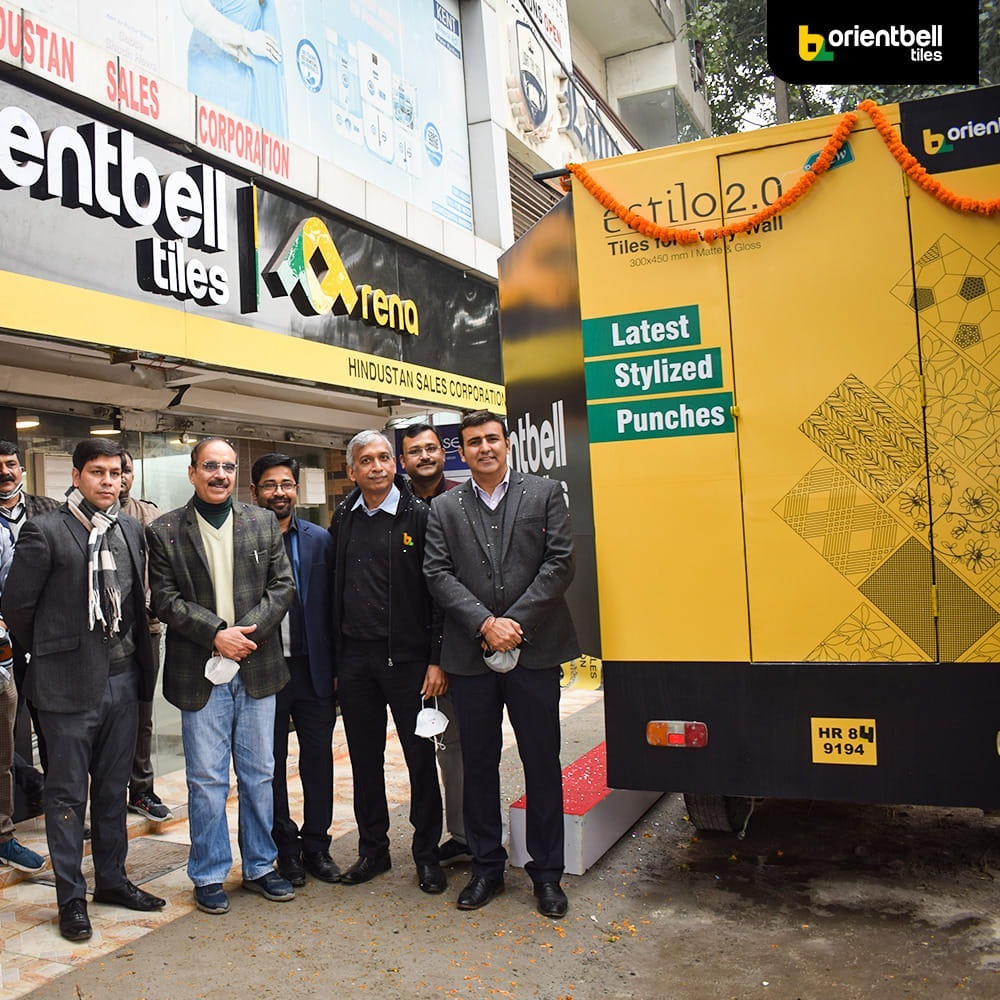
The catalogue runs to more than 4,000 SKUs, meaning distinct product codes. The largest size is 800 by 2400 millimetres and the smallest is 200 by 300. Plank shapes measure 200 by 1200 millimetres, and designs cover wooden, stone, 3D and marble looks in matte and gloss. The collections carry names such as Sparkle, Estilo, Sahara and Rhino, among others. Surface finishes include Sinker Silktouch, Ridge Punch, KitKat Punch and Gloss Emboss Gloss. The last of those is either a finish or a typo that now lives in an investor presentation forever.
Distribution runs through more than 2,000 business partners and