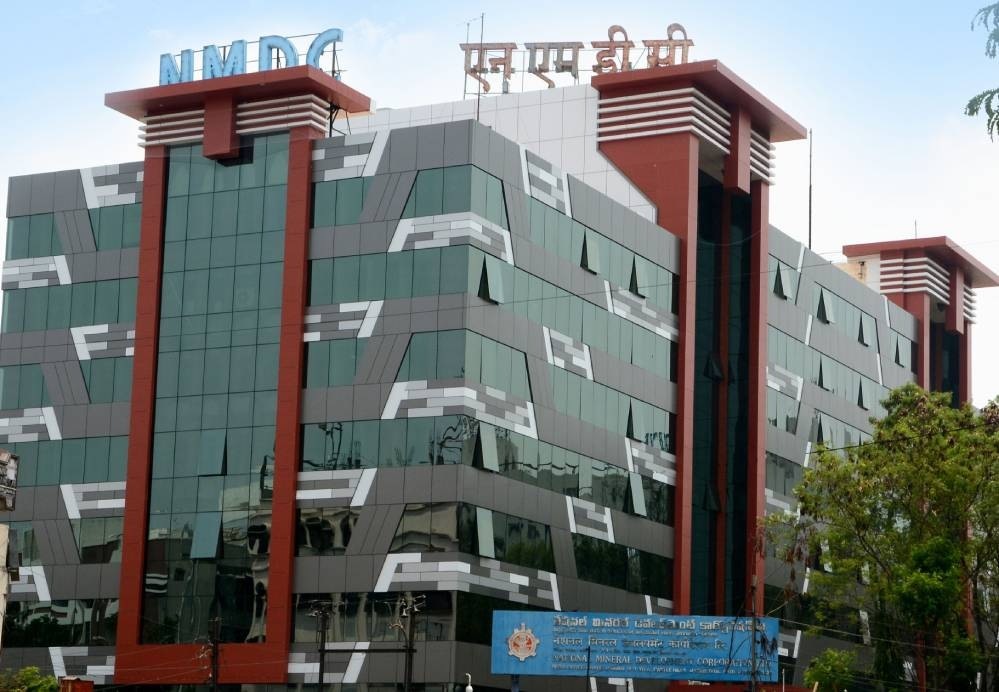
NMDC Q4 FY26: The 53 MT Milestone Doesn’t Hide the Math
General information and entertainment, not investment advice. The author is not a SEBI-registered adviser or research analyst. No recommendation, no promised returns. Markets carry risk including loss of capital. Figures may not be current. Consult a registered adviser before acting.
Prices referenced are not live (last update June 3, 2026).
1. At a Glance
NMDC crossed 53 million tonnes of iron ore production in FY26 for the first time, landing on a long-distance sprint toward 100 MT by 2030. The headline feels muscular. The numbers underneath tell a quieter story: PAT grew 11% YoY to ₹7,450 Cr, while EBITDA margin compressed from 42% down to 33% on a consolidated basis—not because mining got worse, but because the company briefly played trader in HR coils to plug cash at NMDC Steel.
The market pays 10.5x earnings here, against a peer median of 18.8x. That gap sits mostly silent in conversations about optionality and brownfield ramps. The real tension: can new mines and coal diversification generate the returns that 100 MT promises, or will capex (now running ₹6,000–7,000 Cr annually) compress that margin further before anything flows?
A balance sheet with nothing to hide. A growth trajectory with everything still to prove.
2. Introduction
NMDC is a fully government-owned Navratna under the Ministry of Steel. As India’s largest iron ore producer and the sixth largest globally, it controls seven operating mines across Chhattisgarh and Karnataka, sitting on 1,891 MT of reserves—enough for over three decades at current production run-rates.
FY26 was a year of crossing thresholds and announcing big plans. The company hit 53 MT production (up from 44 MT in FY25), commissioned a new coal mine at Tokisud North in Jharkhand, and inked board approval for a ₹3,000 Cr “branded iron ore” blending facility at Vizag. Management flagged a Maharatna aspiration and signalled ₹40,000–50,000 Cr capex over the next three years to reach 100 MT.
New Finance Director appointed March 2026. Directorate shuffles complete as of late Q4. The concall in early June 2026 hammered home: volume is the growth vector; rail doubling (131 km, mostly done) is critical for the century target but not for 60 MT in FY27. Coal ramps slowly; iron ore remains the overwhelm.
3. Business Model: WTF Do They Even Do?
NMDC is not a trader, not an explorer, not a steelmaker. It digs iron ore and sells it. That simplicity masks a creature of industrial policy: it mines where the Ministry tells it, sells to customers chosen partly by state logic (RINL, JSW, ArcelorMittal Nippon), and pays statutory levies that have reset the profit envelope twice in a decade.
Iron ore is 85% of revenue in 9M FY26 (down from 99% in FY22). The rest is splintered across pellet manufacturing (capacity expansion at Nagarnar ongoing), wind power generation (10.5 MW installed; a rounding error on the energy bill), and occasional adventures like HR coil trading (a one-off lifeline for NMDC Steel that management says won’t repeat).
The model’s margin sits in the gap between world-class ore quality (63–69% Fe content, highest grades available) and the world’s lowest cost of production (₹1,000 per tonne excluding levies). That moat is real. The problem: government-set levies have shifted that moat. FY22 onward, the company pays 22.5% premium on average selling price, plus 20% in royalties and cess. Margin, once 50–60%, now sits at 34–42%, dependent on realisation and fixed-cost per tonne.
New mines (Deposit 4, Deposit 13) are expected to follow the same economic model. Coal is a new mineral and geography—initial economics point toward 30–40% EBITDA on thermal coal, lower than iron ore but a hedge against commodity lows.
4. Financials Overview
Figures are consolidated, in ₹ crore.
Metric
Latest Q (Q4 FY26)
YoY Change
QoQ Change
Revenue
11,343
+61.9%
+49.6%
EBITDA
2,644
+29.0%
+23.3%
PAT
2,027
+37.2%
+15.3%
EPS
2.31
—
—
FY26 full year: Revenue ₹32,071 Cr (up 34% YoY), EBITDA ₹9,260 Cr (up 14% YoY), PAT ₹7,450 Cr (up 14% YoY). EBITDA margin on consolidated basis compressed to 29% (from 34% in FY25) due to the HR coil trading drag noted above; iron ore segment standalone maintains 42% margin.
Reported EPS for FY26: ₹8.47 (vs ₹7.43 in FY25, up 14%). At Q4-level EPS of ₹2.31, annualised (using full-year basis) still ₹8.47.
Concall colour: Management cited iron ore prices “fairly range-bound” near term. Pricing reset on June 3, 2026 placed Baila Lump at ₹5,700/ton and Baila Fines at ₹4,850/ton. Realisation per tonne in 9M FY26 was ₹4,992/ton (domestic average), down from ₹5,187 in 9M FY25. The company indexed pricing monthly against international benchmarks, competitor moves, demand, and logistics—not a direct steel-price pass-through.
5. Market Expectations & Historical Multiples
This section describes how the market is currently pricing the company and how that compares with its own history and peer group. It is descriptive, not predictive.
Metric
Current
Historical Average (5Yr)
Peer Median (12 Co)
P/E
10.5x
8.95x
18.79x
EV/EBITDA
6.81x
—
—
ROE
23.4%
26.4%
14.7%
ROCE
27.6%
—
15.62%
The market currently pays 10.5x earnings here, a 17% premium to the stock’s own 5-year average of 8.95x but a 44%